
Claude Alternatives (2026): Benchmarked & Priced
GPT-6.2 and Gemini 4 for frontier quality, DeepSeek V4.1 Flash for cheap open weights, Grok 4.7 for a cheaper closed API - the best Claude alternatives in 2026, benchmarked on the AA Intelligence Index and priced per token, with a verdict by use-case.


The best Claude alternatives right now are GPT-6.2 and Gemini 4 if you want frontier quality, DeepSeek V4.1 Flash if you want cheap open weights, and Grok 4.7 if you want a lower-priced closed API. None of them fully replaces Claude. The right pick depends on whether you're buying intelligence, price, or weights you own.
TL;DR
- Best overall alternative to Claude: GPT-6.2 Sol ($2/$10 per 1M tokens, AA Intelligence Index 57) is the cleanest one-for-one swap for Claude Sonnet 5.5 ($2/$10, index 55) — same price, a hair higher on the index.
- Best cheap / open-weight alternative: DeepSeek V4.1 Flash — MIT-licensed open weights, a 1M-token context window, and API pricing from $0.15/$0.60 off-peak. It undercuts almost everything and you can self-host it.
- Best free option: The Claude Free plan itself ($0, Sonnet + Haiku access), or Gemini and ChatGPT free tiers. For an API with a free-to-run model, use an open-weight DeepSeek or Qwen checkpoint.
- Highest raw intelligence: OpenAI's GPT-6.2 Astra (index 62) and Gemini 4 Neon (61) are the only models that sit near Claude's top tier, Fable 5.2 (65).
- The honest verdict: you don't replace Claude, you route around it — one model for frontier tasks, a cheaper or open one for everything else.
All prices and scores below are dated November 2026 and traced to each vendor's own page or to Artificial Analysis.
What are the best alternatives to Claude?
If you use Anthropic's Claude as your main model, these are the substitutes worth testing, ranked by how directly they stand in for it.
The table compares each on Artificial Analysis Intelligence Index v5.0.1 (max-effort configuration, as of 27 November 2026), which blends reasoning, math, coding and science evals into one number. Claude's own tiers are the top three anchor rows.
| Model | Maker | Price in/out (per 1M) | Open weight? | AA Intelligence Index (v5.0.1) | Best as a Claude alternative for |
|---|---|---|---|---|---|
| Claude Opus 5.5 | Anthropic | $4 / $20 | No | 59 | (anchor) frontier reasoning |
| Claude Sonnet 5.5 | Anthropic | $2 / $10 | No | 55 | (anchor) default workhorse |
| Claude Haiku 5.5 | Anthropic | $0.10 / $0.50 | No | 36 | (anchor) cheap, fast calls |
| GPT-6.2 Astra | OpenAI | $8 / $40 | No | 62 | top-end quality + ecosystem |
| GPT-6.2 Sol | OpenAI | $2 / $10 | No | 57 | the closest swap for Sonnet |
| Gemini 4 (Carbon) | ~$4 / $20 * | No | 60 | long context, Google stack | |
| Grok 4.7 | xAI | $2 / $6 | No | 35 | cheaper closed API, real-time X |
| DeepSeek V4.1 Flash | DeepSeek | $0.15–0.30 / $0.60–1.20 | Yes (MIT) | 33 | cheap API + open weights |
| DeepSeek V4 Pro | DeepSeek | $0.66–1.32 / $1.98–3.96 | Yes (MIT) | 23 | self-hosting, data control |
* Gemini 4 per-token pricing is introductory and largely runs through Google Vertex; treat it as approximate (secondary source). Every other price is from the vendor's own page. DeepSeek prices show off-peak/peak rates.
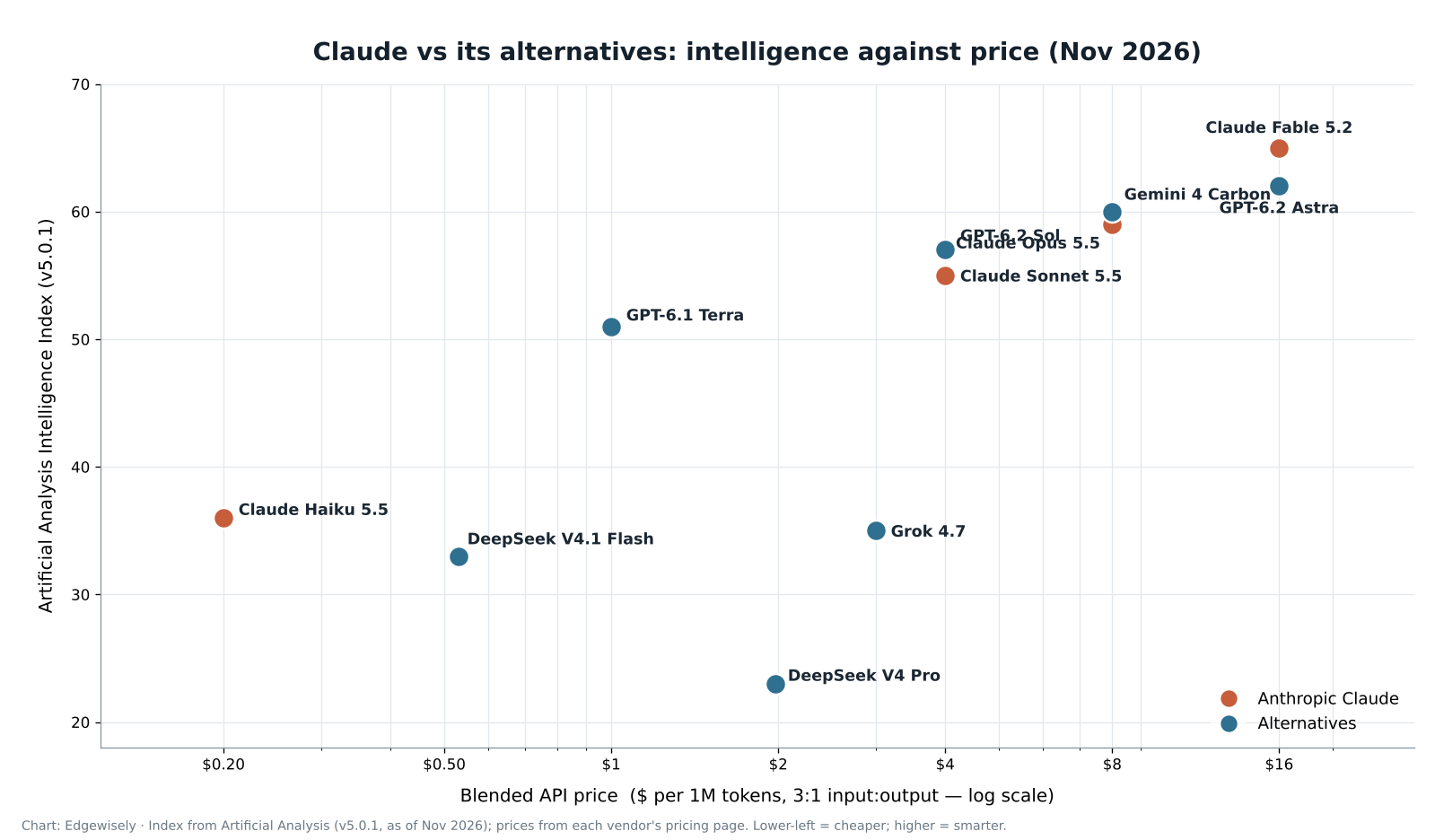
Two things jump out. GPT-6.2 Sol matches Claude Sonnet 5.5 on price and slightly beats it on the index — the easiest switch to justify. And the open-weight DeepSeek models cost a fraction of everything else while landing only a couple of index points below Claude Haiku.
Is GPT a real Claude alternative?
Yes — GPT is the single most complete alternative to Claude, and for most teams it's the first one to trial.
On intelligence, GPT-6.2 Astra scores 62 on the AA Intelligence Index versus Claude's flagship Fable 5.2 at 65 and Opus 5.5 at 59. That's close enough that quality rarely decides it. What decides it is behavior: Claude tends to be more cautious and more literal with instructions, while GPT is more willing and often faster in agentic loops.
On price, the lineups mirror each other almost exactly. GPT-6.2 Astra ($8/$40) sits in the same tier as Claude's Fable 5.2 ($8/$40); GPT-6.2 Sol ($2/$10) matches Sonnet 5.5 ($2/$10); and, on OpenAI's pricing page, its cheap GPT-6.1 Terra ($0.50/$2.50) and GPT-6 Luna ($0.05/$0.25) undercut Haiku 5.5 ($0.10/$0.50) at the very bottom.
So the "claude vs chatgpt alternative" question has a simple answer: GPT is a true peer, not a downgrade. Pick it if you want the largest tooling ecosystem or if your workloads reward GPT's eagerness; keep Claude if you value its instruction-following and refusal discipline.
Is Gemini a better Claude alternative for long context?
Gemini 4 is the other frontier-grade alternative, and it's strongest exactly where you'd reach for Claude's big context window.
Google's flagship tiers rank right alongside Claude: Gemini 4 Neon at 61 and Gemini 4 Carbon at 60 on the index, within a point of Opus 5.5 (59). Gemini's long-context handling and tight integration with Google Workspace and Vertex are its real edge over Claude for document-heavy and retrieval workloads.
The catch is pricing clarity. As of November 2026, Google's public per-token rates for the Gemini 4 flagships are introductory and routed mainly through Vertex, not a clean flat API card like Anthropic's or OpenAI's. Budget for roughly $4/$20 at standard rates and confirm on Vertex before you commit.
Choose Gemini as your Claude alternative when you're already in Google Cloud, when you need very long inputs, or when you want multimodal grounding. It's a lateral move on quality, not a step down.
What's the best open-source alternative to Claude?
The best open source Claude alternative is DeepSeek V4.1 Flash — the only open-weight model that combines near-Haiku intelligence, a 1M-token context window, and genuinely low cost.
DeepSeek publishes its weights under the permissive MIT license, so you can self-host, fine-tune, and run it with no per-token fee and no rate limits. On DeepSeek's hosted API it costs $0.15/$0.60 off-peak ($0.30/$1.20 peak) and scores 33 on the index — two points under Claude Haiku 5.5's 36. Its bigger sibling, DeepSeek V4 Pro, is also MIT-licensed for teams that want to own the whole stack.
Other open-weight contenders fill specific gaps. Qwen3.8-27B (Apache-2.0) from Alibaba is the easiest to actually run on your own hardware, while Qwen4 Max (index 43) is the stronger hosted version. Moonshot's Kimi K3.1 Pro (index 46) and Z.ai's GLM-5.3 are released open-weight too, though Kimi is a ~2.8T-parameter mixture-of-experts that is impractical to self-host. Mistral Large 4 (EU, open-weight under a modified license) is the pick if you need European hosting.
None of these matches Claude Opus or Fable on raw intelligence. But if "open" means data control, fine-tuning, or escaping API limits, DeepSeek is the model that replaces Claude without a contract — we go deeper in DeepSeek vs Claude.
Which Claude alternative is cheapest for API use?
For sheer price per token, DeepSeek V4.1 Flash is the cheapest serious Claude alternative — and it's not close.
At $0.15/$0.60 off-peak, DeepSeek's blended cost runs roughly $0.26 per 1M tokens (3:1 input:output), versus about $0.20 for Claude Haiku 5.5. So at the very bottom, Claude's own Haiku is already price-competitive — the gap only opens up when you compare mid and top tiers.
Look higher and the spread is dramatic. Claude Opus 5.5 blends to ~$8/1M and Fable 5.2 to ~$16/1M; DeepSeek V4.1 Flash does similar-quality bulk work for under $0.55/1M. That's a 15–30x cost difference for a two-to-three-point index drop.
If you want cheap but closed, GPT-6 Luna ($0.05/$0.25) and GPT-6.1 Terra ($0.50/$2.50) are OpenAI's budget swaps for Haiku, and Grok 4.7 ($2/$6) is a mid-priced option with a 500K-token window. But for the lowest defensible cost on real work, route bulk tasks to DeepSeek and reserve a frontier model for the hard 10%.
Is GPT or Gemini a better Claude alternative for coding?
Coding is the one use-case where you shouldn't trust the headline intelligence number alone — the harness matters as much as the model.
On the AA Intelligence Index, GPT-6.2 Astra (62) and Gemini 4 Neon (61) both edge Claude Opus 5.5 (59), and all three are strong agentic coders. In practice, teams still rate Claude highly for careful, multi-step code edits and for sticking to instructions inside an agent loop, which is why many keep it for the final diff even when a cheaper model drafts.
For a best Claude alternative specifically for code: pick GPT-6.2 if you live in that ecosystem and want the strongest all-round agent, or Gemini 4 if you need to reason over a very large codebase in one context. For a cheap coding substitute, DeepSeek V4.1 Flash and Qwen3.8 punch far above their price. Benchmark them on your repo with a real harness before switching — raw index points don't capture tool use or reliability. Our best AI model for coding ranking tests exactly this.
Is there a free Claude alternative?
Yes, and the cheapest free option is Claude itself: Anthropic's Free plan ($0) gives you Sonnet and Haiku access with capped usage, no card required.
For a free chat alternative with a different model, ChatGPT and Google Gemini both run free consumer tiers. If you need a model you can run for free with no provider at all, download an open-weight checkpoint — DeepSeek V4.1 Flash (MIT) or Qwen3.8-27B (Apache-2.0) — and host it yourself. There's no per-token charge once it's running.
Our take
Here's the thesis, stated plainly: the right Claude alternative depends entirely on whether you're optimizing for frontier quality, for cost, or for owning the weights — and for most teams the honest answer is that you don't fully replace Claude, you route around it. The single-model mindset is the mistake. In 2026 the winning setup is a router: a frontier model for the hard 10% of calls, a cheap or open model for the other 90%.
Start with what the benchmark does and doesn't tell you. The AA Intelligence Index is the best single number we have — it blends reasoning, math, coding and science into one score, and at v5.0.1 it cleanly separates the frontier (Fable 5.2 at 65, GPT-6.2 Astra 62, Gemini 4 Neon 61) from the value tier (Haiku 36, Grok 35, DeepSeek V4.1 Flash 33). What it does not capture is just as important: latency, tool-use reliability inside an agent, how a model behaves when instructions are ambiguous, refusal rates, and context-window behavior under load. Two models one index point apart can feel very different in a production agent. Treat the number as a filter, not a verdict.
Now the cost gap, which is the real story. People assume Claude is expensive — but Haiku 5.5 at $0.10/$0.50 is already one of the cheapest frontier-lab models, and it's within a hair of DeepSeek's blended price. The gap that actually hurts is at the top: Opus blends to ~$8 and Fable to ~$16 per 1M tokens, while DeepSeek V4.1 Flash does comparable bulk work for under $0.55. (See our full Claude API pricing breakdown for the per-tier math.) If your workload is mostly routine, paying Opus rates for all of it is the expensive mistake — not using Claude at all. Push the easy tokens to DeepSeek or GPT-6.1 Terra and you'll cut the bill by an order of magnitude with a two-to-three-point quality trade.
Where each alternative genuinely fits: GPT-6.2 is the safe default swap — peer intelligence, matching price ladder, the biggest ecosystem; take it unless Claude's instruction-discipline is load-bearing for you. Gemini 4 wins when you're inside Google Cloud or need huge context, but its introductory, Vertex-centric pricing makes cost modeling harder. DeepSeek is the one that changes the math: MIT weights, a 1M-token window, and pricing low enough to make self-hosting or high-volume pipelines viable — its weakness is that it sits below Claude's flagships on hard reasoning, so it's a workhorse, not a frontier brain. Grok 4.7 is a situational mid-tier closed option with real-time X access; it's cheaper than Opus but scores well below it, so it earns a slot only for specific use-cases. Qwen, Kimi and GLM are credible open-weight names, but Kimi's 2.8T-parameter size and thin public pricing make them harder to operationalize than DeepSeek today.
The cost/quality judgement: for frontier work, Claude's Fable 5.2 and Opus 5.5 are still worth their price on the hardest tasks — the index puts Fable at the top of the board. For everything else, continuing to pay frontier rates is indefensible when DeepSeek and GPT-6.1 Terra exist.
The verdict. Best Claude alternative for quality: GPT-6.2 Astra or Gemini 4 — avoid if you specifically rely on Claude's careful instruction-following. Best for cost and ownership: DeepSeek V4.1 Flash — avoid if you need top-tier reasoning on every call. Best drop-in for Sonnet: GPT-6.2 Sol, same price, marginally higher index. And the uncomfortable truth: for many teams the best "alternative" to Claude is a cheaper Claude tier plus a router, not leaving Anthropic at all.
Frequently Asked Questions
What are the best alternatives to Claude?
The strongest alternatives to Claude are GPT-6.2 and Gemini 4 for frontier quality, DeepSeek V4.1 Flash for cheap open weights, and Grok 4.7 for a lower-priced closed API. GPT-6.2 Sol ($2/$10, index 57) is the closest one-for-one swap for Claude Sonnet 5.5. Pick based on quality, price, or open weights.
Is Claude better than ChatGPT?
They're peers, so GPT is a genuine Claude alternative, not a downgrade. On the Artificial Analysis Intelligence Index (Nov 2026), GPT-6.2 Astra scores 62 to Claude Fable's 65 and Opus's 59 — close enough that behavior decides it. Claude is more instruction-disciplined; GPT is more eager and has the larger ecosystem.
What is the best open-source alternative to Claude?
DeepSeek V4.1 Flash is the best open source Claude alternative: MIT-licensed open weights, a 1M-token context window, and API pricing from $0.15/$0.60 per 1M tokens, scoring 33 on the index versus Haiku's 36. Qwen3.8-27B (Apache-2.0) is the easiest to self-host, and Kimi K3.1 Pro and GLM-5.3 are also open-weight.
Is there a free alternative to Claude?
Yes. Claude's own Free plan ($0) includes Sonnet and Haiku with capped usage. ChatGPT and Google Gemini also run free consumer tiers. For a model you can run yourself at no per-token cost, download an open-weight checkpoint like DeepSeek V4.1 Flash (MIT) or Qwen3.8-27B (Apache-2.0) and self-host it.
Which Claude alternative is cheapest for API use?
DeepSeek V4.1 Flash is the cheapest serious alternative at $0.15/$0.60 per 1M tokens off-peak — a blended cost near Claude Haiku's. For closed models, GPT-6 Luna ($0.05/$0.25) and GPT-6.1 Terra ($0.50/$2.50) are OpenAI's budget tiers. At the top end, DeepSeek runs 15–30x cheaper than Claude Opus or Fable.
Editor's note — sources: Pricing and specs verified November 2026 against claude.com/pricing, OpenAI's API pricing, DeepSeek's pricing and xAI's model docs. Intelligence Index figures are from the Artificial Analysis Intelligence Index (v5.0.1) and the v5.0.1 snapshot (as of November 2026). Gemini 4 per-token pricing is introductory and Vertex-routed, so it is marked approximate. The index is a filter, not a verdict — benchmark any model on your own workload before switching.