
K3s vs K8s: Is K3s Production Ready in 2026?
Every K3s vs K8s comparison on page one is published by a vendor with a stake in the answer, including SUSE, which owns K3s. Here are the verified October 2026 numbers: v1.37.0 shipped 19 days after upstream, the real footprint, the two-item removal list, and a clear verdict.
TL;DR
- K3s is Kubernetes. It is a fully conformant distribution, not a different orchestrator. The current release is v1.37.0+k3s1 (14 September 2026), tracking upstream Kubernetes 1.37.
- K3s is more current than the pages comparing it. It shipped 1.37 just 19 days after upstream v1.37.0, beating its own 30-day target — and ahead of k0s, still on 1.36.4.
- K3s removes only two things from upstream: in-tree storage drivers and the in-tree cloud provider. Pages still listing "legacy and alpha features" are years out of date.
- The footprint numbers everyone quotes are wrong. The binary is 77.7 MB (amd64), but a K3s server running a workload uses about 1,596 MB of RAM — not the few hundred megabytes blogs claim.
- Verdict: run K3s for edge, IoT, CI, homelab and air-gapped clusters, and for small production platforms where you accept owning the control plane. Choose a managed service for large estates. Note K3s has been CNCF Sandbox since August 2020.
K3s vs K8s: the direct answer
In the k3s vs k8s comparison, K3s is not an alternative to Kubernetes — it is a conformant Kubernetes distribution packaged as one 77.7 MB binary, with SQLite as its default datastore and ingress, DNS and storage bundled in. Upstream Kubernetes ships the same APIs as separate components you assemble yourself. Pick K3s for edge and small clusters; pick a managed service for large ones.
One thing to flag before the detail. Every comparison currently ranking for this query is published by a company with a stake in the answer. The most authoritative-looking result is SUSE, which owns K3s outright through its acquisition of Rancher Labs. Another is Traefik, which ships inside K3s as the default ingress controller. The rest are managed-Kubernetes vendors, cloud-cost tools, a hosting company and a Kubernetes training business. Every figure below comes from the projects' own repositories and docs.
What is the difference between K3s and K8s?
K3s is a packaging and operations decision. Kubernetes is the thing being packaged.
Upstream Kubernetes gives you kube-apiserver, the controller manager, the scheduler, kubelet and kube-proxy as separate binaries, plus etcd. You choose a CNI, an ingress controller, a storage class and a load balancer, then wire it together with kubeadm or a managed service.
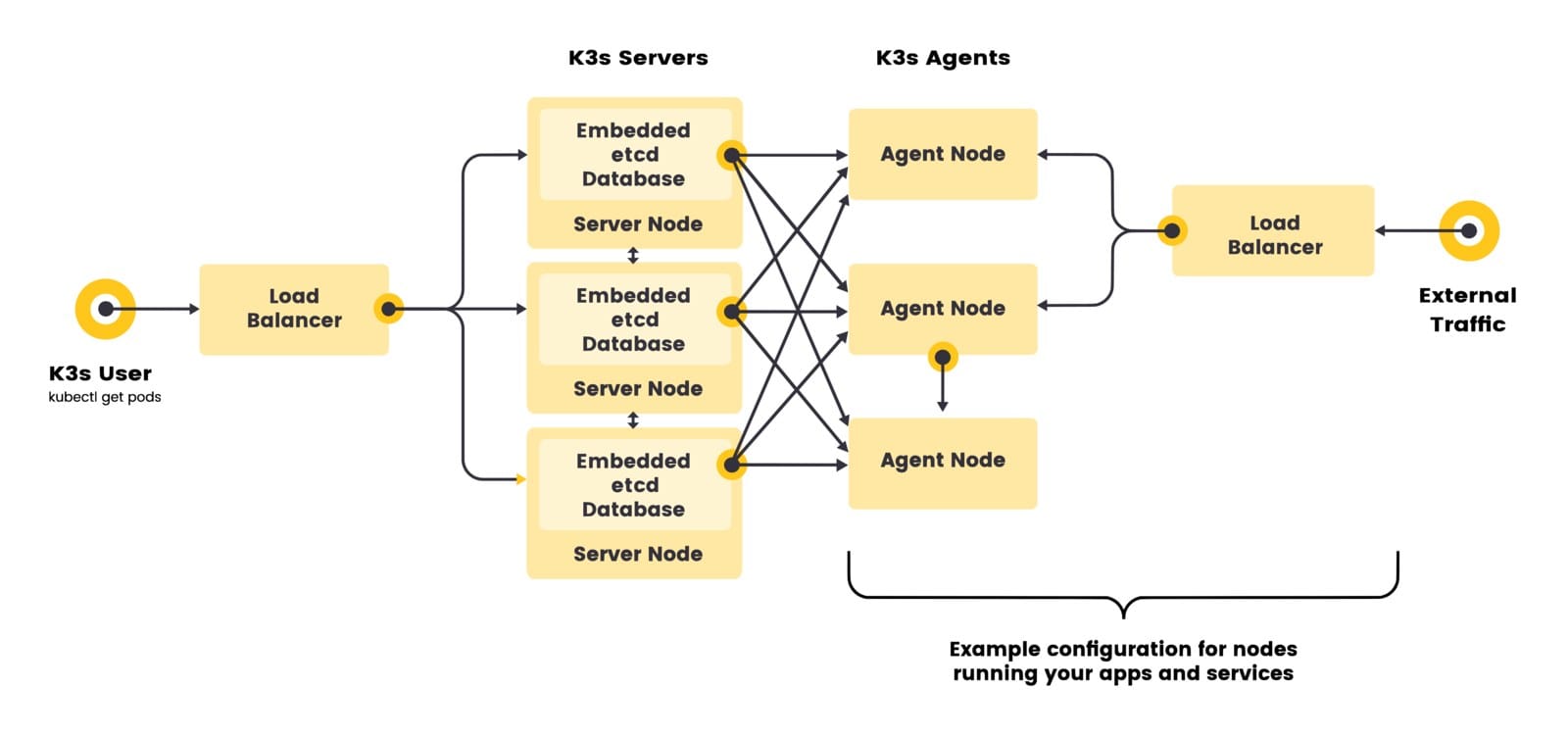
K3s compiles those control plane components into a single binary and a single process, defaults the datastore to SQLite, and bundles containerd, Flannel, CoreDNS, Traefik, ServiceLB, a kube-router network policy controller, local-path-provisioner, metrics-server and a Helm controller. You can disable any of them.
The API surface is identical. Your manifests, Helm charts, operators and kubectl workflows do not change.
There is a second distinction nobody ranking for this query makes clearly. "K8s" in this question usually means one of two very different things:
- Upstream Kubernetes built with kubeadm. You run the control plane. Here K3s is strictly simpler, and the comparison is mostly about operational effort.
- A managed service — EKS, GKE or AKS. The provider runs the control plane, patches it and meets an SLA. Here K3s is strictly more work, and the comparison is about cost, control and where the cluster physically sits.
Those are different questions with different answers. Decide which one you are actually asking.
K3s vs K8s difference: the comparison table
| K3s v1.37.0+k3s1 | Upstream Kubernetes 1.37 | |
|---|---|---|
| Binary / distribution | Single 77.7 MB binary (amd64); 70.3 MB arm64 | Separate component binaries, no single artifact |
| Air-gap bundle | 185.5 MB image tarball (amd64) | Assemble yourself |
| Default datastore | SQLite (single server) | etcd |
| HA approach | 3+ servers on embedded etcd, or external MySQL/MariaDB/PostgreSQL/etcd via Kine | 3+ node etcd cluster, or managed |
| Included by default | containerd, Flannel, CoreDNS, Traefik, ServiceLB, kube-router netpol, local-path-provisioner, metrics-server, Helm controller | Nothing beyond core components |
| Control plane processes | One process | Multiple processes |
| CNCF conformance | Yes, filed for v1.37 | Reference implementation |
| CNCF project maturity | Sandbox since Aug 2020 | Graduated |
| Current minor | 1.37 | 1.37 |
| Windows nodes | Not supported | Supported |
| Target use case | Edge, IoT, CI, ARM, air-gapped, small production | Any scale, cloud-native platforms |
Is K3s production ready?
Yes, and the currency argument against it no longer holds. The project describes itself as a "fully conformant production-ready Kubernetes distribution" in its README, and it backs that with a conformance record filed for Kubernetes v1.37 in the CNCF k8s-conformance repository.
Check the release timing, because most comparisons get this backwards. Upstream Kubernetes v1.37.0 landed on 26 August 2026. K3s shipped v1.37.0+k3s1 on 14 September 2026 — 19 days later, inside the project's own 30-day goal. The K3s releases page also shows four maintained branches (1.37, 1.36, 1.35, 1.34) against upstream's three, so older clusters stay patched slightly longer.
For context on the upstream side, the Kubernetes releases page lists 1.37.1 as current, with three supported minors, roughly one year of patch support each, and about three releases a year.
The real caveat is governance, not code. According to the CNCF K3s project page, K3s was accepted into the CNCF on 19 August 2020 at Sandbox maturity — and it is still Sandbox more than six years later. The project's own website says as much: "K3s is a CNCF Sandbox Project."
CNCF defines Sandbox as experimental and not yet widely tested in production, a label that sits oddly against six years of releases and a documented adopters list. Our analysis: the Sandbox status reflects stalled promotion rather than immature software. But if your procurement process checks CNCF maturity tiers, you will hit it.
One smaller gap worth knowing: at the time of writing, the K3s documentation site has not yet published a release-notes page for the 1.37 line, even though the release itself is out. Use the GitHub releases page for 1.37 changelogs.
What does K3s remove from Kubernetes?
Two things. That is the whole list.
The K3s README is unusually direct about it, and it contradicts most of page one:
- In-tree storage drivers
- In-tree cloud provider
Both have out-of-tree replacements that work in K3s — CSI drivers for storage, CCM for cloud integration — and upstream Kubernetes is removing the in-tree versions anyway. Removing them keeps the binary small without breaking conformance, because neither affects core Kubernetes functionality.
The project explicitly notes that this list "has changed over time" and that early K3s versions removed much more. Any comparison still telling you K3s strips out legacy, alpha and non-default features is describing a version from several years ago.
What it costs you in practice: if you run on a cloud and want native load balancers or block storage, you install the provider's CCM and CSI driver yourself. On bare metal or at the edge, you were never going to use them.
How much lighter is K3s?
Lighter on disk and on process overhead. Less dramatic on RAM than the marketing suggests.
K3s's own resource profiling documentation, measured at the 95th percentile in steady state, gives these figures:
| Configuration | CPU | RAM (SQLite) | RAM (embedded etcd) |
|---|---|---|---|
| Server + workload (Intel 8375C) | 6% of a core | 1,596 MB | 1,606 MB |
| Server + workload (Raspberry Pi 4B) | 30% of a core | 1,588 MB | 1,613 MB |
| Agent node (Intel 8375C) | 3% of a core | 275 MB | 275 MB |
A server node is not running in 512 MB, whatever a blog told you. An agent genuinely is light, at 275 MB.
Two honest caveats. The baseline profiling was performed on K3s v1.26.5 and the server-sizing tests on v1.31.0+k3s1, so these numbers predate the current release and the project has not published newer ones. And the saving comes mainly from collapsing components into one process, which removes duplicated Go runtime overhead rather than making Kubernetes itself smaller.
On scale, the same documentation reports that a single server handles hundreds of agents before CPU — not RAM — becomes the limiting factor, and estimates roughly 50% more capacity with a three-server HA cluster. K3s is not a toy.
k0s vs K3s vs K8s: how do they compare?
All three ship the same Kubernetes APIs. They differ in packaging, defaults and who stands behind them.
| K3s | k0s | MicroK8s | Upstream K8s | |
|---|---|---|---|---|
| Current version | 1.37.0+k3s1 | 1.36.4+k0s.1 | 1.36 | 1.37.1 |
| Backed by | SUSE / Rancher | Mirantis | Canonical | CNCF community |
| CNCF maturity | Sandbox (Aug 2020) | Sandbox (Jan 2025) | Not a CNCF project | Graduated |
| Packaging | Single binary | Single binary | Snap package | Component binaries |
| Default datastore | SQLite (single), etcd (HA) | SQLite (single), etcd (multi) | dqlite | etcd |
| Default CNI | Flannel | kube-router (Calico optional) | Calico | Your choice |
| Default ingress | Traefik, bundled | None bundled | Addon | None |
| Windows | No | Experimental | Worker nodes | Yes |
Two things stale comparisons get wrong here.
K3s is currently ahead of k0s on version currency, not behind it. K3s is on 1.37.0; k0s's latest release is 1.36.4+k0s.1 from 19 September 2026, a full minor back. k0s is also a CNCF Sandbox project, accepted in January 2025. Its design philosophy is deliberately the opposite of K3s: minimal bundled add-ons, control plane isolation by default, no opinionated ingress. That is a real reason to choose it — currency is not.
MicroK8s is no longer Canonical's flagship. Canonical's documented distribution is now Canonical Kubernetes, delivered as a snap, Juju charm or Cluster API provider. MicroK8s still receives releases, but treat it as maintained rather than strategic.
Both lightweight CNCF distributions are Sandbox. Neither K3s nor k0s has incubating status. If maturity tier matters to you, that comparison is a tie at the bottom.
What this means for you
Homelab or learning Kubernetes. Use K3s. One curl command, a ready node in about 30 seconds, and the same API you will use at work. SQLite is fine. Do not bother with HA.
Edge and IoT fleets. K3s is the strongest fit, and this is what it was built for. The 185.5 MB air-gap bundle, ARM support and single-process control plane matter on constrained hardware. Put the datastore on an SSD — etcd will destroy an SD card.
CI and ephemeral test clusters. K3s with SQLite. Clusters come up fast, die cleanly and cost one binary. If you are wiring this into pipelines, see our CI/CD tooling comparison.
Production platform team. Decide what you are comparing against. Versus kubeadm, K3s removes real toil and you should consider it. Versus EKS, GKE or AKS, you are taking on control plane patching, etcd backups, certificate rotation and upgrade testing to save cloud spend — budget headcount for it. Run three servers on embedded etcd or an external PostgreSQL. Never run single-server SQLite in production: it cannot be used with multiple servers at all, so you have no HA path without migrating the datastore. Teams at this point usually pair the cluster with a platform layer; we compared those in our internal developer platform roundup, and the provisioning side in our infrastructure-as-code comparison.
Regulated or air-gapped environments. K3s is a good technical fit, with documented air-gap installs and a CIS hardening guide. Two warnings. The CNCF Sandbox label may fail a compliance checklist that a graduated project would pass. And if you need FIPS or DISA STIG attestations out of the box, Canonical Kubernetes documents both; K3s does not.
Whichever you choose, you still need to see into it. Our Grafana vs Datadog comparison covers the monitoring decision, and Temporal vs Airflow the workload-orchestration one that usually follows.
Frequently Asked Questions
Is K8s too complex? Can I run K3s in production?
Yes, you can run K3s in production. It is fully conformant and the project labels itself production ready. Use three server nodes with embedded etcd, not single-node SQLite, which cannot scale past one server. Accept that you now own control plane patching, etcd backups and upgrades.
What is the difference between k0s, K3s and K8s?
All three run identical Kubernetes APIs. K8s is upstream Kubernetes, assembled from separate components. K3s is a single binary with Traefik, Flannel and storage bundled in, defaulting to SQLite. k0s is a single binary with almost nothing bundled, favouring minimal opinions and control plane isolation. Both K3s and k0s are CNCF Sandbox projects.
Is K3s a fork of Kubernetes?
No. The K3s project states plainly: "No, it's a distribution." It maintains well under 1,000 lines of patches and contributes changes upstream where possible. A fork implies continued divergence, which K3s explicitly avoids. Your manifests, operators and kubectl commands behave identically.
Does K3s pass Kubernetes conformance tests?
Yes. K3s has a conformance record in the CNCF k8s-conformance repository for Kubernetes v1.37, submitted by SUSE, including full end-to-end test logs. The project has filed conformance results across many releases, which is what lets it be called a certified Kubernetes distribution.
Editor's note — sources. Release versions, dates, binary sizes and air-gap bundle sizes are taken from the K3s GitHub releases page; v1.37.0+k3s1 was published on 14 September 2026 and its amd64 binary is 77.7 MB. The removals list, the "not a fork" answer and the "well under 1000 lines" patch figure come from the K3s README. Resource figures come from K3s's own resource-profiling documentation, which was measured on v1.26.5 and v1.31.0+k3s1 — we flag that in the text because the project has published nothing newer. Upstream Kubernetes version, cadence and support window come from kubernetes.io/releases. CNCF maturity and the August 2020 acceptance date come from the CNCF K3s project page. Conformance is verified against the v1.37 K3s record in the CNCF k8s-conformance repository. k0s and MicroK8s versions were read from their own release channels on 1 October 2026.
We could not verify the following. The project's own footprint claims are internally inconsistent: k3s.io advertises "under 70 MB" while the README says "less than 100 MB" and the actual v1.37.0 amd64 artifact is 77.7 MB — we use the measured artifact size. There are no published memory figures for the current release. We also found a large discrepancy between the GitHub star count and the figure shown on the CNCF project panel, so no star count is cited. SUSE's current commercial product naming around Rancher could not be confirmed from a primary SUSE documentation page, so ownership is attributed via the conformance record's vendor field instead.