
Temporal vs Airflow: Which Do You Actually Need?
Most people searching this comparison are asking the wrong question. Airflow schedules batch data pipelines; Temporal runs stateful code that survives crashes. Here is how to tell which one you need.

TL;DR
- Temporal vs Airflow is not a like-for-like choice. Airflow schedules batch data pipelines. Temporal runs long-lived, stateful application code that survives crashes. Most teams that need one do not need the other.
- Apache Airflow 3.3.2 (released 17 September 2026) is current. Airflow 2 hit end of life on 22 April 2026 — if you are still on 2.x you are running unpatched software.
- Temporal Cloud starts at $50 per million actions with $150 in free credits; active storage is $0.042/GB-hour. Airflow is free to self-host, or roughly $365/month for the smallest always-on Amazon MWAA environment.
- Airflow 3.3 narrowed the gap with a durable task state store and experimental Java/Go task SDKs. It still is not durable execution.
They are not competitors. Airflow is a scheduler for batch data pipelines defined as Python DAGs. Temporal is a durable execution engine for long-running application workflows whose state survives process crashes. If your work is scheduled and data-shaped, pick Airflow. If it is event-driven, stateful and must not lose progress, pick Temporal.
Temporal vs Airflow: the architectural difference
Airflow runs a scheduler loop. It parses Python files that define DAGs, works out which tasks are ready, and dispatches them to executors. Task state lives in a metadata database — Postgres or MySQL.
Temporal runs an event-sourced log. Every step a workflow takes is appended to an Event History, and that history is the source of truth.
The consequence is what matters. When an Airflow worker dies mid-task, the task fails and retries from the top. When a Temporal worker dies, a different worker fetches the event history, replays your workflow code against it, and resumes at the exact line where the process stopped — local variables intact.
That is the whole argument. Everything else follows from it.
What is durable execution, concretely?
Durable execution means your workflow function keeps running to completion even though no single process stays alive for its duration.
Per Temporal's own documentation, workflow code must be deterministic because Temporal reruns it to rebuild state after failure. Anything touching the outside world — API calls, database writes, charging a card — goes in an Activity, which Temporal supervises with retry policies, timeouts and heartbeats.
A workflow can sleep on a durable timer for months without consuming a worker. It can receive signals and answer queries while running. It can be paused during an incident and resumed without losing state.
You cannot express that in a DAG. A DAG is a finite graph that runs and finishes.
The programming model: Python DAGs vs workflow code
Airflow is Python-first. You write DAGs with the @dag and @task decorators from the airflow.sdk namespace, introduced in 3.0.
Temporal ships eight SDKs — Go, Java, Python, TypeScript, .NET, PHP, Ruby and Rust. Workflows written in different languages can call each other. For a polyglot backend team, that is often the deciding factor on its own.
The 2026 wrinkle: Airflow is no longer strictly Python-only. Airflow 3.3.0, released 6 July 2026, added a Language Task SDK (AIP-108) letting individual task implementations run as Java jars or Go binaries, with XComs crossing language boundaries. It is marked experimental, the SDKs ship as separate artifacts, and DAG structure is still declared in Python.
Airflow 3.3's state store is not durable execution
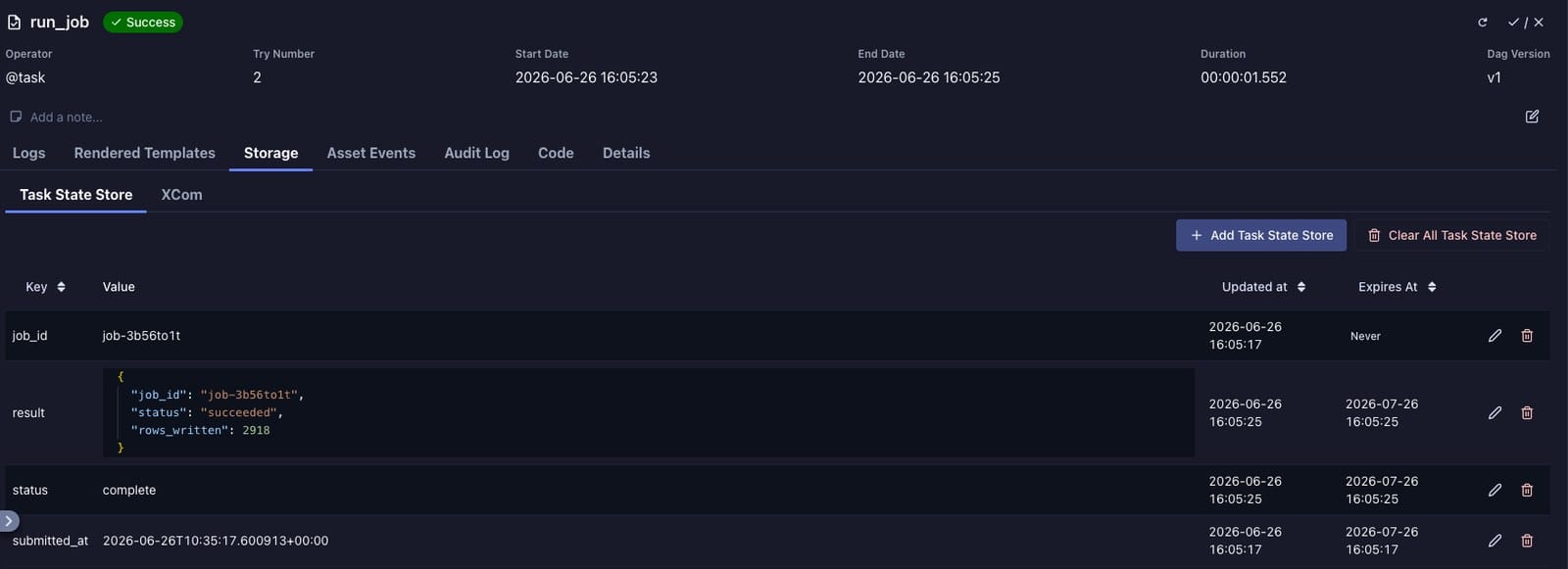
Airflow 3.3 also shipped AIP-103, a first-class task and asset state store. Tasks can persist key-value state that survives retries via a task_state_store accessor. The SparkSubmitOperator now defaults to durable=True, reconnecting to an existing Spark job instead of resubmitting after a worker dies.
That is genuinely useful and it closes a real gap. But read the difference carefully.
Airflow gives you a place to write checkpoints manually. Temporal rebuilds your program's local variables automatically by replaying code. One is a key-value store you must remember to use; the other is a runtime guarantee you get for free. Do not let a vendor comparison blur the two.
Temporal vs Airflow: the comparison that matters
| Dimension | Apache Airflow 3.3 | Temporal |
|---|---|---|
| Primary job | Scheduled batch data pipelines | Long-running stateful application workflows |
| Unit of work | Task in a DAG | Workflow calling Activities |
| State model | Metadata DB + optional state store | Event-sourced history, replayed on recovery |
| Crash recovery | Task retries from the start | Resumes mid-function, variables intact |
| Languages | Python (Java/Go tasks, experimental) | 8 SDKs, fully polyglot |
| Long waits | Sensors and deferrable operators | Durable timers, months or years |
| Mid-flight interaction | Limited | Signals, queries, updates |
| Scheduling | Core strength: cron, assets, backfills | Schedules exist, but secondary |
| Backfill / replay of history | First-class, UI-driven | Not the design goal |
| Typical user | Data engineer | Backend or platform engineer |
| Licence | Apache 2.0 | MIT |
If you are surveying the wider field rather than these two, our roundup of workflow orchestration platforms for data and AI pipelines covers the alternatives.
What does each one cost?
Both are free to self-host. Both cost real money to operate.
Airflow self-hosted needs a metadata database, scheduler, API server, triggerer and workers — plus someone to upgrade them. The bill is your infrastructure and your engineers' time.
Airflow managed is priced per running environment. Amazon MWAA charges $0.49/hour for a small environment in US East — about $365/month before workers — and $0.99/hour for large, with meta-database storage at $0.10/GB-month. Astronomer Astro starts at $0.35/hour per deployment on the Developer plan, with workers from $0.13/hour that scale to zero when idle.
Temporal Cloud bills consumption, not uptime. From Temporal's pricing page:
| Item | Price |
|---|---|
| Actions, first 5M/month | $50 per million |
| Actions, 100M–200M/month | $25 per million |
| Active storage (open workflows) | $0.042 per GB-hour |
| Retained storage (closed) | $0.00105 per GB-hour |
| Support | 10% of usage (Developer) |
| Business support | Greater of $500/mo or 10% of usage |
| Free credits | $150, expiring after 90 days |
Actions are the billable unit: starting a workflow, each activity execution or retry, each timer, signal, query and update. A modest service burning 1M actions a month lands near $55 including the support percentage.
Two multipliers to budget for: enabling high availability replication applies a 2× multiplier to actions and storage, and task queue fairness adds 0.1 actions per action for every hour it is enabled on a namespace — whether or not you use it.
Temporal also offers $6,000 in credits to startups with under $30M in funding.
Temporal vs Airflow for data pipelines: which should you pick?
Pick Airflow if your workloads are scheduled, batch-shaped, and owned by data engineers. Nightly ELT, dbt runs, warehouse loads, model training jobs, anything you will need to backfill across six months of partitions. Airflow's backfill and asset-scheduling machinery is genuinely hard to replicate, and the provider ecosystem covering warehouses and cloud services is unmatched.
Pick Temporal if you are orchestrating application logic where losing progress is unacceptable. Payment flows, order fulfilment, multi-step provisioning, saga-style compensation, anything that waits days for a human or a third party. Also pick it if your team is not Python-first.
For AI and agent workloads, the split holds. Scheduled embedding refreshes and evaluation runs are Airflow's shape. A long-running agent that makes dozens of tool calls, retries failed ones and must not lose its place mid-conversation is Temporal's shape. Both vendors now court this workload — Airflow with its Common AI Provider, Temporal with durable agent-SDK integrations. If you are instrumenting those agent runs, our Langfuse vs LangSmith comparison covers the observability layer that sits alongside them.
What this means for you
If you're a solo dev or small startup: you probably need one, not both. Building a product with stateful multi-step flows? Temporal, on the free credits, self-hosted if you are cost-sensitive. Moving data between systems on a schedule? Airflow, self-hosted with Docker Compose, or Astro's Developer tier.
If you run a data platform team: stay on Airflow. Migrating a mature DAG estate to Temporal means rewriting your scheduling, backfill and lineage model to get durability you mostly do not need. Upgrade to 3.x instead — Airflow 2 lost security patches in April 2026.
If you run a backend platform team: Temporal replaces the state table, checkpoint columns, reconciliation cron and retry wrapper you have already half-built. That is the honest pitch. If you recognise that codebase, the migration pays for itself.
If you are choosing under pressure: ask one question. Does a crashed process need to resume mid-function with its variables? Yes means Temporal. No means Airflow, and Airflow will be cheaper and simpler.
Frequently Asked Questions
Is Temporal a replacement for Airflow?
No, not for scheduled data pipelines. Temporal has schedules, but lacks Airflow's backfill machinery, asset-aware scheduling and the large provider ecosystem for warehouses and cloud services. Temporal replaces hand-rolled state machines, retry wrappers and reconciliation jobs in application code — not your nightly ELT.
What is durable execution?
Durable execution means a workflow runs to completion even if the process executing it crashes. Temporal appends every step to an event history, then replays that history on a healthy worker to rebuild local variables and resume mid-function. You get crash recovery as a platform guarantee rather than code you write and maintain.
Is Apache Airflow still worth using in 2026?
Yes, for scheduled data work. Airflow 3.3.2 is current, with roughly 30 million monthly downloads and 80,000 organisations using it. Airflow 3 added DAG versioning, event-driven scheduling and a redesigned UI. The caveat: Airflow 2 reached end of life in April 2026, so upgrade if you have not.
Can you use Temporal and Airflow together?
Yes, and it is a common pattern. Let Airflow own the scheduled data plane and Temporal own durable application execution, with Airflow tasks triggering Temporal workflows where reliability matters most. Airflow 3.3's experimental Dag Results endpoint also lets external systems call a DAG and block for its return value.
Which is cheaper, Temporal or Airflow?
It depends on shape. Airflow's managed cost is driven by uptime — about $365/month minimum for a small MWAA environment, even when idle. Temporal Cloud bills per action, starting at $50 per million, so low-volume workloads cost very little. Both are free to self-host, with real operational overhead.
Editor's note — sources: the Apache Airflow 3.3.0 release announcement, Temporal's "Understanding Temporal" documentation, Temporal's pricing page, Amazon MWAA pricing and Astronomer Astro pricing — all linked inline above. Airflow 3.3.2 release date and the 22 April 2026 Airflow 2 end-of-life date come from the Apache Airflow release notes; the 30 million monthly downloads and 80,000 organisations figures come from the Airflow 3.0 GA announcement. Pricing verified 25 September 2026 and subject to change.