
Kling vs Veo: Specs, Price, Benchmarks (2026)
Kling 3.0 vs Veo 3.1 compared on price per second, resolution, clip length and audio, with the independent video-arena benchmark and a clear verdict — now that OpenAI's Sora has been discontinued.

TL;DR
- Verdict: Veo 3.1 is the safer default for polished, audio-synced shots — but Kling 3.0 generates up to 15-second clips (vs Veo's 8s native) and costs less per second at 1080p.
- Price (API, per second, as of Nov 2026): Kling 3.0 $0.112 at 1080p without audio, $0.168 with audio; Veo 3.1 Standard $0.40 with audio baked in; Veo 3.1 Fast $0.12 at 1080p; Veo 3.1 Lite $0.08.
- Specs: Both do native audio and up to 4K. Kling tops out at 15s clips with multilingual lip-sync; Veo does 4/6/8s clips, extendable, with audio on by default.
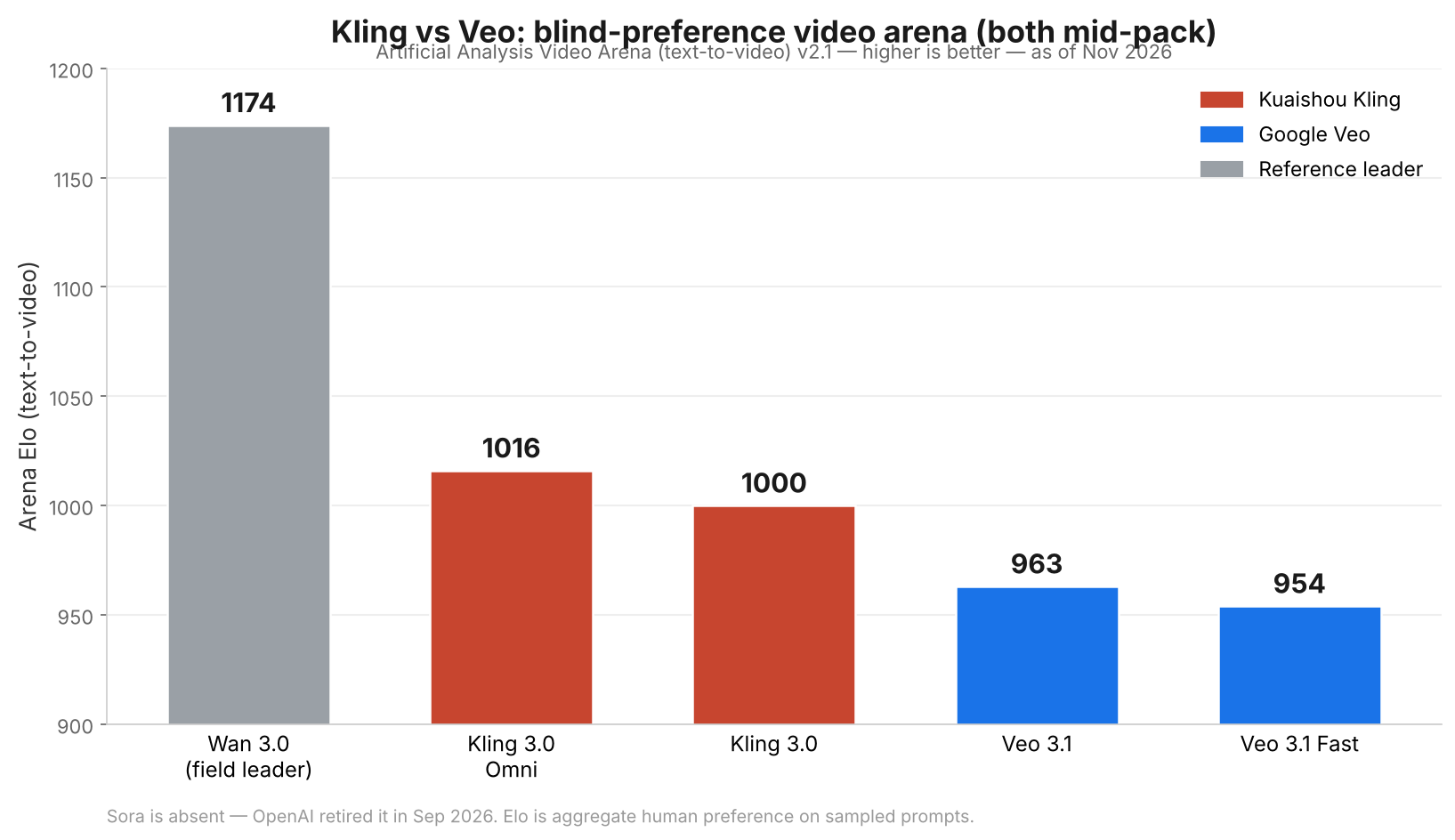
- Independent benchmark: On the Artificial Analysis Video Arena (text-to-video, v2.1), Kling 3.0 Omni sits at 1016 and Veo 3.1 at 963 — both mid-pack behind leader Wan 3.0 (1174).
- Sora is gone: OpenAI shut the Sora app on April 26, 2026 and retired the Videos API on September 24, 2026, which is why Kling vs Veo is now the real choice.
Kling vs Veo, in one line: pick Google Veo 3.1 when audio, prompt-following and ecosystem matter most; pick Kuaishou Kling 3.0 when you want longer clips, cheaper per-second generation, and sign-up that doesn't route through Google Cloud. Both beat the alternative that no longer exists: OpenAI's Sora shut down in 2026.
Kling vs Veo: which is better?
For most people, Veo 3.1 is the better all-rounder and Kling 3.0 is the better value. Veo's audio is on by default, its prompt adherence is strong, and it lives inside Google's Gemini and Vertex stack. Kling gives you longer clips, cheaper 1080p generation, and direct sign-up that doesn't require a Google Cloud project.
Neither leads the field on blind quality tests. That matters, and we cover it below.
Here is the head-to-head on the specs and prices you can actually verify.
Kling vs Veo: full comparison table
| Model | Maker | Max resolution | Max clip length | Native audio | API price (per second, 1080p) | Arena Elo (T2V) | Best for |
|---|---|---|---|---|---|---|---|
| Kling 3.0 | Kuaishou | 4K | 15s | Yes (multilingual) | $0.112 (no audio) / $0.168 (audio) | 1000 | Long clips, cost, direct access |
| Kling 3.0 Omni | Kuaishou | 4K | 15s | Yes (lip-sync, storyboard) | $0.168 (with audio) | 1016 | Multi-shot narratives with speech |
| Veo 3.1 | 4K | 8s (extendable) | Yes (default) | $0.40 (audio included) | 963 | Polished, audio-synced shots | |
| Veo 3.1 Fast | 4K | 8s (extendable) | Yes (default) | $0.12 | 954 | Cheaper Veo output | |
| Veo 3.1 Lite | 1080p | 8s | Yes (default) | $0.08 | 949 | High-volume, budget work |
Prices from kling.ai's API pricing and Google's Gemini API pricing, both as of November 2026. Elo from the Artificial Analysis text-to-video leaderboard. Duration and audio from the Kling 3.0 launch release and Google's Veo 3.1 Lite announcement.
Kling vs Veo pricing: which is cheaper?
Kling is cheaper at matched resolution, but the gap narrows once you account for audio and Veo's cheaper tiers. At 1080p, Kling 3.0 runs $0.112 per second silent and $0.168 with audio. Veo 3.1 Standard is a flat $0.40 per second with audio always included.
That makes Veo Standard roughly 2.4x the price of Kling's audio tier, second for second.
But Veo has cheaper siblings. Veo 3.1 Fast is $0.12/s at 1080p and Veo 3.1 Lite is $0.08/s — undercutting Kling's audio price outright. So the real pricing question is quality-per-dollar at a given tier, not sticker price.
A worked example: a 10-second 1080p clip with audio costs about $1.68 on Kling 3.0, $4.00 on Veo 3.1 Standard, $1.20 on Veo 3.1 Fast, and $0.80 on Veo 3.1 Lite. At 4K, Kling charges $0.42/s and Veo 3.1 Standard $0.60/s.
Consumer plans differ too. Kling sells credit-based subscriptions directly (an entry tier around $6.99/mo, scaling to an Ultra tier); Veo access comes bundled into Google's Gemini subscriptions and the pay-as-you-go API. If you want a flat consumer plan without a cloud console, Kling is the simpler buy.
Kling vs Veo on quality (benchmarks)
On independent blind testing, both models sit mid-pack — and Kling edges Veo. The Artificial Analysis Video Arena (text-to-video, version 2.1) ranks models by human preference votes on an Elo scale. As of November 2026:
- Kling 3.0 Omni: 1016
- Kling 3.0: 1000 (the scale's anchor point)
- Veo 3.1: 963
- Veo 3.1 Fast: 954
- Veo 3.1 Lite: 949
The leader is Wan 3.0 at 1174, with Seedance, MiniMax and several others above both Kling and Veo. So the honest read: Kling 3.0 Omni outscores Veo 3.1 by about 53 Elo points, but neither is the best model you can buy on raw preference. Wan now leads the open-weight field too — we broke that down in Hunyuan vs Wan.
Two caveats. Arena Elo measures aggregate human preference on a sampled prompt set — it does not isolate audio quality, prompt adherence on complex instructions, or consistency across a multi-shot sequence. And a 53-point gap is real but not enormous; both land in the same tier. Treat the ranking as a tiebreaker, not a verdict.
Which handles audio and longer clips better?
Kling wins on length; it's a closer call on audio. Kling 3.0 generates clips up to 15 seconds, more than Veo 3.1's native 8-second output (Veo supports 4s, 6s and 8s, with scene extension to stitch longer sequences).
On audio, both generate native, synced sound. Kling 3.0 Omni produces multilingual lip-synced speech across English, Chinese, Japanese, Korean and Spanish, and can have different characters speak different languages in one scene. Veo 3.1 bakes audio into every generation by default — dialogue, ambient sound and effects — which is simpler but gives you less explicit control.
If your work is dialogue-heavy or multilingual, Kling's per-character voice control is the more flexible tool. If you want good audio with zero configuration, Veo's default-on approach is less to think about.
What happened to Sora?
OpenAI discontinued Sora in 2026. It announced the shutdown on March 24, 2026, closed the Sora app and sora.com on April 26, 2026, and retired the Videos API on September 24, 2026. OpenAI said Sora continues internally as a world-model research program, not a consumer product — there was no drop-in replacement.
That is the context that makes this comparison matter. For most of 2025, "best AI video model" was a three-way race. Now Sora is gone, Google's Veo and Kuaishou's Kling are the two leading general-purpose models still broadly available, and the choice is effectively between them (plus challengers like Wan and Seedance). We compared Veo 3 vs Sora and Kling vs Sora before the shutdown; those match-ups are now historical.
If you built on Sora, you migrated — most teams moved to Veo 3.1 or Kling 3.0.
Which should you pick?
Default to Veo 3.1. Switch to Kling 3.0 for length, cost, or access.
- Pick Veo 3.1 if you want polished, audio-first clips with minimal setup and you're already in Google's ecosystem.
- Pick Veo 3.1 Fast or Lite if you're generating at volume and need the cheapest credible output.
- Pick Kling 3.0 if you need 15-second clips, cheaper 1080p-with-audio, multilingual lip-sync, or sign-up that skips Google Cloud.
- Pick Kling 3.0 Omni for multi-shot narratives with per-character speech and storyboard control.
- Avoid assuming either is the quality leader — on blind tests, Wan 3.0 and Seedance currently outrank both.
Our take
The stale comparison pages still treat this as Kling-vs-Veo-vs-Sora. It isn't. Sora's exit in 2026 is the single most important fact in this category, and it reframes everything else. When a lab with OpenAI's resources can shut a flagship consumer video product inside a year, the lesson for anyone building on these tools is blunt: model availability is a business risk, not a given. Price it in.
That reframing is why we land on Veo 3.1 as the default rather than the winner. Google is unlikely to pull Veo — it's load-bearing inside Gemini, Vertex AI and Google's broader AI pitch to enterprises. That institutional stickiness is worth more to a product team than a few Elo points. If you're shipping video generation inside a product with a roadmap, platform durability should weigh as heavily as output quality, and here Google has the stronger hand. Kling is backed by Kuaishou, a large and profitable company, but it's a China-headquartered consumer app whose Western availability and data posture are harder to underwrite for an enterprise buyer.
Now the honest part, because the benchmark cuts against our default. On the Artificial Analysis arena, Kling 3.0 Omni (1016) beats Veo 3.1 (963). We're not going to wave that away. But we'd caution against reading it as "Kling makes better video." Arena Elo is aggregate human preference on sampled prompts. It flattens the things that separate these models in production: how reliably audio syncs to lips, how well a model holds a character across a multi-shot sequence, how it handles a long and specific prompt versus a vibes-y one. Veo's reputation is built on prompt adherence and clean default audio, and those strengths are exactly what a preference-vote average under-weights. Our read: Kling is modestly ahead on raw preference; Veo is ahead on control and consistency. Both claims can be true.
The money math is where it gets interesting, and where we think most coverage is lazy. Yes, Kling's 1080p-with-audio at $0.168/s undercuts Veo 3.1 Standard's $0.40/s. But Veo 3.1 Lite at $0.08/s undercuts Kling, and at the scale where cost actually bites — thousands of clips — the right comparison is quality-per-dollar within a tier, not headline price. A startup generating marketing clips at volume should test Veo Lite and Kling standard side by side on its own prompts before trusting either leaderboard. A studio doing hero shots should ignore price entirely and test on quality, where it may well find that neither Kling nor Veo beats Wan 3.0 or Seedance for its specific look.
So the segmented verdict:
- Creators and solo makers: Kling 3.0, for the 15-second clips, direct sign-up, and cheaper audio tier. Best for narrative and dialogue work. Avoid if you need the Google ecosystem or enterprise support.
- Product teams embedding video generation: Veo 3.1 via the Gemini or Vertex API. Best for durability, support and default audio. Avoid if your use case genuinely needs clips longer than 8 seconds without stitching.
- Enterprises: Veo 3.1, almost regardless of the Elo gap. The procurement, compliance and availability story is cleaner, and that's what you're actually buying.
- Anyone chasing maximum quality: test Wan 3.0 and Seedance 2.5 too. The two most-searched names are not the two highest-scoring models, and pretending otherwise is how the stale pages mislead you.
One last opinion, flagged as opinion: the arena gap between Kling and Veo is small enough that it will flip with the next release from either side. Don't architect a product around a 53-point Elo lead that could evaporate in a quarter. Architect around the thing that doesn't move as fast — which vendor will still be serving the API in two years. On that test, Veo wins today.
Frequently Asked Questions
Is Kling better than Veo?
On the independent Artificial Analysis video arena (Nov 2026), Kling 3.0 Omni scores 1016 versus Veo 3.1's 963, so Kling edges ahead on blind human preference. But Veo tends to win on prompt adherence and default audio control. Neither leads the field; Wan 3.0 outscores both.
Is Kling or Veo cheaper?
At matched 1080p resolution, Kling 3.0 is cheaper: about $0.168 per second with audio versus Veo 3.1 Standard's $0.40. But Veo 3.1 Fast ($0.12/s) and Veo 3.1 Lite ($0.08/s) undercut Kling. The cheapest credible option is Veo 3.1 Lite, as of November 2026.
Do Kling and Veo generate audio?
Yes, both generate native synced audio. Veo 3.1 includes audio by default in every clip — dialogue, effects and ambient sound. Kling 3.0 Omni produces multilingual lip-synced speech across English, Chinese, Japanese, Korean and Spanish, and can give different characters different languages in one scene.
Which makes more realistic AI video, Kling or Veo?
By blind preference votes on the Artificial Analysis arena, Kling 3.0 Omni (1016) rates slightly more realistic than Veo 3.1 (963) as of November 2026. The difference is modest, and both trail current leaders like Wan 3.0. For your specific prompts, test both before deciding.
Can I still use Sora instead?
No. OpenAI discontinued Sora in 2026 — it closed the app on April 26, 2026 and retired the Videos API on September 24, 2026, with no consumer replacement. Kling and Veo are the two leading general-purpose video models still broadly available, which is why they're the real choice now.
Editor's note — sources: Kling 3.0 launch release (Kuaishou/PRNewswire); Kling API pricing (kling.ai); Google Gemini API pricing; Google Veo 3.1 Lite announcement; Artificial Analysis text-to-video leaderboard; CBS News on Sora's discontinuation; Axios on the Sora shutdown. Prices and benchmark standings as of November 2026 and will change; verify current figures before committing budget.