
GLM vs DeepSeek: Which Open Model Wins?
GLM-5.3 and DeepSeek V4 are near-tied on measured intelligence but split on license, price and vision. Verified specs, a comparison table, a benchmark chart, and a clear verdict on which open-weight model to pick.


TL;DR
- GLM-5.3 (Z.ai/Zhipu) and DeepSeek V4 Pro / V4.1 Flash are near-tied on raw intelligence but win on different things. Pick GLM-5.3 for coding agents and Claude Code; pick DeepSeek for the price floor, MIT weights, and native vision.
- Price: DeepSeek V4.1 Flash is the cheapest at $0.30 in / $1.20 out per 1M tokens. GLM-5.3 lists $1.40 / $4.40. DeepSeek V4 Pro runs ~$1.27 / $3.90 at peak (half off-peak).
- Intelligence (AA Index v5.0.1, Nov 2026): DeepSeek V4.1 Flash 33, GLM-5.3 (Max) 32, GLM-5.3 (Low) 23, DeepSeek V4 Pro 23. Effectively a tie at the top.
- License: DeepSeek V4 Pro weights are MIT. GLM-5.3 shipped under a custom license (GLM-5.2 was MIT) — permissive in practice, but not MIT.
- What changed: GLM moved to GLM-5.3 (Aug 2026) on a custom license; DeepSeek shipped V4 Pro 0813 (MIT, Aug) and the cheaper, vision-capable V4.1 Flash (Sep–Oct 2026).
GLM vs DeepSeek — which should you use? For coding agents and Claude Code workflows, choose GLM-5.3. For the lowest cost, the cleanest MIT license, and native image input, choose DeepSeek — V4.1 Flash for cheap bulk work, V4 Pro for 1.6T-parameter frontier scale. On measured intelligence the two makers are within a point of each other.
GLM vs DeepSeek: which is better?
Neither is strictly better. They optimize for different buyers.
GLM-5.3 is Z.ai's coding-and-agent play. It uses the same base as GLM-5.2, with gains from post-training, a 1M-token context, and 128K max output (docs.z.ai). Its edge is tooling: the GLM Coding Plan plugs into Claude Code and other agent harnesses (docs.z.ai/devpack).
DeepSeek competes on price and openness. V4 Pro is a 1.6T-parameter Mixture-of-Experts model with 49B active per token, 1M context, and MIT weights (DeepSeek V4 model card). V4.1 Flash is the cheap, vision-capable sibling at 552B total / ~16B active, text and image (DeepSeek release notes).
Pick on your bottleneck: agent ergonomics (GLM) or cost and license purity (DeepSeek).
GLM vs DeepSeek: the specs that matter
Every figure below is dated and sourced. "Active" params for GLM-5.3 are not disclosed by Z.ai.
| Model | Maker | Params (total / active) | Context | Price $/1M (in–out) | AA Index v5.0.1 | License | Best for |
|---|---|---|---|---|---|---|---|
| GLM-5.3 | Z.ai (Zhipu) | 753B / not disclosed (MoE) | 1M | $1.40 / $4.40 | 32 (Max) | GLM-5.3 custom | Coding agents, Claude Code |
| GLM-5.3-Flash | Z.ai (Zhipu) | 320B / not disclosed (MoE) | 1M | not disclosed by Z.ai | not scored | GLM-5.3 custom | Cheap multimodal GLM |
| DeepSeek V4 Pro | DeepSeek | 1.6T / 49B (MoE) | 1M | ≈$1.27 / ≈$3.90 (peak) | 23 | MIT | Frontier scale, MIT self-host |
| DeepSeek V4.1 Flash | DeepSeek | 552B / ~16B (MoE) | 1M | $0.30 / $1.20 | 33 | MIT | Cheap bulk, vision |
Sources: params/context/license from the GLM-5.3 card, GLM-5.3 license, DeepSeek V4 card, and DeepSeek V4.1 Flash notes; prices from Z.ai, DeepSeek, and OpenRouter; AA scores from Artificial Analysis (Index v5.0.1, as of November 2026). DeepSeek V4 Pro input is converted from DeepSeek's published RMB rate; off-peak rates are ~50% of peak.
How do GLM and DeepSeek compare on benchmarks?
On the one independent metric that spans both, they are effectively tied.
The Artificial Analysis Intelligence Index v5.0.1 (November 2026) puts DeepSeek V4.1 Flash at 33, GLM-5.3 (Max reasoning) at 32, and both GLM-5.3 (Low reasoning) and DeepSeek V4 Pro at 23 (Artificial Analysis). Reasoning effort moves GLM-5.3 nine points, which matters for cost.
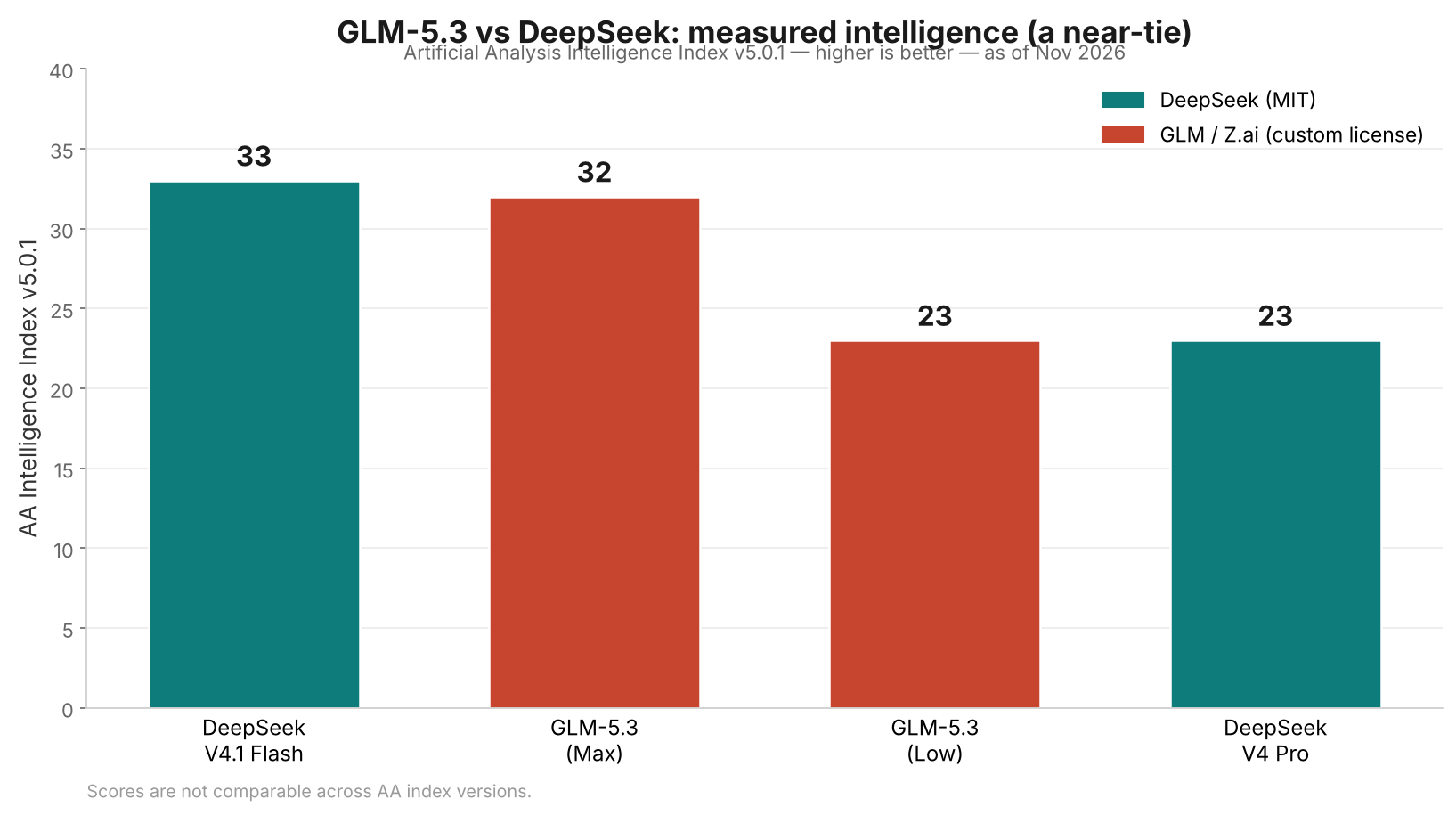
A caution: scores are not comparable across index versions. Press coverage quoting GLM-5.3 at "60" or V4 Pro at "53" used an earlier index generation (VentureBeat). On today's v5.0.1 scale the numbers are lower and closer.
Vendor-reported coding benchmarks exist but run on each maker's own harness, so treat them as marketing. DeepSeek reports V4 Pro at 87.9 on Terminal-Bench 2.1; Z.ai reported GLM-5.2 at 81.0 on the same test and 62.1 on SWE-bench Pro (DeepSeek via RITS, Z.ai via VentureBeat). Different harnesses, different dates — not a clean head-to-head.
GLM vs DeepSeek pricing: which is cheaper?
DeepSeek is cheaper, but it depends which DeepSeek.
DeepSeek V4.1 Flash is the price floor at $0.30 in / $1.20 out per 1M tokens (DeepSeek). That undercuts GLM-5.3 at $1.40 / $4.40 (Z.ai) by more than 3x on output. DeepSeek set the price floor across the whole field — we tracked the broader rankings in our cheapest AI API breakdown.
DeepSeek V4 Pro is closer to GLM. DeepSeek's published rates work out to roughly $1.27 in / $3.90 out at peak hours, halving off-peak (RITS). GLM-5.3 also offers $0.26/1M cached input, which helps agent loops that re-read the same context.
If you run coding agents all day, the GLM Coding Plan changes the math: a subscription from a listed $18/month (Lite tier) routes requests to GLM-5.3 and works with Claude Code (docs.z.ai/devpack), which can beat per-token billing for heavy users.
Can you self-host GLM and DeepSeek?
Yes — both ship open weights on Hugging Face, but the licenses differ, and that is the real decision.
DeepSeek V4 Pro weights are MIT (model card) — no user cap, no revenue cap, no review. The catch is scale: 1.6T parameters is a serious multi-GPU deployment, not a single-card job.
GLM-5.3 ships under a custom "GLM-5.3 License", not MIT (license). It grants use, modification, distribution, sale, and fine-tuning, and keeps a notice requirement. The one real restriction: Model-as-a-Service operators with over $10B revenue in any 12 months must pass a Z.ai security review before commercial use. For most teams that never binds — but it is not MIT, and GLM-5.2 was.
If license purity is a hard requirement, DeepSeek's MIT is the safer self-host base.
GLM vs DeepSeek for coding
For hands-on coding agents, GLM-5.3 is the more considered pick.
GLM-5.3 was built for long-horizon agentic coding, and Z.ai ships the ergonomics to match: a Claude-Code-compatible GLM Coding Plan, reasoning-effort controls, and a 1M-context window tuned for repo-scale work (docs.z.ai). That tooling, not a benchmark point, is the differentiator. GLM also takes on Anthropic directly in our GLM vs Claude comparison.
DeepSeek is no slouch — V4 Pro posts strong vendor coding numbers and ships with speculative decoding — but DeepSeek sells raw model access, not an opinionated agent workflow. You wire it into your own harness. If you want the frontier open-vs-closed case, that is our DeepSeek vs Claude analysis.
For a cheap coding sidecar, DeepSeek V4.1 Flash at $0.30/$1.20 is hard to beat for bulk edits and boilerplate.
Which should you pick?
- Coding agents / Claude Code: GLM-5.3, via the Coding Plan.
- Lowest cost per token: DeepSeek V4.1 Flash ($0.30/$1.20).
- MIT self-host at frontier scale: DeepSeek V4 Pro.
- Vision / image input: DeepSeek V4.1 Flash (GLM-5.3 is text-only).
- Avoid GLM-5.3 if you need an MIT license or multimodal input.
- Avoid DeepSeek if you want a packaged, Claude-Code-ready agent subscription out of the box.
If you want DeepSeek measured against another open-weight challenger, see our Kimi vs DeepSeek head-to-head.
Our take
Here is the thesis: on the numbers that are independently measured, GLM and DeepSeek are a tie, and once two open-weight models are a tie on intelligence, the decision stops being about the model and starts being about everything wrapped around it — license, price structure, modality, and the harness you deploy into. That is where these two diverge, and it is the only thing worth optimizing.
Start with the intelligence tie, because it kills the usual framing. On AA Intelligence Index v5.0.1 (November 2026), DeepSeek V4.1 Flash scores 33 and GLM-5.3 at max reasoning scores 32. A one-point gap on a versioned, periodically re-based index is noise. Anyone telling you GLM "crushes" DeepSeek or vice versa is almost always quoting an older index generation (the 60-vs-53 era) and comparing scores that the index maker itself says are not comparable across versions. Ignore cross-version claims. On the current scale, you are choosing between two models of the same measured caliber.
So the tiebreakers decide, and they do not point the same way. License is the cleanest split. DeepSeek V4 Pro is MIT — the most permissive terms in wide use, no caps, no review. GLM-5.3 is not. It moved off the MIT license that GLM-5.2 carried and onto a custom license whose only teeth are a security-review trigger for Model-as-a-Service operators above $10B in revenue. In practice that clause never touches a startup, an internal tool, or a product that embeds the model in a feature. But "in practice it is fine" is not the same as MIT, and if your legal team wants a one-word answer, DeepSeek gives it and GLM does not. This is the single most under-reported fact in the GLM-vs-DeepSeek comparisons currently ranking, most of which still call GLM "MIT."
Price structure is the second tiebreaker, and it rewards DeepSeek on the low end and GLM on the high end — which sounds contradictory until you look at how you actually spend. If your workload is bulk inference — classification, extraction, summarization, cheap agent steps — V4.1 Flash at $0.30/$1.20 is the rational floor, and it adds native vision that GLM-5.3 simply does not have. But if your workload is a developer sitting in Claude Code all day, per-token billing is the wrong model entirely, and GLM's Coding Plan from a listed $18/month can be dramatically cheaper than metered V4 Pro calls. The lesson is that "which is cheaper" has no single answer; it depends on whether you are billing tokens or billing seats.
Modality quietly settles a lot of cases. GLM-5.3 is text-only. If your pipeline touches screenshots, documents, diagrams, or UI, DeepSeek V4.1 Flash's image input removes a whole model from your stack. That is a bigger deal than a benchmark point.
Where does that leave a recommendation? Pick GLM-5.3 if you are shipping coding agents and want a Claude-Code-native subscription and strong long-horizon behavior — the tooling is the product, and it is good. Pick DeepSeek if you want the price floor, the MIT license, or vision — V4.1 Flash for cheap multimodal bulk work, V4 Pro when you need 1.6T-parameter scale on weights you can host with zero license anxiety. Avoid GLM-5.3 if an MIT license or multimodal input is non-negotiable. Avoid DeepSeek if you want a packaged agent experience rather than raw model access you assemble yourself.
The broader read: these two are the clearest sign that open-weight Chinese frontier models have stopped competing on "can they keep up" — they have — and started competing on distribution and terms. That is a healthier fight for you, the buyer, because it is winnable on your requirements, not theirs.
Frequently Asked Questions
Is GLM better than DeepSeek?
Not clearly. On the AA Intelligence Index v5.0.1 (November 2026), DeepSeek V4.1 Flash scores 33 and GLM-5.3 scores 32 at max reasoning — a tie within measurement noise. GLM-5.3 is better tooled for coding agents; DeepSeek wins on price, MIT license, and vision. Pick on your use case, not an overall ranking.
Is GLM or DeepSeek cheaper?
DeepSeek, at the low end. DeepSeek V4.1 Flash costs $0.30 input / $1.20 output per 1M tokens, versus GLM-5.3 at $1.40 / $4.40. DeepSeek V4 Pro is closer (~$1.27/$3.90 peak). But GLM's Coding Plan from $18/month can beat per-token pricing for heavy Claude Code users.
Are GLM and DeepSeek open source?
Both ship open weights, but the licenses differ. DeepSeek V4 Pro weights are MIT — fully permissive. GLM-5.3 uses a custom license (GLM-5.2 was MIT), permissive in practice but with a security-review trigger for Model-as-a-Service operators above $10B revenue. For strict MIT, choose DeepSeek.
Which is better for coding, GLM or DeepSeek?
GLM-5.3, for most agent workflows. It was built for long-horizon agentic coding and plugs into Claude Code via the GLM Coding Plan. DeepSeek V4 Pro posts strong vendor coding scores but sells raw model access, not a packaged agent. For cheap bulk coding, DeepSeek V4.1 Flash is the value pick.
Can you run GLM and DeepSeek locally?
Yes, both publish weights on Hugging Face. DeepSeek V4 Pro is 1.6T parameters (49B active) — a multi-GPU deployment, MIT-licensed. GLM-5.3 is 753B total under a custom license. Neither is a single-consumer-GPU model; both need serious hardware or a hosted endpoint for real workloads.
Editor's note — sources: Z.ai GLM-5.3 docs; GLM-5.3 model card and license; DeepSeek V4 model card; DeepSeek V4.1 Flash notes; Artificial Analysis Intelligence Index v5.0.1; OpenRouter; VentureBeat. Figures verified November 2026; model benchmarks and prices change frequently.