
Best Midjourney Alternatives in 2026
Midjourney has no free tier and no public API. The best alternatives in 2026: Nano Banana Pro for quality ($0.134/image), FLUX.2 for price and open weights ($0.03/image), and Stable Diffusion 3.5 for a free, self-hosted model you own — benchmarked on the Artificial Analysis Image Arena.
TL;DR
- Best overall quality: Google Nano Banana Pro (Gemini 3 Pro Image) — Artificial Analysis Image Arena among the leaders, $0.134/image at 1K/2K, $0.24 at 4K (as of November 2026).
- Best price + open weights: Black Forest Labs FLUX.2 — about $0.03 for a 1‑megapixel image via API; [dev] (32B) and [klein] (Apache‑2.0) weights run on your own hardware.
- Best free, fully-owned: Stable Diffusion 3.5 — open weights, free for commercial use under $1M revenue, self-hosted.
- Key gap: Midjourney has no free tier and no public API, and it is not benchmarked on the Artificial Analysis Image Arena.
The best Midjourney alternatives in 2026 are Google's Nano Banana Pro for quality, Black Forest Labs' FLUX.2 for price and open weights, and Stable Diffusion 3.5 for a free, self-hosted model you fully own. Midjourney has no free tier and no public API — these do. For commercial safety with legal indemnity, use Adobe Firefly instead.
Why look for a Midjourney alternative?
Three reasons, all structural. Midjourney charges from day one, it won't plug into your code, and its quality claims aren't independently benchmarked.
No free tier. Midjourney discontinued its free trial back in 2023. The cheapest way in is the Basic plan at $10/month, per Midjourney's plan documentation. Standard runs $30, Pro $60, and Mega $120 a month. Every rival below has either free open weights or a free hosted tier.
No public API. Midjourney still ships no official API. Generation happens through its web app and Discord. If you want images inside a product, a pipeline, or a batch job, Midjourney is a dead end — and the API-first models here are the point.
Commercial fine print. You own what you make, but companies above $1,000,000 in annual revenue must sit on a Pro or Mega plan to own their output, per Midjourney's Terms of Service. Images are also public by default unless you pay for Stealth mode (Pro/Mega only).
Midjourney still makes beautiful, opinionated images. But "beautiful" is now table stakes.
What are the best Midjourney alternatives in 2026?
Six are genuinely competitive. Here is the full comparison.
| Tool | Maker | Open/closed | Free option | API? | Price (per image or plan) | Commercial rights | Best for |
|---|---|---|---|---|---|---|---|
| Nano Banana Pro | Closed | Yes (Gemini app, limited) | Yes | $0.134 (1K/2K), $0.24 (4K) | Allowed; SynthID watermark | Top quality + text | |
| FLUX.2 | Black Forest Labs | Mixed | Yes ([dev]/[klein] weights) | Yes | $0.03 / 1 MP image | pro: API terms; klein: Apache‑2.0; dev: non‑commercial | Price + self-host |
| Stable Diffusion 3.5 | Stability AI | Open | Yes (weights) | Via hosts | $0 self-hosted (compute only) | Free commercial under $1M rev. | Free, owned, local |
| GPT Image | OpenAI | Closed | Yes (ChatGPT, limited) | Yes | Not disclosed (current model) | Allowed under API terms | ChatGPT-native workflows |
| Adobe Firefly | Adobe | Closed | Yes (web, credits) | Yes | Plan/credit-based | Indemnified for enterprise | Commercial-safe teams |
| Ideogram | Ideogram | Closed | Yes (web, limited) | Yes | Plan-based | Allowed under terms | Text inside images |
All prices and scores as of November 2026. Midjourney, for contrast: $10–$120/month, no free tier, no public API.
Best free Midjourney alternatives
The strongest free Midjourney alternative is Google's Gemini app, which runs Nano Banana — the current arena quality leader — at no cost with usage limits. No install, no GPU.
If you want free and fully owned, go open-weight:
- Stable Diffusion 3.5 — free weights under the Stability AI Community License, free for commercial use for anyone under $1M annual revenue, self-hosted so nothing leaves your machine.
- FLUX.2 [klein] — Apache‑2.0, the most permissive license here, commercial use included.
- FLUX.2 [dev] — a 32B open model, free for non-commercial use; a commercial license is sold separately, per Black Forest Labs.
Free hosted tiers also exist on ChatGPT, Adobe Firefly, Ideogram and Leonardo.Ai, each with credit or rate limits. The trade: hosted free tiers cap volume and usually watermark or log; open weights cost you a GPU but nothing per image.
Midjourney offers none of this. That single fact drives most "free Midjourney alternative" searches.
Midjourney vs FLUX: which is better?
For engineers, FLUX.2 wins — on price, API access and self-hosting. For pure hands-off aesthetics, Midjourney still has an edge in default polish.
FLUX.2 costs about $0.03 for a 1‑megapixel image via API (roughly $0.015 for each additional megapixel). It ships open weights you can run locally, and it has a real API. Midjourney has neither an API nor a per-image price — you rent GPU hours inside a subscription.
On independent quality, Black Forest Labs' models sit mid-board on the Artificial Analysis Image Arena, with FLUX 3 Image reaching 1114 Elo. Midjourney isn't on the board at all, so a like-for-like Elo comparison doesn't exist.
Pick FLUX.2 if you ship images in software, care about cost, or need to self-host. Pick Midjourney if you only ever type prompts in a web box and want the most forgiving default look. If you want a deeper read on the open-image field, see our FLUX vs Nano Banana comparison.
Which alternative has the best image quality?
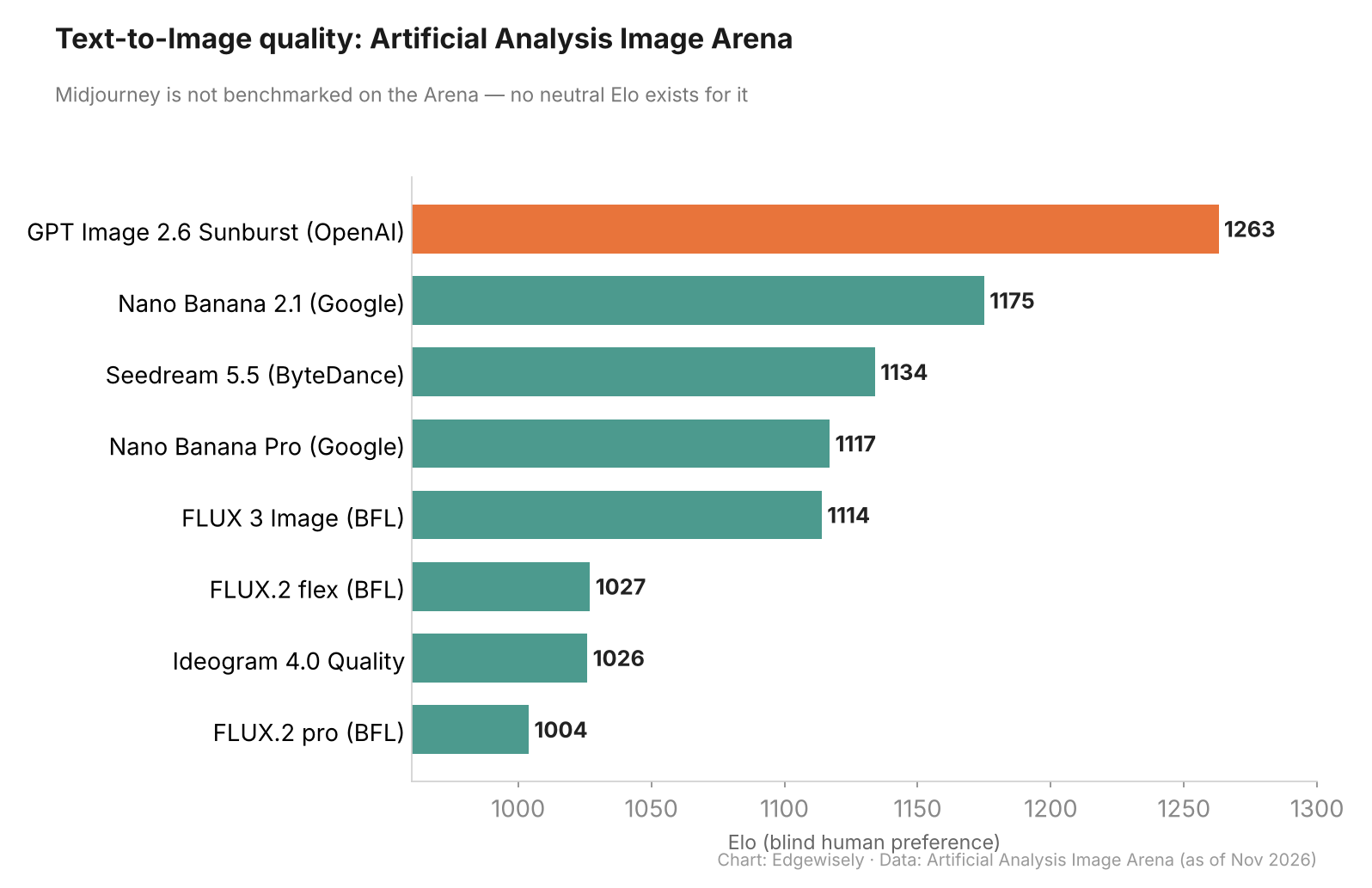
By independent blind preference, OpenAI's GPT Image leads the Artificial Analysis Text-to-Image Arena at 1263 Elo, followed by Google's Nano Banana line. Here are the headline scores, as of November 2026:
| Model | Maker | Image Arena Elo |
|---|---|---|
| GPT Image 2.6 Sunburst | OpenAI | 1263 |
| Nano Banana 2.1 | 1175 | |
| Seedream 5.5 | ByteDance | 1134 |
| Nano Banana Pro | 1117 | |
| FLUX 3 Image | Black Forest Labs | 1114 |
| FLUX.2 [flex] | Black Forest Labs | 1027 |
| Ideogram 4.0 (Quality) | Ideogram | 1026 |
| FLUX.2 [pro] | Black Forest Labs | 1004 |
Midjourney is not listed. Artificial Analysis ranks over a hundred models by blind human votes, and Midjourney doesn't appear. Treat any claim that Midjourney is "the best" as unbenchmarked.
Elo captures aggregate preference, not your use case. For text inside images, Ideogram and Nano Banana lead. For editing consistency, ByteDance's Seedream tops the separate image-editing arena. For brand and vector work, Recraft is built for it. One number won't tell you which to use. If you want the image-model-vs-image-model view, our Nano Banana vs Seedream breakdown goes deeper.
Which alternative gives you clean commercial rights?
For legal cover, Adobe Firefly is the safe default: it's trained on licensed and public-domain content and Adobe says it offers IP indemnification to enterprise customers. No other major option indemnifies you.
The rest, in plain terms:
- Stable Diffusion 3.5 / FLUX.2 [klein] — open licenses, commercial use included (SD free under $1M revenue; klein is Apache‑2.0). You hold the output.
- Nano Banana / GPT Image — commercial use allowed under API terms; Google tags outputs with an invisible SynthID watermark.
- FLUX.2 [dev] — free weights are non-commercial; buy a license before you sell anything made with it.
- Midjourney — you own assets, but above $1M revenue you must be on Pro/Mega, and work is public by default.
What this means for you
Match the tool to the job, not the hype.
- Solo creator, want free and easy: Google Gemini app (Nano Banana). Top quality, zero cost, no setup.
- Developer shipping images in a product: FLUX.2 API at about $0.03/image, or Nano Banana Pro if you need the best text rendering and will pay $0.134.
- Privacy or volume at scale: self-host Stable Diffusion 3.5 or FLUX.2 [dev]/[klein] — no per-image cost, nothing leaves your infrastructure.
- Enterprise, legal risk matters: Adobe Firefly for the indemnity.
- You only type prompts and love the look: stay on Midjourney — just know you're paying a subscription for polish, not capability.
Working in video instead of stills? The same "leave the closed app" logic applies — see our guide to the best Sora alternatives.
Our take
Our thesis: Midjourney's moat has collapsed to taste, and taste is no longer worth a closed, API-less, subscription-only product for anyone building rather than dabbling. The alternatives don't just match Midjourney — most of them do things it structurally cannot.
Start with what the benchmarks actually measure. The Artificial Analysis Image Arena is a blind-preference Elo: humans pick the nicer of two images. That rewards aesthetic default and prompt adherence, and it's genuinely useful — GPT Image's 1263 and Nano Banana 2.1's 1175 are earned. But the Elo hides three things that decide real projects. It doesn't measure text rendering (where Ideogram and Nano Banana pull ahead and most diffusion models still fail). It doesn't measure editing and consistency across a series (ByteDance's Seedream leads that separate board). And it says nothing about cost, license, or whether you can even call the model from code. A model can win the arena and still be wrong for you.
That's also why Midjourney's absence from the leaderboard matters more than its fans admit. It isn't that Midjourney would score badly — its images are frequently gorgeous. It's that nobody can tell you where it ranks, because it doesn't compete on neutral ground. When the pitch is "trust us, it looks best" and the price is a mandatory subscription with no API, the burden of proof is on the vendor, and Midjourney hasn't met it.
Now the real trade-offs, because there's no single winner. There are three honest archetypes:
Closed polish. Nano Banana Pro and GPT Image give you the highest ceiling and the least control. You pay per image ($0.134 and up for Google; OpenAI's current price isn't publicly listed), you accept a watermark, and you get frontier quality with almost no effort. Best for teams who want results now and don't care about owning the pipeline.
Open control. FLUX.2 and Stable Diffusion 3.5 invert every one of those choices. Weights on your disk, $0 marginal cost, full control of the stack, no watermark — in exchange for running a GPU and tuning your own workflow. FLUX.2 at roughly $0.03/image via API is also the price story of the year: a fraction of Nano Banana Pro for output that's competitive for most work. Best for engineers and anyone at volume.
Commercial-safe. Adobe Firefly is the only option that sells you legal certainty. Its arena scores trail the leaders, but for a Fortune 500 marketing team, indemnification beats a few Elo points every time.
On cost-versus-quality, the defensible call is this: the quality gap between the top closed models and open FLUX.2 is smaller than the price gap. Nano Banana Pro is better, clearly. It is not several times better, which is roughly what you pay. Unless you specifically need its text rendering or its one-shot polish, FLUX.2 is the rational default, and self-hosted Stable Diffusion is the rational default at scale.
The verdict, best-for / avoid-if:
- Nano Banana Pro — best quality and text. Avoid if you need low per-image cost or an unwatermarked, fully-owned output.
- FLUX.2 — best price, best self-host, real API. Avoid [dev] for commercial work without buying the license.
- Stable Diffusion 3.5 — best free-and-owned. Avoid if you can't run or rent a GPU.
- Adobe Firefly — best legal cover. Avoid if you want frontier aesthetics.
- Ideogram — best text-in-image. Avoid as a general-purpose default.
- Midjourney — best hands-off look. Avoid if you need an API, a free tier, or a benchmark you can check.
If you're building, leave Midjourney. If you're dabbling and like the pictures, there was never anything wrong with staying — you're just paying for a vibe now, and you should know that's the deal.
Frequently Asked Questions
Is there a free alternative to Midjourney?
Yes. Several. Google's Gemini app runs Nano Banana free with limits, and ChatGPT, Ideogram, Adobe Firefly and Leonardo.Ai have free tiers. For free and fully owned, run open weights like Stable Diffusion 3.5 or FLUX.2 [klein] on your own hardware. Midjourney itself has no free tier.
What is the best free alternative to Midjourney?
For most people, Google's Gemini app (Nano Banana) — it's free, needs no setup, and uses a current arena quality leader. If you want to own your output and avoid watermarks, self-host Stable Diffusion 3.5, free for commercial use under $1M annual revenue, or FLUX.2 [klein] under Apache‑2.0.
What is the best Midjourney alternative overall?
Nano Banana Pro (Gemini 3 Pro Image) for quality at $0.134/image, or FLUX.2 for price and open weights at about $0.03/image. Choose Nano Banana Pro if default polish and text rendering matter most; choose FLUX.2 if you want an API, self-hosting, or the lowest cost per image.
Is FLUX better than Midjourney?
For builders, yes. FLUX.2 has a real API, costs about $0.03 per megapixel image, and ships open weights you can self-host — none of which Midjourney offers. On independent arena quality the newest FLUX 3 Image scores 1114; Midjourney isn't benchmarked. Midjourney still wins on hands-off aesthetic defaults for non-technical users.
Which Midjourney alternative has an API?
Most of them. FLUX.2 (Black Forest Labs), Nano Banana / Gemini (Google), GPT Image (OpenAI), Adobe Firefly, Ideogram and Stable Diffusion (via hosts) all expose APIs. Midjourney does not offer an official public API as of November 2026, which is a primary reason developers switch.
Editor's note — sources
Prices and benchmarks as of November 2026; figures attributed to each vendor are the vendor's own claims. Arena scores are independent (Artificial Analysis, blind human preference). Sources: Midjourney plan documentation, Midjourney Terms of Service, Black Forest Labs (FLUX.2), Google Gemini API pricing, Artificial Analysis Image Arena, Stability AI Community License.