
Suno Alternatives: 8 Best AI Music Tools (2026)
The best Suno alternatives in 2026, compared on real pricing and rights: ElevenLabs, Udio, Stable Audio, Mureka, plus open-weight self-host picks.


The best Suno alternatives in 2026 are Udio (closest sound, but file exports are disabled), ElevenLabs Music (strong vocals with the clearest licensing), Stable Audio (instrumentals that drop into your DAW), and Mureka (a Suno-style workflow with no hard download cap), plus open-weight models like MiniMax Music and ACE-Step for self-hosting. Suno v6 still leads for full vocal songs.
The catch across the board is rights. The AI-music licensing wars have made "which tool sounds best" less important than "which tool can legally hand you a release-ready file." That is where most comparison pages go quiet, so that is where this one focuses.
TL;DR
- Best overall alternative for vocal songs: none fully beats Suno v6 on finished pop/vocal tracks, but ElevenLabs Music is the strongest pick if you also need clean, documented commercial rights. Creator at $22/mo is the cheapest ElevenLabs tier that lets you distribute to Spotify and Apple Music.
- Avoid for release work: Udio. Since its Universal Music Group deal, "downloading of audio, video, and stems has been disabled." You can generate and share links, but you cannot export files.
- Cheapest paid entry: Google Flow Music and ElevenLabs Starter sit around $6/mo; good for sketches, not for streaming distribution.
- For DAW producers: Stable Audio 3.0 generates instrumentals (no sung vocals), up to ~6 minutes, trained on licensed data, with open-weight models you can self-host.
- The quiet winner for control: open-weight models (MiniMax Music, YuE2, ACE-Step) — no download caps, local use, but you bring your own GPU and licensing judgment.
- Rights caveat: with Suno, downloaded songs on a paid plan carry commercial rights; undownloaded ones do not travel with you. Every tool here handles this differently. Verify before you release.
The best Suno alternatives, compared
Every figure below is current as of November 2026 and traces to the vendor's own pricing or terms page where marked. Prices are the entry paid tier unless noted.
| Tool | Maker | Best for | Price (entry paid) | Vocals? | Downloads / commercial rights | Notable |
|---|---|---|---|---|---|---|
| Suno (baseline) | Suno | Full vocal songs | $10/mo ($8 yearly) | Yes | Download on paid plan = commercial rights; 20 downloads/mo on Pro | v6 built with Warner/BMG/Believe; sued again Sep 2026 |
| Udio | Udio | Suno-like sound | ~$10/mo | Yes | Exports disabled — generate/listen/share only | Closest to Suno sonically; no files out |
| ElevenLabs Music | ElevenLabs | Vocals + clean licensing | $22/mo (Creator) | Yes | Streaming distribution on Creator+ only | Licensed model; multilingual; section edits, stems |
| Stable Audio 3.0 | Stability AI | Instrumentals in a DAW | ~$12/mo (Solo) | No (instrumental) | Licensed training; open-weight small/medium models | Up to ~6 min; DAW plugin; self-host option |
| Mureka | Kunlun Tech | Suno-style, no hard cap | ~$8/mo (Basic) | Yes | Commercial license on paid; song-count limits, not a hard download cap | Voice cloning, stems on Pro |
| Google Flow Music | Cheap sketches | ~$6/mo (Starter) | Yes | SynthID watermark on all output; commercial terms unclear | Lyria model; verify rights before release | |
| AIVA | AIVA | Orchestral / cinematic scores | ~€11/mo (Standard) | No (instrumental) | You own copyright only on Pro; MIDI export | Score composition, not pop songs |
| Soundraw | Soundraw | Royalty-free background music | ~$11/mo (Creator) | No | Trained only on in-house music; clean licensing | Streaming distribution on Artist plans |
What is the best alternative to Suno?
For finished vocal songs, no alternative clearly beats Suno v6 on sound quality — but ElevenLabs Music is the best choice once you factor in rights. It produces convincing multilingual vocals, supports section editing and stems, and was built on announced licensing deals, including a Universal partnership announced September 10, 2026. Its terms spell out exactly what you can and cannot do per tier, which is rare. (The same team's voice models top our best TTS model comparison.)
Be skeptical of "beats Suno" claims. Several tools cite benchmarks where they outscore Suno, but those are the vendors' own automatic evaluations, not blind human listening tests. There is no reliable, independent blind-listening leaderboard across these tools. Treat any quality ranking as marketing until a neutral party runs it.
If you want the sound closest to Suno, that is Udio — with a fatal catch covered below.
Is there a free Suno alternative?
Yes, but every free tier has a sharp limit. ElevenLabs offers a free plan with 10k credits/month, though free output requires you to attribute ElevenLabs and bars streaming distribution. Google Flow Music and Mureka have free tiers for testing. AIVA is free with 3 downloads/month, but AIVA owns the copyright on the free plan and bars monetization.
The honest answer: free tiers are for trying the tool, not releasing music. Suno's own free tier produces no commercial-use rights at all. For anything you plan to publish, budget for a paid plan.
The best free-and-open route is self-hosting an open-weight model (see below). Free to run, no caps — if you have the hardware.
Best Suno alternative for commercial use and rights
For documented commercial rights, pick ElevenLabs Music on Creator ($22/mo) or higher, or Soundraw for royalty-free background music. Both give you the clearest paper trail.
ElevenLabs is explicit: per its music model terms, "Music Streaming Distribution is permitted only as set out in the Music Commercial Rights Table," and streaming distribution is available on Creator and above — not Free or Starter. Free output also requires attribution. Note one limit: paid tiers still exclude use in film, TV, radio, and certain games unless you are on Enterprise Music.
Soundraw trains only on music it commissions in-house, which sidesteps the training-data lawsuits entirely. Its Artist plans ($29.99/mo, or $19.49 billed yearly) add distribution to Spotify and Apple Music. It makes no vocals — this is instrumental background music for videos, podcasts, and streams.
Suno itself grants commercial rights on any paid plan, but only to songs you download — and Pro caps you at 20 downloads/month per its pricing page. Generate 200 tracks, download 20, and the other 180 are not yours to release.
Watch the legal backdrop. Universal and Sony sued Suno a second time on September 18, 2026, arguing v6 is "the fruit of the same poisoned tree" even though Suno says it trained v6 with Warner, BMG, and Believe. The suit targets the platform, not individual users, but it is a reason to keep your own downloaded files and licenses.
Udio vs Suno: which is better?
Suno wins for anyone who needs files. Udio sounds arguably closest to Suno, but since its UMG partnership, its own help article states "downloading of audio, video, and stems has been disabled." You can generate, listen, and share a link — you cannot export anything. (We go deeper in our Suno vs Udio head-to-head.)
That single change rules Udio out for release work, sync, or any workflow where you need a WAV. The partnership was announced October 29, 2025, and the no-export reality has held since. If Udio restores downloads, it jumps back into contention immediately. Until then, Suno is better for any practical purpose because you can actually keep what you make.
Use Udio only to audition its sound or share preview links. Do not build a release pipeline on it.
Best open-source and self-hosted music AI
For maximum control and no download caps, self-host an open-weight model: ACE-Step (MIT-licensed, runs on consumer GPUs and Apple Silicon), MiniMax Music (open weights, released August 2026), or YuE / YuE2 (open weights, CC BY-NC — non-commercial). Stable Audio also ships open-weight small and medium models.
ACE-Step is the most accessible — an MIT license means you can use output commercially and it runs locally without a cloud subscription. MiniMax opened its Music weights broadly. YuE2's maker claims it beats Suno v6 on open benchmarks, but again, that is an automatic benchmark, not a listening test, and its CC BY-NC license bars commercial use of the weights.
The trade-off is real: you manage your own GPU, setup, and — critically — your own judgment on training-data provenance. Open weights don't come with a label's blessing. But for developers, researchers, and anyone who wants unlimited generation without a per-download meter, this is the category the SEO spam pages ignore, and it is often the right answer.
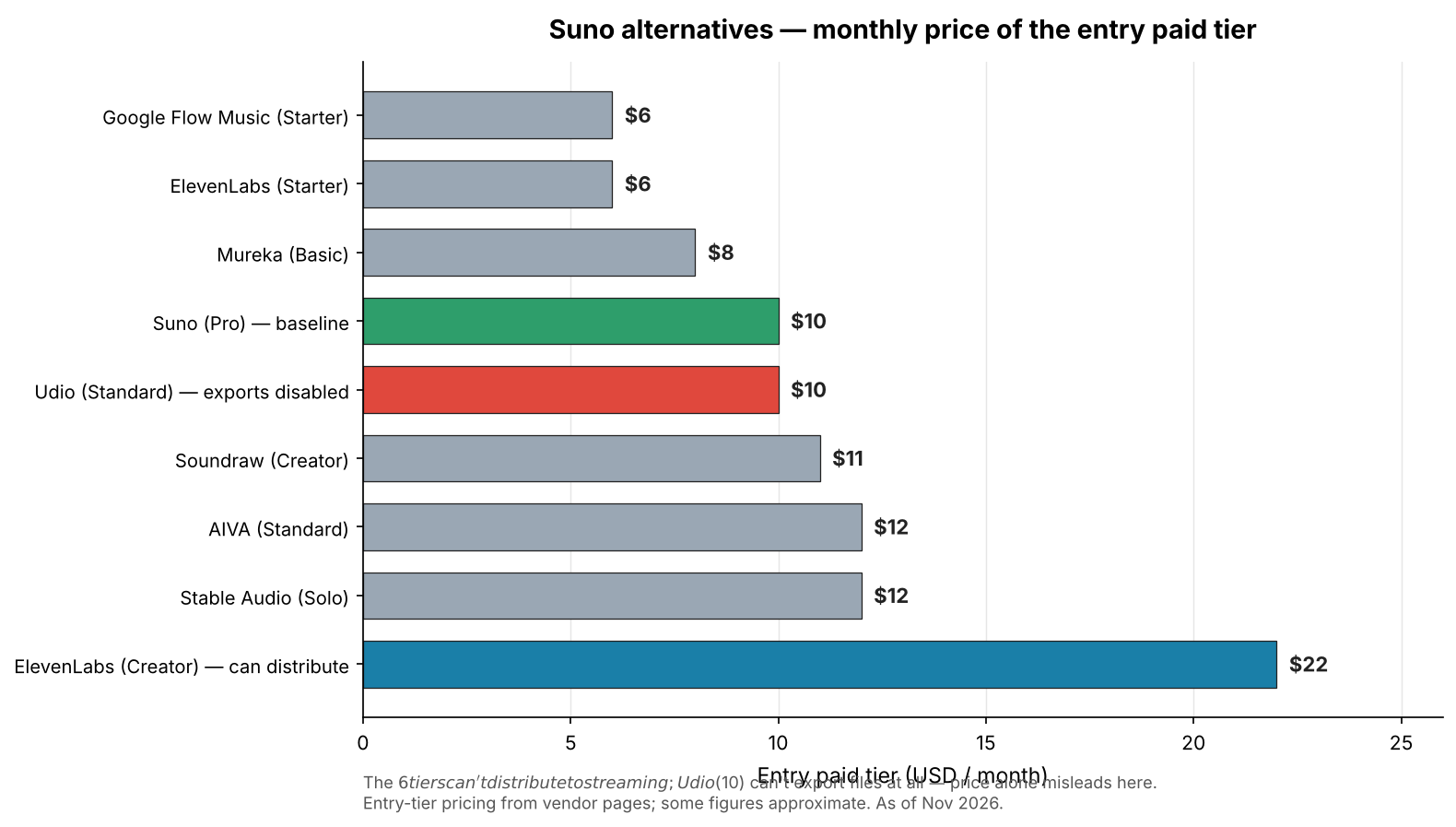
Monthly price comparison (entry paid tier)
The most useful chart here is price, not a fabricated quality score. Below is the entry paid tier for each tool, current as of November 2026. (Full data and sources in the metadata.)
- Google Flow Music (Starter): $6
- ElevenLabs (Starter): $6
- Mureka (Basic): $8
- Suno (Pro): $10
- Udio (Standard): $10 — exports disabled
- Soundraw (Creator): $11
- AIVA (Standard): $12
- Stable Audio (Solo): $12
- ElevenLabs (Creator, needed to distribute): $22
Read it with the asterisks in mind: the cheapest tiers (Google, ElevenLabs Starter) cannot distribute to streaming, and the cheapest "closest to Suno" tier (Udio) cannot export at all. Price alone is misleading in this category.
Which alternative should you pick?
- You make full vocal songs and want the best sound: stay on Suno (Pro, $10/mo), and download the keepers before you hit the 20/month cap.
- You release to Spotify and need clean rights: ElevenLabs Music, Creator ($22/mo).
- You score video, film, or games (instrumental): Stable Audio or AIVA Pro (for copyright ownership).
- You need royalty-free background beds, no vocals: Soundraw.
- You want control, local use, no caps: open-weight ACE-Step or MiniMax Music.
- You only want to audition Suno's sound elsewhere: Udio — but know you cannot export.
Our take
The licensing war, not the audio quality race, now decides which Suno alternative is "best." A year ago you picked a tool by how its choruses sounded. In November 2026 the first question is colder: who can legally hand you a file you are allowed to release? That reframing changes every recommendation. The same turmoil is reshaping generative media next door — it is the backdrop to our Kling vs Sora video and Nano Banana vs Seedream image comparisons too.
Udio is the clearest casualty of its own deal. It makes music that rivals Suno, and it is the alternative people most want to love. Then its UMG partnership disabled downloads of audio, video, and stems — and a music tool you cannot export from is a demo, not a product. This is a self-inflicted wound: the sound is there, the pipeline is gone. Unless Udio restores exports, treat it as a sketchpad you can share links from, nothing more. Anyone recommending Udio for releasing music in late 2026 has not read its own help docs.
Suno's weakness is quieter but real: the download cap is the business model. Twenty downloads a month on Pro means the commercial rights you are paying for are rationed. Generate freely, but the moment a track matters, download it — undownloaded songs don't follow you out the door, and the second Universal/Sony lawsuit is a reminder that the ground can shift. Keep local copies and your receipts. My opinion: Suno is still the right default for vocal songs, but its value is in the files you pull down, not the generations you leave in the cloud.
ElevenLabs is the most underrated pick because it treats rights as a feature. Its terms table is specific about who can distribute to streaming (Creator and up), what's excluded (film, TV, radio), and what free users owe (attribution). That specificity is worth paying for. The $6 Starter tier is a trap for release work — it can't distribute — so budget for Creator at $22 if Spotify is the goal. For creators who need to show a label, a distributor, or a client exactly what license governs a track, this is the cleanest answer on the market.
The segment-by-segment verdict:
Hobbyists making songs for fun should use Suno's or ElevenLabs' cheap tiers, or a free open-weight model, and not overthink rights they'll never exercise.
Indie artists releasing to Spotify should use ElevenLabs Creator or Suno Pro, download everything, and keep the license text with the files. Avoid Udio (no files) and Google Flow Music (SynthID watermark on all output and murky commercial terms — fine for sketches, risky for a release you'll monetize).
Content creators who need safe background music should use Soundraw or AIVA, both instrumental, both with cleaner training-data stories than the vocal-song tools fighting lawsuits.
Developers and self-hosters are the segment the spam pages pretend doesn't exist, and they may have the best deal: ACE-Step under MIT runs locally, costs nothing per track, and has no download meter. The price is your own GPU and your own judgment on provenance — open weights don't absolve you of training-data questions. But for unlimited, controllable generation, this is the quiet winner.
Who should switch, and who should stay? Stay on Suno if you make vocal songs and the 20-download cap covers your output — nothing beats it on finished tracks. Switch to ElevenLabs if rights clarity matters more than the last 5% of sound quality. Switch to open-weight if you value control and volume over convenience. And skip Udio for anything you intend to keep. These are opinions grounded in the pricing and terms pages above, not a quality leaderboard — because no trustworthy one exists yet.
Frequently Asked Questions
What is the best alternative to Suno?
For vocal songs with the clearest commercial rights, ElevenLabs Music is the strongest alternative; its Creator plan ($22/mo) permits streaming distribution. Udio sounds closest to Suno but has disabled all file downloads. For instrumentals, use Stable Audio. No alternative decisively beats Suno v6 on finished vocal tracks.
Is there a free alternative to Suno?
Yes. ElevenLabs, Google Flow Music, Mureka, and AIVA all have free tiers, though each limits downloads and commercial use — AIVA, for instance, keeps the copyright on its free plan. For truly unlimited free generation, self-host an open-weight model like ACE-Step (MIT license) if you have a capable GPU.
What is the best AI music generator in 2026?
Suno v6 still leads for full vocal songs, built with Warner, BMG, and Believe. For instrumentals, Stable Audio 3.0 is strongest; for licensing clarity, ElevenLabs Music. There is no independent blind-listening leaderboard, so any single "best" claim — including vendors' own benchmarks — should be treated skeptically.
Can you use AI-generated music commercially?
Sometimes, and only under each tool's terms. Suno grants commercial rights to downloaded songs on paid plans. ElevenLabs allows streaming distribution on Creator and above. Soundraw and AIVA Pro give clean rights. Udio currently blocks downloads entirely, and Google Flow Music watermarks all output with SynthID. Always verify the current terms.
Is Udio better than Suno?
Udio arguably matches Suno's sound, but Suno is more useful because Udio has disabled downloads of audio, video, and stems since its Universal Music Group deal. You can generate and share links on Udio, but you cannot export files, which rules it out for releasing music. For any practical workflow, Suno wins.
Editor's note — sources: Suno pricing and download caps are from suno.com/pricing and Suno's help center; the second Universal/Sony lawsuit (filed Sep 18, 2026) is from Music Business Worldwide. Udio's export disabling is quoted from its own help article. ElevenLabs tiers and distribution rules are from elevenlabs.io/pricing and its music model terms. Stable Audio, AIVA, and Soundraw details are from their vendor pages; ACE-Step is MIT-licensed. Entry-tier prices for Udio, Google Flow Music, Stable Audio, and Mureka are approximate (vendor pricing pages are JS-rendered; figures corroborated by dated secondary sources as of November 2026). No independent blind-listening quality leaderboard exists across these tools; "Our take" is Edgewisely's opinion, labeled as such.