
Qwen vs Claude: Which Is Better for Coding?
Qwen vs Claude for coding, Nov 2026: Qwen3-Coder is Apache-2.0 and self-hostable; Claude Opus/Sonnet 5.5 lead on reliability. Price and benchmark verdict.


Qwen vs Claude: which wins for coding?
For agentic coding, Claude still wins on reliability and Qwen wins on cost and control. If you want the most dependable coding agent out of the box, pick Claude Opus 5.5 or Sonnet 5.5. If you need open weights you can self-host for data residency or to cut per-token spend, Qwen3-Coder (Apache-2.0) is the real alternative. That is the whole qwen vs claude decision in one line.
The rest of this is the evidence: what each costs, what the benchmarks actually say, and whether self-hosting Qwen is worth the ops burden.
TL;DR
- Verdict (Nov 2026): Claude leads on agentic-coding reliability; Qwen3-Coder is the best open, self-hostable alternative. Most teams should default to Claude Sonnet 5.5 for coding and reach for Qwen3-Coder when license, cost, or data control decides it.
- Price gap is large. Claude Sonnet 5.5 is $2 / $10 per 1M tokens (in/out); Claude Opus 5.5 is $4 / $20. Hosted Qwen3-Coder runs roughly $0.31–$0.38 in / $1.00–$1.40 out across providers — and $0 per token if you self-host the weights.
- Benchmarks don't line up. Alibaba reports Qwen3-Coder-480B at up to 69.6% SWE-bench Verified; Anthropic reports Opus 5.5 at 66.4% Terminal-Bench 4.0 and doesn't publish SWE-bench Verified for the 5.5 line. Different tests, both self-run — don't read them as head-to-head.
- License is the real differentiator. Qwen3-Coder is Apache-2.0 open weights you can run on your own GPUs. Claude is closed; API or cloud marketplace only, no self-host.
- What changed: Alibaba shipped Qwen3-Coder-Next (Apache-2.0) in February 2026, replacing the July 2025 480B flagship; Anthropic shipped Opus 5.5 / Sonnet 5.5 in September 2026.
Qwen vs Claude: the models that actually matter for coding
Ignore the spam versions. The SERP is full of invented strings ("Qwen 3.7 Max", "Claude Opus 4.7"). Here are the models you can verify on primary sources as of November 2026, framed for coding and self-hosting.
| Model | Maker | License | Context | Price $/1M (in·out) | Self-host? | Best for |
|---|---|---|---|---|---|---|
| Qwen3-Coder-Next | Alibaba | Apache-2.0 | ~256k | ~$0.31 · $1.00 (hosted) | Yes | Open agentic coding, cost control |
| Qwen3-Coder-480B-A35B | Alibaba | Apache-2.0 | 262k (→1M) | ~$0.38 · $1.40 (hosted) | Yes | Proven open coder, benchmarked |
| Qwen3-Coder-30B-A3B | Alibaba | Apache-2.0 | 262k | ~$0.19 · $0.77 (hosted) | Yes (single GPU) | Local/on-prem, cheap inference |
| Claude Sonnet 5.5 | Anthropic | Closed | 1M | $2 · $10 | No | Default coding workhorse |
| Claude Opus 5.5 | Anthropic | Closed | 1M | $4 · $20 | No | Hardest agentic tasks |
Prices for Qwen vary by host; the figures above track the blended rates Artificial Analysis lists across providers, and self-hosting removes per-token cost entirely. Claude pricing is Anthropic's own API rate per the Claude Opus 5.5 page and Claude Sonnet 5.5 page.
Which Qwen model competes with Claude?
The coding comparison is Qwen3-Coder, not Qwen3-Max. The flagship Qwen3-Max is proprietary and API-only — not self-hostable — and its benchmark coverage is stale, so it's the wrong model for this fight. Alibaba's open, Apache-2.0 coding line (Qwen3-Coder-Next, the 480B, and the 30B) is what you weigh against Claude. For how the broader Qwen line stacks up against other open weights, see our Qwen vs Llama comparison.
Qwen vs Claude: which is better for coding?
Claude is better for agentic-coding reliability; Qwen3-Coder is close enough to matter when cost or openness wins the decision. The honest problem is that the two camps no longer report the same benchmark, so be skeptical of any site claiming a single head-to-head score.
Here's what's actually published:
- Qwen3-Coder-480B: Alibaba reports up to 69.6% SWE-bench Verified, calling it state-of-the-art among open models, per the Qwen3-Coder blog and the Together AI model page. That blog benchmarked it as "comparable to Claude Sonnet 4" — an older Claude.
- Claude Opus 5.5: Anthropic reports 66.4% on Terminal-Bench 4.0 (agentic coding, high effort), and does not publish a SWE-bench Verified number for the 5.5 generation, per the Anthropic Opus 5.5 announcement.
Those are different tests, run by different vendors on their own harnesses. Qwen's 69.6% SWE-bench Verified and Claude's 66.4% Terminal-Bench are not comparable. Anyone stacking them in one bar chart is guessing.
Where a neutral index does cover both lines, Claude leads: on Artificial Analysis's Intelligence Index v5.0.1, Opus 5.5 scores 59 and Sonnet 5.5 scores 55. The Qwen3-Coder models aren't scored on that index (coding-specialised models often aren't), so treat the index as a general-capability signal, not a coding verdict.
Is Qwen cheaper than Claude?
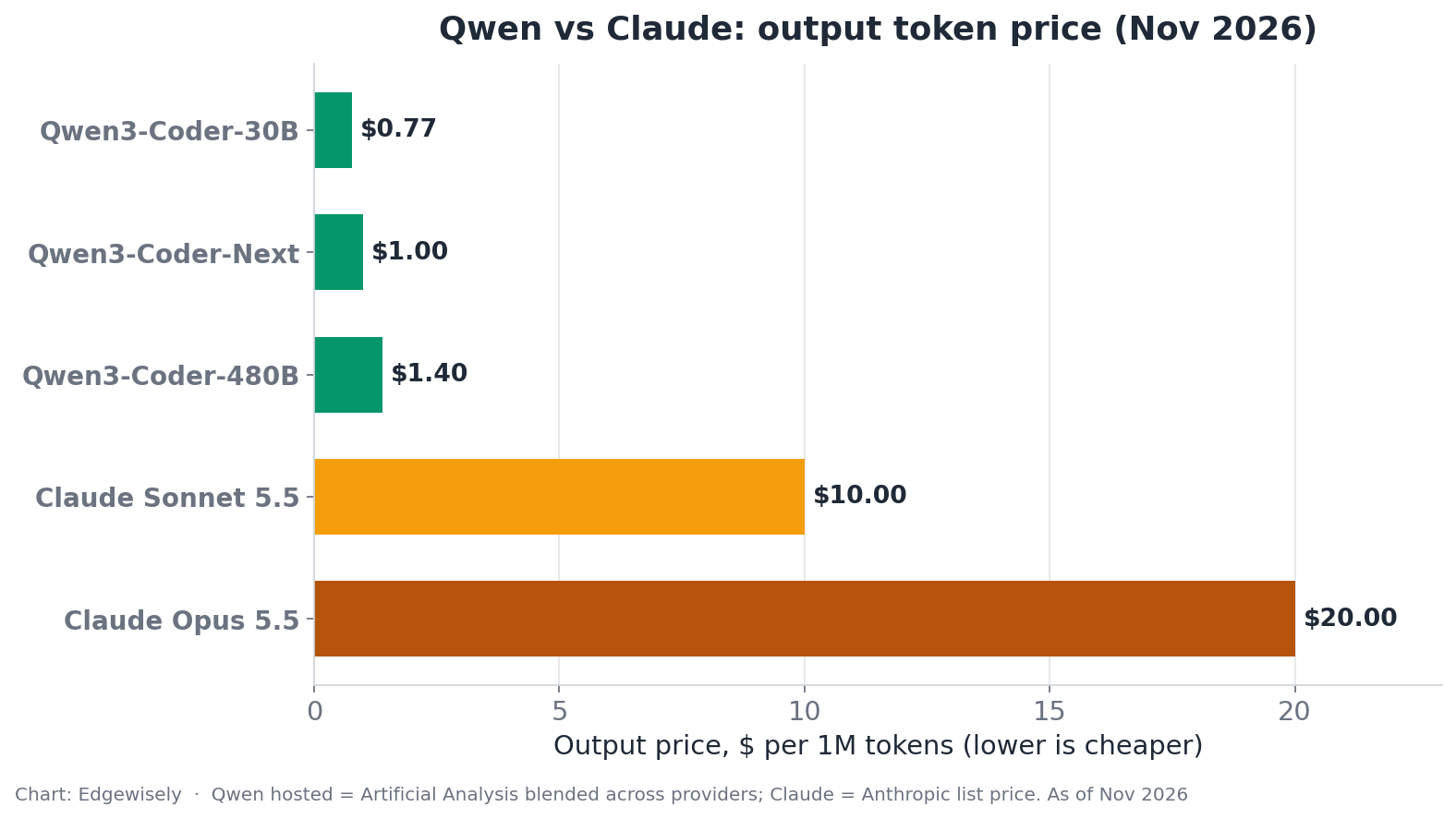
Yes — substantially, and by more if you self-host. On hosted API pricing, Qwen3-Coder is roughly a fifth to a tenth of Claude's cost per token.
- Qwen3-Coder-Next (hosted): about $0.31 in / $1.00 out per 1M tokens.
- Qwen3-Coder-30B (hosted): about $0.19 in / $0.77 out.
- Claude Sonnet 5.5: $2 in / $10 out.
- Claude Opus 5.5: $4 in / $20 out.
On output tokens — where agentic coding burns most of its budget — Claude Opus 5.5 costs roughly 20x a hosted Qwen3-Coder-Next call. Sonnet narrows that to about 10x. For a team running coding agents at volume, that gap is the headline.
Self-hosting flips the model entirely: you pay for GPUs and ops, not tokens. Whether that's actually cheaper depends on utilization — more on that below. For hosted rates across every major vendor, see our cheapest AI API comparison.
Can you self-host Qwen (and should you)?
Yes, you can — Qwen3-Coder is Apache-2.0 — but whether you should depends on GPU utilization and ops maturity. This is the single biggest difference from Claude, which you cannot self-host at all.
What self-hosting gives you:
- Data stays in your perimeter. No code or prompts leave your network — the deciding factor for regulated, air-gapped, or IP-sensitive teams.
- No per-token bill. At high, steady utilization, amortized GPU cost per token can undercut any API.
- Version control. The weights don't change under you; no silent model updates mid-project.
What it costs you:
- Hardware. The 480B-A35B MoE needs a multi-GPU server (think 8x data-center GPUs) to serve at useful speed. The 30B-A3B (3B active) is the practical on-prem pick — it runs on a single high-memory GPU.
- Ops burden. You own inference serving, autoscaling, quantization choices, upgrades, and uptime. That's a real team cost most orgs underprice.
- Throughput and latency. A self-hosted model is only as fast as your serving stack; a saturated single GPU will feel slower than Claude's API under load.
Rule of thumb: self-host Qwen when data control is non-negotiable or you have sustained, high-volume coding-agent traffic to fill the GPUs. Otherwise a hosted Qwen3-Coder endpoint gives you most of the cost win with none of the ops.
Qwen3-Coder vs Claude as a Claude Code alternative
Qwen3-Coder is a credible Claude Code alternative for cost-sensitive and self-hosted setups, but Claude's agent harness is still more reliable on long, multi-step tasks. This is the question most searchers are really asking.
The practical path: Qwen ships Qwen Code, an open CLI agent, and Qwen3-Coder is tuned for agentic tool use and long-context repo work (256k native, extendable toward 1M). You can also point open coding harnesses at a Qwen endpoint — hosted or local — and keep your workflow.
Where Qwen3-Coder holds up: single-file edits, well-scoped changes, and tool-calling loops where the task is clear. Where Claude still pulls ahead in practice: sprawling, many-turn agentic runs where context management and recovery from its own mistakes matter — the reliability the raw benchmarks don't fully capture.
Our take
Our thesis: the "qwen vs claude" coding question is no longer about who tops a leaderboard — it's about whether you're buying a managed capability or building an owned one. Claude is the managed capability; Qwen3-Coder is the owned one. Both are defensible. The mistake is pretending one score settles it.
Start with what the benchmarks do and don't capture. SWE-bench Verified measures whether a model's patch makes a real repo's tests pass — valuable, but it's a single-shot, well-scaffolded task. Alibaba's 69.6% is a genuine, strong open-model result. But Anthropic has walked away from that benchmark for the 5.5 line in favor of Terminal-Bench 4.0, which scores an agent driving a real terminal across multi-step work. That shift isn't marketing noise — it reflects where coding agents actually spend their time. Neither score tells you about the thing that breaks real agent runs: context rot on long tasks, recovery after a wrong turn, and whether the harness keeps the model on track across dozens of tool calls. Those are properties of the system, not the model weights, which is exactly why a self-hosted Qwen with a weaker harness can underperform its benchmark, and a well-scaffolded Claude agent can overperform.
On price, the raw per-token gap is real and large — roughly 10–20x on output tokens in Claude's disfavor. But "cheaper" is a trap if you read it as self-host economics. Self-hosting is only cheaper at high, sustained utilization. Idle GPUs are the most expensive tokens in the world. For a team doing bursty coding-agent work, a hosted Qwen endpoint captures most of the savings; a rented 8-GPU box sitting at 15% utilization does not. Add the ops tax — serving, quantization, upgrades, on-call — and the honest break-even is further out than the sticker price suggests. Claude's premium buys you zero ops and a hardened agent harness. For many teams that's worth $10–$20 per million output tokens; for a high-volume platform it isn't.
Data control is where the decision gets easy. If your code or prompts legally cannot leave your network — regulated industries, air-gapped environments, sensitive IP — Claude is simply off the table as a self-hosted option, and Qwen3-Coder's Apache-2.0 license becomes the whole point. No amount of Claude's reliability edge matters if you can't deploy it where the data lives. This is the strongest, least-hyped reason Qwen is winning mindshare among enterprise platform teams. Our DeepSeek vs Claude analysis covers the same open-weights-versus-closed-frontier trade with a different challenger.
For builders and teams adopting coding agents, our guidance: don't standardize on one. Default your developers to Claude Sonnet 5.5 — it's the best reliability-per-dollar in coding right now, cheaper than Opus and close to it. Escalate the genuinely hard, long-horizon agentic tasks to Opus 5.5. Then stand up Qwen3-Coder (hosted first, self-hosted only if utilization or data rules justify it) for the cost-sensitive, high-volume, or data-residency workloads. Route by task, not by loyalty.
Where each actually fits: - Best for most coding: Claude Sonnet 5.5 — reliability and price balance. - Best for the hardest agentic runs: Claude Opus 5.5 — avoid if budget is tight. - Best open / self-hostable: Qwen3-Coder-Next or 480B — avoid if you lack serving ops. - Best cheap local coder: Qwen3-Coder-30B — avoid for the most complex multi-repo tasks.
The verdict: Claude for reliability, Qwen3-Coder for control and cost. Anyone telling you open weights have fully closed the gap on hard agentic coding is ahead of the evidence — and anyone telling you a 10–20x price gap doesn't matter has never run agents at scale.
Which should you use?
- You want the most reliable coding agent, minimal setup: Claude Sonnet 5.5, upgrading to Opus 5.5 for the hardest tasks.
- You need open weights, data residency, or air-gapped deployment: Qwen3-Coder (Apache-2.0), self-hosted.
- You run coding agents at high volume and cost dominates: hosted Qwen3-Coder-Next, with self-host once GPUs stay busy.
- You want a cheap local model for everyday edits: Qwen3-Coder-30B on a single GPU.
Frequently Asked Questions
Is Qwen better than Claude for coding?
Not on reliability. As of November 2026, Claude Opus 5.5 and Sonnet 5.5 lead on agentic-coding dependability and on Artificial Analysis's general intelligence index. Qwen3-Coder is competitive and open, and Alibaba reports strong SWE-bench Verified results, but Claude remains the safer default for hard, long-running agent tasks.
Is Qwen cheaper than Claude?
Yes, by a wide margin. Hosted Qwen3-Coder runs roughly $0.31 in / $1.00 out per 1M tokens versus Claude Sonnet 5.5 at $2 / $10 and Opus 5.5 at $4 / $20. On output tokens that's about 10–20x cheaper. Self-hosting removes per-token cost but adds GPU and ops spend.
Can you self-host Qwen?
Yes. Qwen3-Coder is Apache-2.0 licensed, so you can run the weights on your own hardware. The 30B-A3B variant fits a single high-memory GPU; the 480B MoE needs a multi-GPU server. Claude cannot be self-hosted at all — it's closed and API-only. Self-hosting fits data-residency and high-volume needs.
Is Qwen3-Coder a good Claude Code alternative?
For cost-sensitive or self-hosted setups, yes. Qwen3-Coder is tuned for agentic tool use and ships the open Qwen Code CLI, and you can point coding harnesses at hosted or local endpoints. Claude's agent harness is still more reliable on sprawling multi-step tasks, so test on your own workflows before switching.
Which Qwen model competes with Claude?
Qwen3-Coder — specifically Qwen3-Coder-Next (February 2026) and the 480B-A35B flagship — not Qwen3-Max. Qwen3-Max is proprietary and API-only, so it misses the open-weight, self-host advantage that makes Qwen interesting against Claude. The coding comparison is the Apache-2.0 Qwen3-Coder family.
Editor's note — sources: Artificial Analysis model pages for Claude Opus 5.5, Claude Sonnet 5.5 and Qwen3-Coder-Next (AA Intelligence Index v5.0.1, pricing, license, context — as of Nov 2026); the Anthropic Claude Opus 5.5 announcement (Terminal-Bench 4.0 66.4%, $4/$20, Sep 2026); the Qwen3-Coder blog (model specs, 256k/1M context, Claude Sonnet 4 comparison); and the Together AI Qwen3-Coder-480B page (69.6% SWE-bench Verified, Apache-2.0, context). All benchmarks are vendor self-reported unless noted; Qwen and Claude report different coding benchmarks, so treat cross-model figures as directional, not head-to-head.