
The 7 Best LLM Observability and Tracing Tools in 2026: Langfuse, LangSmith, Arize, Helicone, Braintrust, Weave, and TrueFoundry Compared
Langfuse, LangSmith, Arize AI, Helicone, Braintrust, Weights & Biases Weave, and TrueFoundry, ranked honestly on tracing depth, evaluation integration, pricing transparency, and deployment flexibility — with real pros and cons for each.


The 7 Best LLM Observability and Tracing Tools in 2026: Langfuse, LangSmith, Arize, Helicone, Braintrust, Weave, and TrueFoundry Compared
Langfuse, LangSmith, Arize AI, Helicone, Braintrust, Weights & Biases Weave, and TrueFoundry, ranked on tracing depth, how tightly evaluation ties to production monitoring, pricing transparency, and deployment flexibility.
An LLM application fails in ways a normal application doesn't: a tool call loops, a retrieved document is irrelevant, a model quietly drifts on a prompt that used to work. Traditional monitoring — uptime, latency, error rate — doesn't catch any of that. LLM observability tools exist to trace the specific parts that matter: prompts, retrieved context, tool invocations, token cost, and the reasoning path an agent actually took. This roundup ranks the seven strongest options in 2026 on what they actually trace and evaluate, what they cost, and how they can be deployed — including TrueFoundry, evaluated on the same criteria as the rest and given the same scrutiny.
How we picked these
We weighted four factors: the depth and portability of tracing (span-level detail, and whether traces are OpenTelemetry-native or locked to a proprietary format); how tightly evaluation and scoring connect to live production monitoring rather than sitting as a separate offline exercise; whether pricing is published and easy to model versus requiring a sales conversation; and deployment flexibility — cloud-only versus self-hosted versus VPC/on-prem/air-gapped options. We treated vendor-published product documentation and pricing pages as primary evidence, and where a company doesn't publish self-serve pricing, we say so rather than guessing a figure.
1. LangSmith
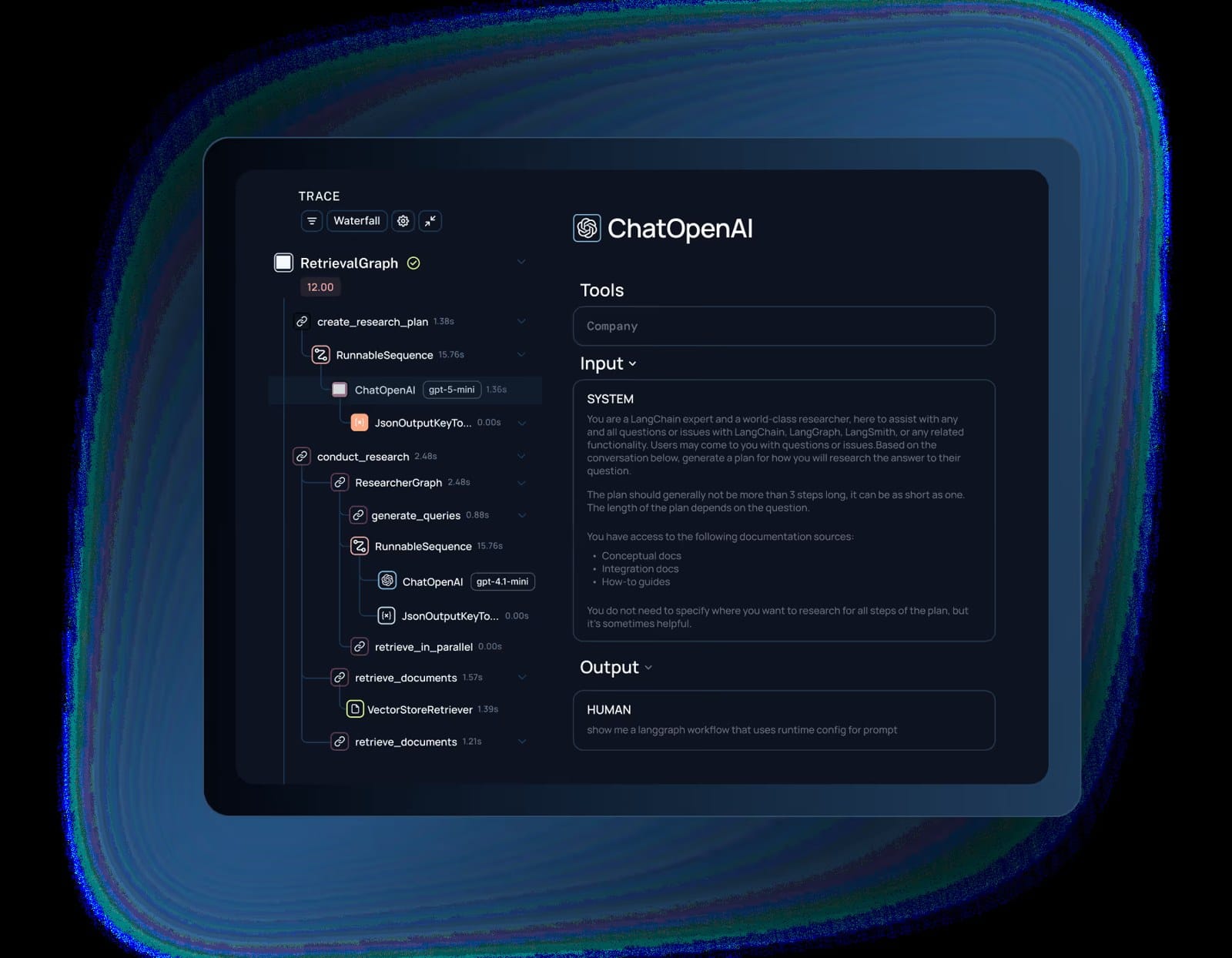
LangSmith is LangChain's observability and evaluation platform, built around three pillars: Tracing, Monitoring, and Insights. It captures every LLM call, tool invocation, and chain step as a structured trace, and pairs that with dataset-based evaluation so teams can test prompt or model changes against real production traffic before shipping changes. LangSmith works natively with LangChain and LangGraph but is also usable with other frameworks through its SDK and OpenTelemetry-compatible tracing. LangChain has recently emphasized "SmithDB," a backend rearchitecture the company says improves trace-query performance at scale.
Best for: Teams building on LangChain or LangGraph who want tracing, evaluation, and monitoring connected in one product.
Pros:
Deepest integration with the LangChain and LangGraph ecosystem of any tool here. Combines tracing, dataset-based evaluation, and production monitoring in a single connected workflow. Recent backend investment (SmithDB) aimed specifically at trace-query performance at scale. Usable outside LangChain via SDK and OpenTelemetry, so it isn't strictly framework-locked.
Cons:
Independent product comparisons have flagged its interface as more complex to navigate than some newer, narrower competitors. The deepest value shows up when you're already on LangChain or LangGraph — less so for teams standardized on a different agent framework. Its evaluation workflows lean on LangChain-specific concepts that add a learning curve for teams unfamiliar with the framework.
2. Langfuse
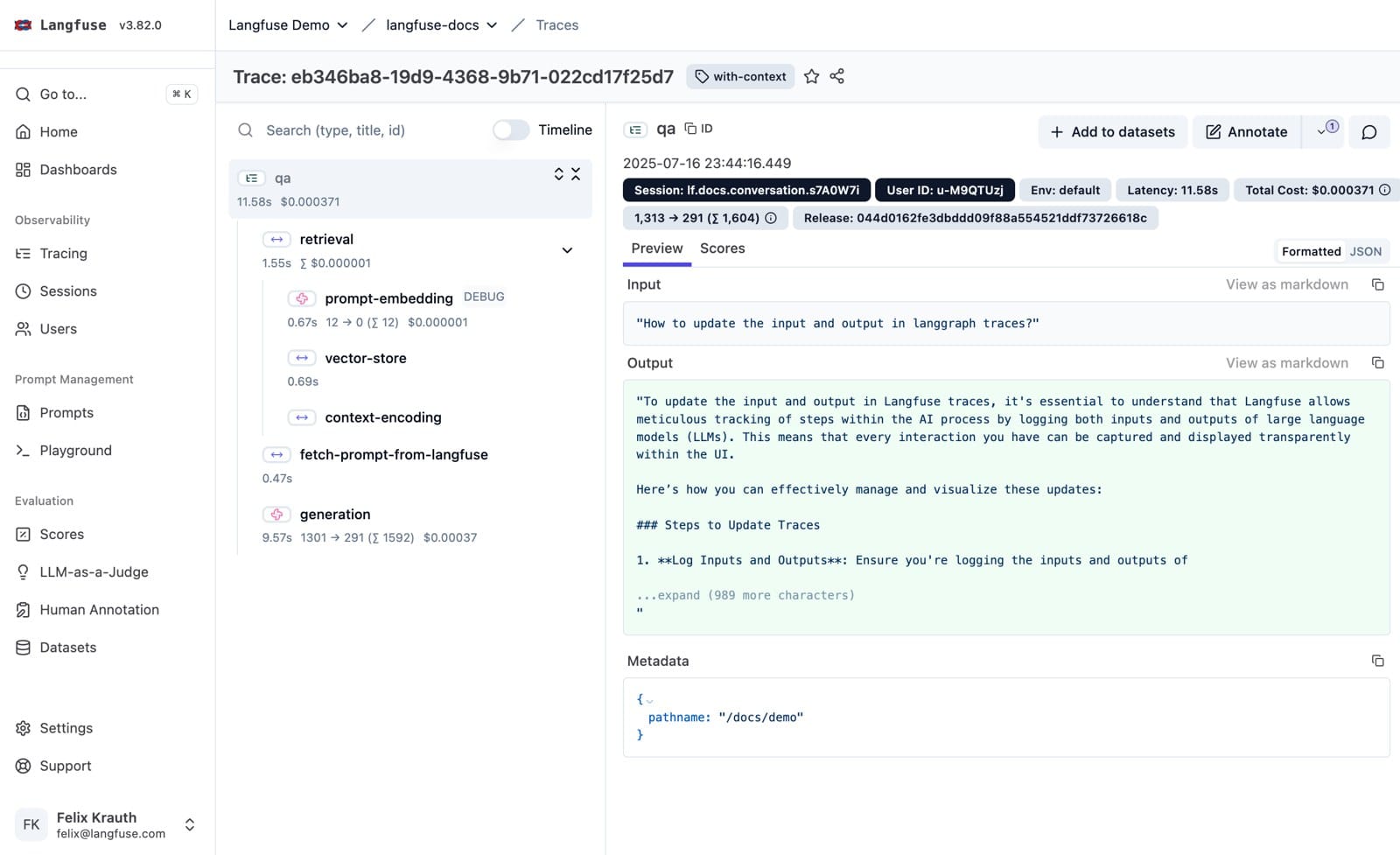
Langfuse is an open-source LLM engineering platform covering tracing, evaluation, and prompt management, available both as a self-hosted deployment and a managed cloud service. Its tracing view captures the full call tree of an LLM application — prompts, completions, retrieved context, and nested tool calls — in a single dashboard, layered with evaluators and prompt-version tracking. Because the full stack is open-source, teams that need complete data control can self-host rather than send production traffic to a third-party cloud.
Best for: Teams that want open-source flexibility — self-host for full data control, or use the managed cloud — without locking into a specific agent framework.
Pros:
Genuine open-source self-hosting option, appealing to teams with data-residency requirements. Tracing, evaluation, and prompt management combined in one platform. Framework-agnostic rather than tied to a specific agent library. Active open-source community reduces vendor lock-in risk.
Cons:
Self-hosting the full platform, versus using the managed cloud, requires real infrastructure investment and ongoing maintenance. Third-party feature comparisons note its user-tracking and segmentation tooling as comparatively lighter than some competitors'. As a smaller, independent company relative to the cloud-hyperscaler-backed competitors on this list, enterprise buyers weighing long-term vendor durability should factor that in.
3. Arize AI (Phoenix)
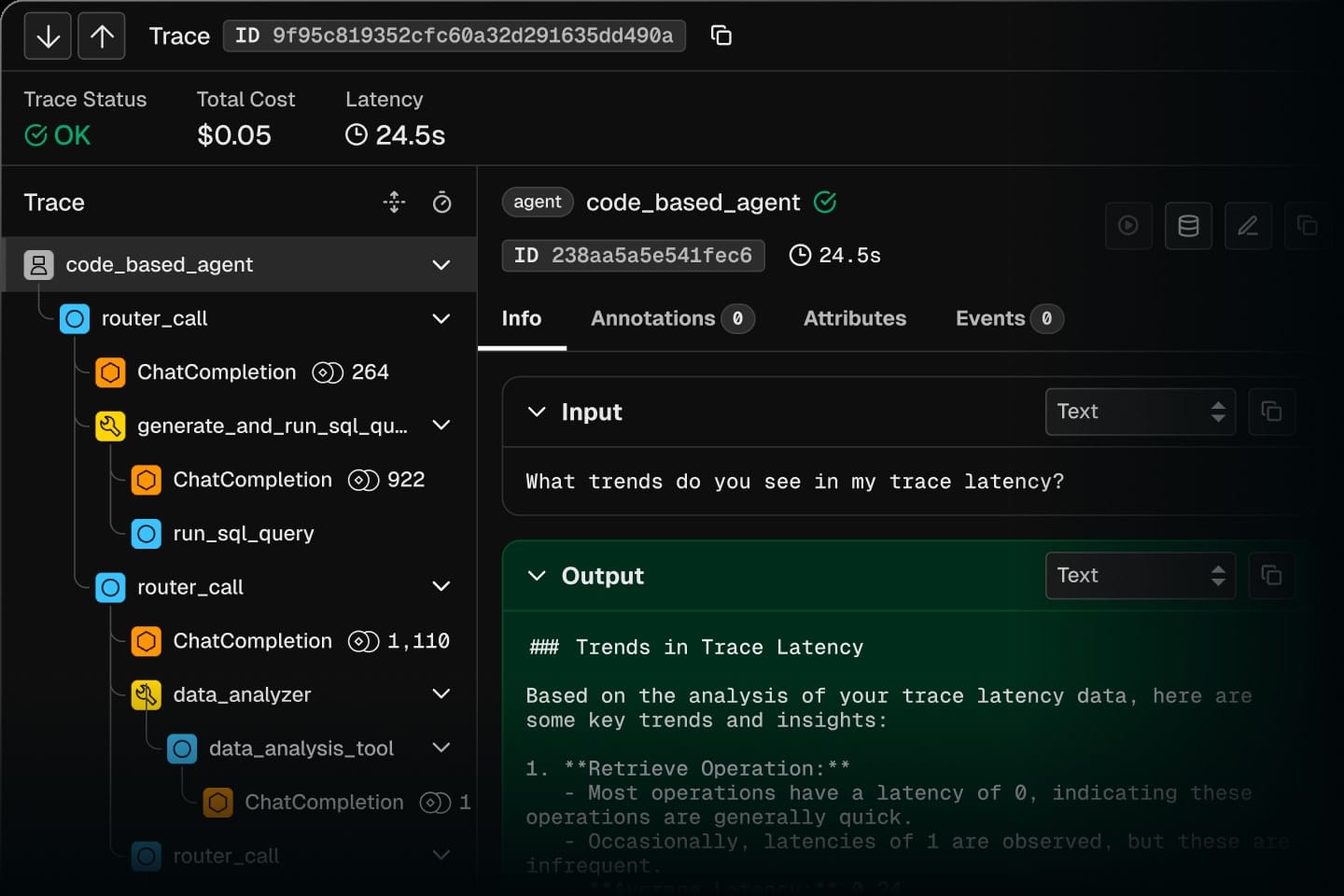
Arize offers both a commercial AI observability platform and Phoenix, its open-source counterpart built on OpenTelemetry. Phoenix focuses on tracing, evaluation, and experimentation for LLM applications and agents, and can be self-hosted or run through Arize's cloud. Because it's OpenTelemetry-native, Phoenix traces are portable across other OTel-compatible tooling rather than locked into a single proprietary format.
Best for: Teams that want an open-source, OpenTelemetry-native observability layer with a clear path to a commercial platform if they outgrow self-hosting.
Pros:
OpenTelemetry-native design means traces aren't locked into a proprietary format. Genuine open-source option (Phoenix) alongside a commercial platform (Arize AI) for teams that outgrow self-hosting. Strong focus on evaluation and experimentation, not just passive trace viewing. Backed by a company with a longer track record in ML observability generally, not only LLMs.
Cons:
Running two related but distinct products — open-source Phoenix and the commercial Arize AI platform — can create ambiguity about which capabilities live where. The broader Arize platform's roots in traditional ML monitoring mean some LLM-specific agent-tracing features are newer additions rather than the product's original core. Smaller ecosystem of pre-built framework integrations than LangSmith's LangChain-native tooling.
4. Helicone
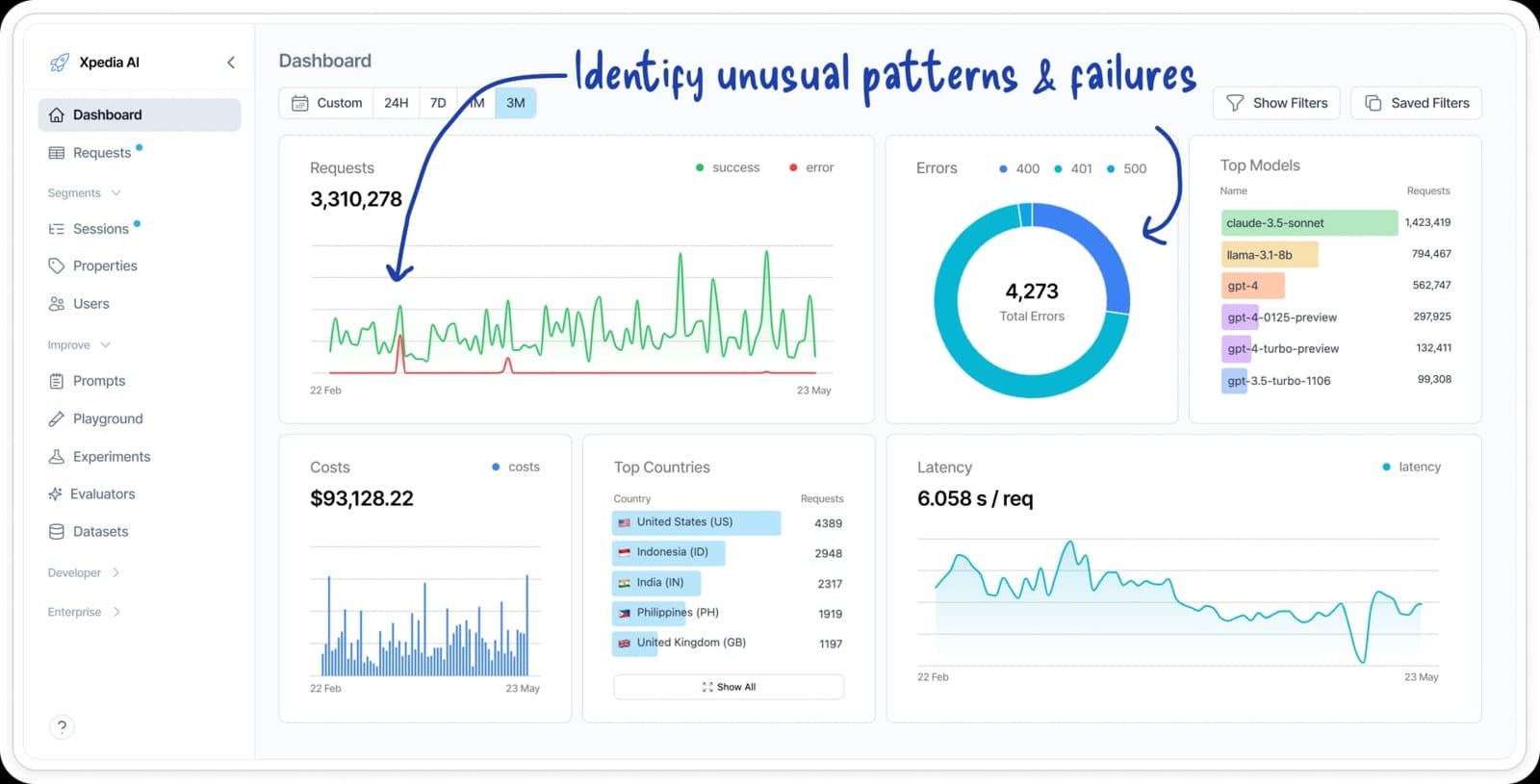
Helicone combines an LLM gateway with observability: point your OpenAI, Anthropic, or other provider calls at Helicone's proxy or SDK, and get request logging, cost tracking, caching, and analytics with a one-line integration change. It layers in prompt experimentation, custom properties for segmenting traffic, real-time Slack or email alerts, and built-in prompt-injection detection powered by Meta's security models. Pricing is fully published: a free Hobby tier (10,000 requests/month, 1 seat, 7-day retention), Pro at $79/month (unlimited seats, alerts, its HQL query language, plus usage-based overage), Team at $799/month (SOC 2 and HIPAA compliance, 5 organizations), and custom Enterprise pricing with on-prem deployment and SAML SSO.
Best for: Teams that want gateway-level caching and cost control bundled with observability, with transparent, published pricing.
Pros:
Pricing is fully published and easy to model, unlike several competitors that require a sales conversation. Combines a caching and routing gateway with observability rather than treating them as separate products. Open-source with a large public GitHub following. Built-in prompt-injection security scanning is a genuine differentiator versus pure-observability tools.
Cons:
The free Hobby tier's ingestion cap (10 logs/minute) is restrictive for anything beyond light testing. Helicone's own published comparison table rates its prompt and dataset/evaluation tooling as less developed than LangSmith's or Langfuse's. Being gateway-first means teams that already run a separate LLM gateway may find some functionality redundant.
5. Braintrust
Braintrust pairs production agent observability tightly with evaluation: every request becomes a tree of traced spans — LLM calls, tool invocations, retrieval steps — and the same scorers used in offline evaluation experiments can run automatically on live production traffic, scoring dimensions like factuality, helpfulness, and safety in real time. It offers two integration paths: SDK-based auto-instrumentation for supported providers and frameworks, or routing through Braintrust's own gateway for a one-line integration across OpenAI, Anthropic, Google, and other providers. Braintrust's site cites Vercel, Browserbase, and Retool among its customers.
Best for: Teams that want the same evaluation scorers running in both offline experiments and live production traffic, rather than two disconnected systems.
Pros:
Unifies offline evaluation and online production scoring under one set of scorers, closing the common gap between how a system was tested and how it behaves live. Two integration paths — SDK or gateway — fit different existing architectures. Named enterprise customers (Vercel, Browserbase, Retool) suggest real production usage at scale. Dashboards are built for both engineering and leadership audiences out of the box.
Cons:
The tight coupling of evaluation and observability is a strength for teams that want both, but less natural for a team that only wants lightweight tracing without adopting Braintrust's evaluation framework. Smaller standalone brand recognition than LangSmith or Weights & Biases among general engineering teams. The gateway integration path, while simple, still means routing production LLM traffic through a third-party endpoint.
6. Weights & Biases Weave
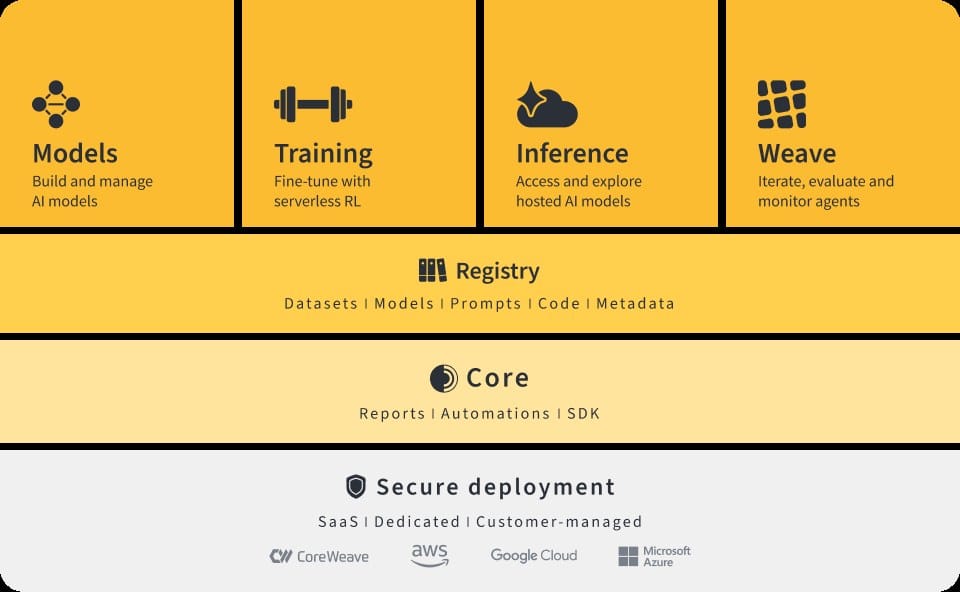
Weave is Weights & Biases' product layer purpose-built for LLM application observability, evaluation, and governance, built on top of the broader W&B platform that many ML teams already use for experiment tracking. It provides monitoring and signals, agent-native tracing, a dedicated evaluation framework, guardrails, leaderboards for comparing models and prompts, and an MCP-server integration that lets agents query Weave's own observability data to iterate autonomously. Because Weave sits inside W&B's existing pricing structure rather than as a fully separate product, teams already using W&B for model training can adopt it without a new vendor relationship.
Best for: Teams already using Weights & Biases for ML experiment tracking who want LLM observability inside the same platform rather than adding a new vendor.
Pros:
No new vendor relationship needed for teams already on W&B for training and experiment tracking. Agent-native tracing plus a dedicated evaluation framework and guardrails in one product. Leaderboards make model and prompt comparison a first-class, visual workflow. MCP-server integration lets agents query their own observability data programmatically.
Cons:
Because Weave's pricing and plans are folded into W&B's broader structure rather than sold standalone, teams that don't already use W&B end up adopting a larger platform than they may need. The free tier's data-ingestion limits are modest compared with some open-source-first competitors here. Weave's LLM-specific feature set is younger than W&B's core ML-training tooling, so some capabilities are newer and less battle-tested than the company's traditional strengths.
7. TrueFoundry (Tracing)
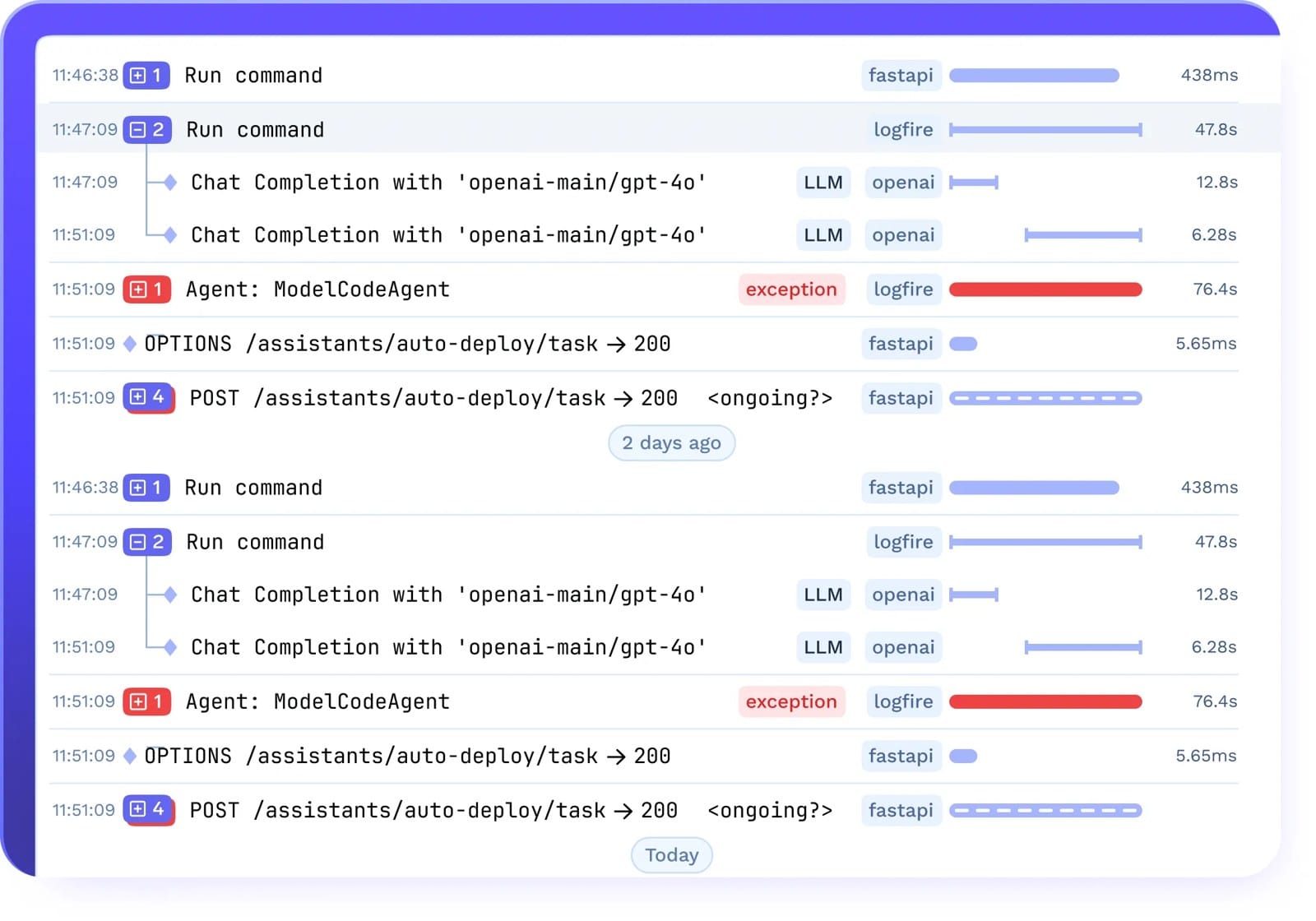
TrueFoundry's Tracing product is one part of a broader AI Gateway and LLMOps platform, built on OpenTelemetry, aimed at end-to-end observability for LLM-powered APIs, RAG pipelines, and multi-agent systems. It auto-instruments LLM calls, tool invocations, and workflow branching, captures agent-to-agent handoffs and delegation in multi-agent setups, and ships an OpenTelemetry collector backend with a UI for filtering and querying spans. TrueFoundry markets Tracing specifically toward regulated enterprises, offering VPC, on-prem, and air-gapped deployment so trace data never has to leave the customer's own environment, alongside SOC 2, HIPAA, and GDPR compliance claims and integrations for LangGraph, CrewAI, Agno, and other agent frameworks.
Best for: Enterprises that need tracing deployed inside their own VPC or air-gapped environment as part of a broader AI gateway and LLMOps platform, rather than as a standalone SaaS tool.
Pros:
Genuine on-prem and air-gapped deployment option, which none of the open-source-first tools here offer as a first-class enterprise product. OpenTelemetry-native, so traces aren't locked into a proprietary format. Bundled with TrueFoundry's broader AI Gateway, so routing, tracing, and guardrails can share one control plane instead of stitching together separate tools. Framework coverage spans LangGraph, CrewAI, Agno, and more.
Cons:
TrueFoundry does not publish self-serve pricing for Tracing on its site — evaluating cost requires booking a demo, unlike Helicone's or Langfuse's published tiers. Tracing is positioned as one module inside a larger gateway and LLMOps platform rather than a focused, standalone observability product, so teams that only want tracing may end up evaluating a bigger platform than they need. Its evaluation and scoring layer is less prominent in its own marketing than the dedicated eval-and-observability focus of Braintrust or LangSmith.
How to choose
If you're already deep in the LangChain or LangGraph ecosystem, start with LangSmith — the framework-native integration is hard to replicate elsewhere. If data control or self-hosting matters, Langfuse and Arize's Phoenix are the two genuine open-source options, with Phoenix's OpenTelemetry-native design giving you the most portable traces. If you want gateway-level caching and cost control bundled with observability and prefer pricing you can model without a sales call, Helicone is the clearest fit. Teams that want the same scorers running in offline tests and live production should look at Braintrust first. If you're already running Weights & Biases for model training, Weave lets you add LLM observability without a new vendor relationship. And if the hard requirement is on-prem or air-gapped deployment as part of a broader AI gateway rather than a standalone tool, TrueFoundry's Tracing is the most purpose-built option among these seven — though you'll need to book a demo to get pricing.
FAQ
What's the difference between LLM tracing and traditional APM?
Traditional application performance monitoring tracks uptime, latency, and error rates for deterministic code. LLM tracing captures the non-deterministic parts specific to AI systems — prompts, retrieved context, tool calls, token usage, and model reasoning steps — as a structured span tree, which is what lets you debug why a model produced a particular answer rather than just that a request was slow.
Which of these tools is open-source?
Langfuse and Arize's Phoenix are both open-source with self-hosting options, and Helicone is open-source as well. LangSmith, Braintrust, Weave, and TrueFoundry's Tracing are primarily offered as commercial products.
Which tool is best if I need on-prem or air-gapped deployment?
TrueFoundry's Tracing is the most explicitly built for VPC, on-prem, and air-gapped deployment among these seven, marketed specifically at regulated enterprises. Langfuse's open-source self-hosting option is also viable for teams with the infrastructure capacity to run and maintain it themselves.
Can I use the same tool for both testing/evaluation and live production monitoring?
Braintrust is built specifically around that connection — the same scorers used offline can run on live traffic. LangSmith and Langfuse also combine evaluation and monitoring, with different emphases on framework integration versus open-source flexibility.
Do I need to change my LLM provider's base URL to use these tools?
Helicone and Braintrust both offer a gateway path where you point your existing OpenAI or Anthropic client at their endpoint for a one-line integration. Langfuse, LangSmith, Arize/Phoenix, and Weave primarily use SDK-based instrumentation instead, which doesn't require changing your base URL. TrueFoundry's Tracing uses auto-instrumentation and an OpenTelemetry collector rather than a gateway swap.
Editor's note — sources: LangSmith observability page, Langfuse documentation, Arize Phoenix product page, Helicone pricing page, Helicone observability blog, Braintrust Observe product page, Weights & Biases Weave page, TrueFoundry Tracing product page.