
Top 7 Backend-as-a-Service (BaaS) Platforms for 2026
A skeptical, sourced comparison of the seven leading backend-as-a-service (BaaS) platforms and Firebase alternatives in 2026 - Supabase, Firebase, AWS Amplify, Appwrite, Convex, PocketBase and Nhost - with verified pricing, licenses and honest pros and cons for each.


A backend-as-a-service (BaaS) gives you a ready-made backend — database, authentication, storage, and serverless functions — behind an API, so you ship an app without running servers. In 2026 the leading options are Supabase, Firebase, AWS Amplify, Appwrite, Convex, PocketBase, and Nhost. The split that matters most: Firebase and Amplify are proprietary managed services, while Supabase, Appwrite, PocketBase, Nhost, and Convex can be self-hosted — the core reason most "Firebase alternatives" searches end on this list.
TL;DR
- Best open-source Firebase alternative: Supabase — Postgres with row-level security, self-hostable, Pro from $25/mo.
- Most mature managed BaaS: Firebase — zero-ops, deep Google Cloud integration, free Spark tier then pay-as-you-go Blaze.
- Lightest self-host: PocketBase — a single Go binary over SQLite, MIT-licensed, free.
- Watch the billing model: Firebase and Amplify bill per-usage across many services, which is hard to predict; most open-source options charge a flat $25/mo tier plus metered egress.
What is a backend-as-a-service?
A backend-as-a-service is a platform that provides the common backend building blocks — a database, user authentication, file storage, and functions — as managed, API-accessible services. You connect a web or mobile front end and skip building and operating that backend yourself.
The appeal is speed: auth, data, and storage work on day one. The trade-offs are vendor lock-in (for proprietary options), query limits (for NoSQL-based services), and usage-based bills that can climb at scale. Open-source BaaS tools answer the lock-in concern by letting you self-host the same stack.
We ranked these seven by maturity, adoption, capability, and fit — not alphabetically, and with no sponsored placement.
How we picked these
- Maturity and adoption: production track record, community size, and public GitHub or customer signals where disclosed.
- Capability: database model, auth, storage, functions, realtime, and how complete the stack is out of the box.
- Deployment honesty: whether you can genuinely self-host, and the exact license.
- Pricing transparency: published prices beat "contact sales," and we flag usage-based billing that is hard to forecast.
- Fit: each gets a one-line "best for" to match it to your project.
Quick comparison
| Platform | Best for | Deployment | Pricing model (Oct 2026) |
|---|---|---|---|
| Supabase | Postgres + open source | Managed + self-host (Apache-2.0) | Free, Pro $25/mo, Team $599/mo |
| Firebase | Google-stack, zero-ops mobile | Managed (proprietary) | Spark free, Blaze pay-as-you-go |
| AWS Amplify | Teams already on AWS | Managed (AWS services) | Pay-as-you-go, no minimum |
| Appwrite | Self-hosted, multi-language | Managed + self-host (BSD-3) | Free, Pro $25/mo, Scale/Enterprise |
| Convex | Reactive/realtime TypeScript apps | Managed + self-host (FSL) | Free, Pro $25/dev/mo, Business $2,500/mo |
| PocketBase | Solo devs, small self-hosted apps | Self-host only (MIT) | Free (self-host) |
| Nhost | GraphQL-first on Postgres | Managed + self-host (MIT) | Free, Pro $25/mo, Team $599/mo |
1. Supabase
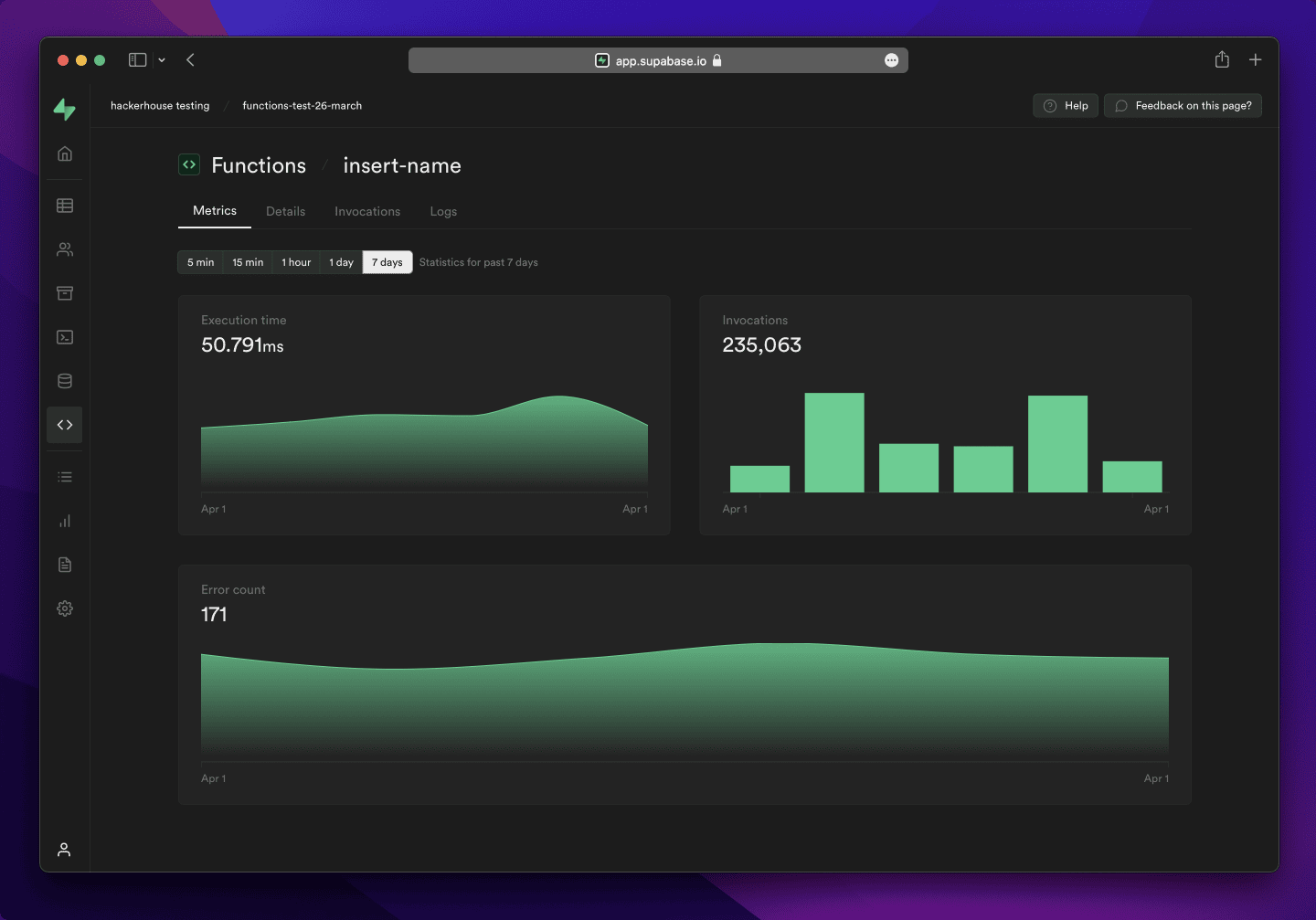
Supabase is the open-source Firebase alternative most teams reach for. It is built on PostgreSQL, with auto-generated REST and GraphQL APIs (via PostgREST), Postgres row-level security for authorization, realtime over logical replication, authentication, storage, Deno-based edge functions, and pgvector for AI embeddings. You can use the managed cloud or self-host the whole stack; the repo is Apache-2.0.
Supabase has raised quickly: a $200M Series D at a $2B valuation in April 2025, then a $100M Series E at a $5B valuation in October 2025.
Best for: developers who want relational SQL, open source, and a path off Firebase.
Pros
- Open source under Apache-2.0 and fully self-hostable — no proprietary lock-in.
- Real Postgres with row-level security, SQL, and extensions including pgvector.
- Auto-generated REST and GraphQL APIs plus realtime straight from your schema.
Cons
- Self-hosting the full stack (several services) is operationally heavier than the managed option.
- Egress and compute add-ons can lift the real bill above the $25/mo Pro headline.
- Edge functions and some managed features are less battle-tested than Firebase's.
2. Firebase
Firebase is Google's managed BaaS and the benchmark every alternative is measured against. It offers NoSQL document stores (Cloud Firestore and the legacy Realtime Database), realtime listeners with offline sync, Firebase Auth, Cloud Storage, Cloud Functions, hosting, messaging, and Crashlytics. In 2025 Google added Data Connect (a GraphQL layer over Cloud SQL Postgres, GA in April 2025), its move toward relational data. The core backend is proprietary and cannot be self-hosted.
Best for: mobile and web teams that want a zero-ops, Google-managed backend.
Pros
- Fully managed and zero-ops, with deep Google Cloud, Auth, messaging, and Crashlytics integration.
- Strong offline sync and realtime out of the box.
- Generous free Spark tier and a large ecosystem and documentation base.
Cons
- Vendor lock-in to Google; proprietary with no self-host.
- Firestore's NoSQL model has query limits — no native joins, limited aggregation, and composite-index management.
- Blaze pay-as-you-go billing (per read/write plus egress) can scale unpredictably.
3. AWS Amplify
AWS Amplify is Amazon's full-stack framework and hosting that provisions a backend from AWS primitives: Cognito for auth, AppSync (GraphQL) or API Gateway, DynamoDB for data, Lambda for functions, and S3 for storage. Amplify Gen 2 uses a TypeScript, code-first backend definition and bundles CI/CD hosting for web and server-rendered apps. The core services are proprietary AWS; the client libraries and CLI are Apache-2.0.
Best for: teams already standardized on AWS that want a managed full-stack with hosting.
Pros
- Deep AWS integration — Cognito, AppSync, DynamoDB, Lambda, and S3 under one framework.
- Pay-as-you-go with no per-seat or team fee, scaling on AWS infrastructure.
- Gen 2's code-first TypeScript backend plus built-in CI/CD hosting, including server-side rendering.
Cons
- Strong vendor lock-in to AWS; the backend is not portable or self-hostable.
- Cost is fragmented across many AWS services (build minutes, egress, SSR, WAF), making bills hard to predict.
- Steeper learning curve, and the Gen 1 to Gen 2 transition has caused migration friction.

4. Appwrite
Appwrite is a self-host-first open-source BaaS. It bundles a document database (backed by MariaDB), authentication with 30-plus OAuth methods, storage, multi-runtime functions (Node, PHP, Python, Dart, and more), realtime, messaging, and web hosting through Appwrite Sites, all behind first-party SDKs in many languages. Run it with Docker or use Appwrite Cloud; the repo is BSD-3-Clause.
In September 2025 Appwrite moved its Pro plan from per-seat to per-project billing.
Best for: teams wanting a self-hostable, language-agnostic Firebase alternative with broad SDK coverage.
Pros
- Open source (BSD-3) with Docker self-hosting in minutes.
- Very broad official SDK coverage and multi-runtime functions.
- Unified auth, database, storage, functions, messaging, and sites in one console.
Cons
- The document database runs on MariaDB — not full relational SQL with joins like Postgres-based rivals.
- Per-project billing ($25/mo Pro plus $15 per extra project) adds up for multi-project setups.
- A smaller third-party integration ecosystem than Firebase or Supabase.
5. Convex
Convex is a reactive backend and sync engine. Its document-relational database runs backend logic as transactional TypeScript functions, and clients subscribe so the UI auto-updates when underlying data changes — no manual cache invalidation or realtime wiring. It bundles scheduling, workflows, full-text and vector search, and file storage, and markets itself for AI-agent backends. The self-hostable core is released under the Functional Source License (FSL), which converts to Apache-2.0 after two years.
Convex announced a $57M Series B led by Insight Partners in August 2026, bringing total funding to about $110M. No valuation was disclosed.
Best for: TypeScript developers building realtime or collaborative apps and AI-agent backends.
Pros
- End-to-end reactive sync engine — queries auto-update, with no manual realtime or cache code.
- Transactional TypeScript functions and a typed database, with search, scheduling, and file storage built in.
- Open-core and self-hostable, with a future Apache-2.0 grant.
Cons
- FSL is source-available with a roughly two-year commercial-use restriction — not OSI open source, which some organizations will reject.
- An opinionated model (TypeScript-function access, no raw SQL) means lock-in to Convex's paradigm.
- A younger, smaller ecosystem, and per-developer plus usage pricing can climb for larger teams.
6. PocketBase
PocketBase is a backend in a single Go binary over embedded SQLite. One executable bundles realtime subscriptions, authentication (email and OAuth), file storage, and an admin dashboard, with no external database or services to run. You can also use it as a Go framework. It is MIT-licensed and self-host only — there is no official managed cloud.
As of October 2026 PocketBase is still pre-1.0 (the v0.x line), so its API can change between minor versions.
Best for: solo developers and small apps that want one portable, self-hosted file.
Pros
- A single self-contained Go binary plus SQLite — trivial to deploy, with no infrastructure.
- Open source under MIT, and embeddable as a Go framework.
- Realtime, auth, storage, and an admin UI built in, with zero external dependencies.
Cons
- SQLite is single-node, so horizontal scaling and high-concurrency writes are limited.
- Still pre-1.0, with possible breaking changes and a small maintainer team.
- No first-party managed hosting — you own ops, backups, and scaling.
7. Nhost
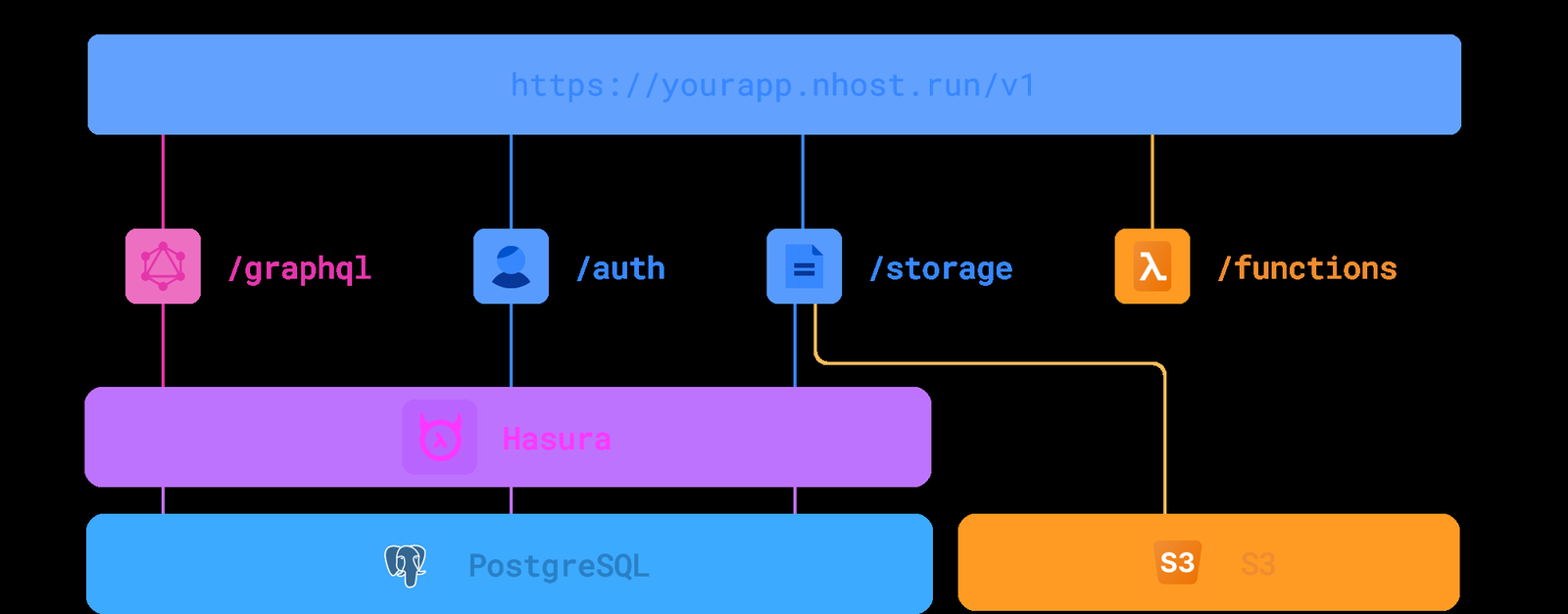
Nhost is an open-source backend built on PostgreSQL plus the Hasura GraphQL engine. It gives you an instant GraphQL API over your schema, authentication, storage, serverless JavaScript/TypeScript functions, realtime GraphQL subscriptions, and infrastructure-as-code. Use the managed cloud or self-host; the Nhost repo is MIT and the underlying Hasura engine is Apache-2.0.
Best for: teams that want a GraphQL-first backend on a Postgres foundation.
Pros
- Instant GraphQL API over Postgres via Hasura, with realtime subscriptions.
- Open source under MIT, self-hostable, with infrastructure-as-code.
- A Postgres relational foundation plus built-in auth, storage, and functions.
Cons
- GraphQL-centric — less ideal if you want plain REST or SQL-first access.
- A smaller company, community, and ecosystem than Supabase or Appwrite, which raises longevity risk.
- Tightly tied to Hasura, so your stack inherits Hasura's roadmap and changes.
How to choose a backend-as-a-service
Decide on lock-in first, because it narrows the list fast.
If you want to avoid proprietary lock-in or need to self-host, choose Supabase, Appwrite, PocketBase, or Nhost. Supabase is the default for Postgres and the broadest feature set; PocketBase is unbeatable for a single-file, small-scale self-host; Appwrite suits language-agnostic teams; Nhost fits GraphQL-first projects. Note that Convex is source-available under FSL rather than OSI open source.
If you want fully managed and zero-ops, Firebase is the most mature choice for mobile and Google-stack teams, and Amplify is the natural fit if you already live in AWS. In both cases, model your usage carefully — per-read, per-write, egress, and build charges are where the bill surprises teams.
If realtime is the core requirement, Convex's reactive sync engine removes the most wiring, while Supabase and Firebase both offer solid realtime with more conventional models.
A BaaS usually sits next to other data and identity infrastructure. See our guides to NoSQL databases, vector databases for AI and RAG, and identity and access management solutions for the adjacent layers.
Frequently Asked Questions
What is a backend-as-a-service (BaaS)?
A backend-as-a-service is a platform that provides managed backend building blocks — database, authentication, storage, and serverless functions — behind an API. You connect a front end and avoid building or running the backend yourself. Firebase, Supabase, and Appwrite are common examples used for web and mobile apps.
What are the best Firebase alternatives?
Supabase is the most popular Firebase alternative, offering Postgres, open source, and self-hosting. Appwrite and Nhost are strong self-hostable options, PocketBase suits small self-hosted apps, and Convex targets realtime TypeScript apps. AWS Amplify is the alternative for teams already committed to the AWS ecosystem.
Is Supabase a backend-as-a-service?
Yes. Supabase is an open-source backend-as-a-service built on PostgreSQL. It provides a database, authentication, storage, realtime, edge functions, and auto-generated APIs, the same category of building blocks as Firebase. Unlike Firebase, Supabase is Apache-2.0 licensed and can be self-hosted as well as used on its managed cloud.
Can you self-host a backend-as-a-service?
Some you can, some you cannot. Supabase, Appwrite, PocketBase, and Nhost are open source and fully self-hostable, and Convex offers a source-available self-hostable core under the FSL. Firebase and the core of AWS Amplify are proprietary managed services and cannot be self-hosted, though both ship open-source client libraries.
Is a BaaS cheaper than building your own backend?
Early on, usually yes — a BaaS removes the cost of building and operating auth, storage, and a database. At scale the answer depends on usage. Proprietary pay-as-you-go services (Firebase, Amplify) can become expensive and hard to predict, while self-hosting an open-source BaaS trades that metered bill for infrastructure and maintenance effort.
Editor's note — sources: Pricing, licensing, and ownership facts were verified on October 23, 2026 against each vendor's official site and pricing pages (Supabase, Firebase, AWS Amplify, Appwrite, Convex, PocketBase, Nhost). Supabase funding is per reporting on its Series D (April 2025, $2B) and Series E (October 2025, $5B). Convex's August 2026 Series B is per the company's disclosure. Firebase Data Connect GA is per the Firebase blog. Prices and features are current as of October 2026 and change over time.