
Top 7 Data Governance Tools in 2026
For data leaders choosing a governance platform in 2026: Collibra, Microsoft Purview, Informatica, Alation, Atlan, Unity Catalog and DataHub, compared on coverage, deployment and cost.


For data leaders choosing a governance platform in 2026. The category has stopped being about cataloging tables and started being about supplying context to AI agents — and the vendor list has consolidated hard.
The leading data governance tools in 2026 are Collibra, Microsoft Purview, Informatica, Alation, Atlan, Databricks Unity Catalog and DataHub. Enterprise suites (Collibra, Informatica) cover policy, lineage, quality and privacy in one platform. Catalog-first tools (Alation, Atlan) win on usability and metadata activation. Purview and Unity Catalog are the native options if you already live in Microsoft or Databricks. DataHub is the open-source default.
Two things changed the shortlist this year. Salesforce closed its acquisition of Informatica in November 2025, putting one of the oldest names in data management under new ownership. And nearly every vendor rewrote its positioning around AI agents — Collibra now calls itself an "enterprise AI control plane," Atlan a "context layer for AI." Read past the renaming: the underlying products are still catalogs, lineage graphs and policy engines.
How we picked these
Selection criteria, applied in this order:
- Governance breadth. Does it do policy, lineage, quality and access — or just search-and-browse? A catalog alone is not governance.
- Verifiable enterprise adoption. Published customer counts, analyst placements, or a large public user base. Not vendor adjectives.
- Deployment honesty. Self-hosted, SaaS-only, or open source, stated plainly.
- Connector coverage across warehouses, lakehouses, BI tools and pipelines.
- Pricing transparency. Almost nobody in this category publishes list prices. Where a real published price exists, we say so; where it doesn't, we say "on request" rather than guessing.
Ranking runs roughly from broadest enterprise governance coverage to narrowest/most specialised. It is not a quality ladder — #6 and #7 are the right answer for a lot of teams, and the "How to choose" section below maps situations to picks. All pricing and feature claims are as of September 2026.
Quick comparison
| Platform | Best for | Deployment | Pricing model |
|---|---|---|---|
| Collibra | Regulated enterprises needing one governance system of record | SaaS (also self-managed) | On request |
| Microsoft Purview | Estates already standardised on Microsoft 365 and Azure | SaaS | Pay-as-you-go meters |
| Informatica | Teams that need governance plus MDM and data quality | SaaS (IDMC) | On request |
| Alation | Analyst-heavy orgs where adoption is the hard part | SaaS, self-hosted available | On request |
| Atlan | Modern cloud stacks wanting metadata to drive automation | SaaS | On request |
| Databricks Unity Catalog | Lakehouse governance at the table and model layer | Managed in Databricks; OSS self-hosted | Included with Databricks; OSS free |
| DataHub | Engineering teams that want to own the deployment | Self-hosted OSS; managed cloud | Free (Apache 2.0); cloud on request |
1. Collibra
Collibra is the most complete governance suite on this list, and the one most often bought by banks, insurers and government agencies that need an auditable system of record. Founded in 2008 with dual headquarters in Brussels and New York, it sells a modular platform: Data Catalog, Data Governance, Data Lineage, Data Quality & Observability, Data Privacy, Data Access and Data Marketplace, plus a newer AI Command Center aimed at governing agents in production.
The company says it serves more than 700 customers, including 78 of the Fortune 500, and governs over 2 billion assets. In July 2025 it acquired Deasy Labs, a Y Combinator-backed startup founded in 2023 that automatically discovers taxonomies in unstructured files and enriches them with metadata — an attempt to bring contracts, transcripts and PDFs under the same governance umbrella as warehouse tables. Collibra also ships an MCP server, letting agents query governed metadata directly.
Its last disclosed round was a $250 million Series G at a $5.25 billion valuation, led by Sequoia Capital Global Equities and Sofina — but that was November 2021, and the company has not published a valuation since.

Best for: regulated enterprises that need one governance platform to satisfy auditors.
Pros
- Broadest functional coverage here: policy workflow, lineage, quality, privacy and access in one product line
- Deep workflow engine for stewardship approvals and change management, which is what regulated industries actually buy
- Published adoption figures (700+ customers, 78 of the Fortune 500) rather than vague claims
- Unstructured-data enrichment via the Deasy Labs acquisition, an area most catalog vendors still ignore
Cons
- No published pricing, and it has a reputation as the most expensive option in the category
- Implementation is heavy — the workflow depth that regulated buyers want is overhead for a 40-person data team
- Modular packaging means the quote you get may not include quality, privacy or lineage
- Last public valuation is from November 2021, so current financial standing is not disclosed
2. Microsoft Purview
Microsoft Purview is the default answer if your data already sits in Microsoft 365, Fabric and Azure. It merged the old Azure Purview data-map product with Microsoft's compliance tooling, and now presents a Unified Catalog covering governance domains, data products, glossaries and critical data elements, alongside data loss prevention, insider risk and records management on the compliance side.
Purview is the only platform here with genuinely public pricing. Since 6 January 2025 it bills on a pay-as-you-go model with two meters: governed assets that you actively curate in Unified Catalog, and Data Governance Processing Units for compute-bound work like quality rules. Assets scanned into the Data Map without being curated are not billed under that model. Parts of the compliance suite are instead bundled into Microsoft 365 E5 licensing.
The catch is scope. Purview's coverage of non-Microsoft sources exists but is consistently thinner than the third-party catalogs, and the product has absorbed so many separate tools that navigating it is a recurring complaint.
Best for: organisations where the data estate is already Microsoft top to bottom.
Pros
- The only platform in this list with published, self-serve pricing you can model before talking to sales
- Scanning into the Data Map is free if you don't curate those assets in Unified Catalog
- Governance and compliance (DLP, insider risk, records) live in one portal instead of two vendors
- Included capability overlap with Microsoft 365 E5 licences many enterprises already hold
Cons
- Two-meter pay-as-you-go billing is hard to forecast; costs scale with curated assets and processing tier
- Connector depth outside Azure, Fabric and Microsoft 365 lags the dedicated catalog vendors
- The Purview brand now covers a sprawl of formerly separate products, and the portal reflects that
- SaaS only — no self-hosted option for teams with data-residency constraints Microsoft doesn't serve
3. Informatica
Informatica sells Cloud Data Governance and Catalog (CDGC) as part of its Intelligent Data Management Cloud. It is the pick when governance cannot be separated from master data management, data quality and integration — Informatica has been building those since the 1990s, and the lineage it can resolve through its own ETL jobs is more complete than a metadata scraper can manage.
The material change is ownership. Salesforce completed its acquisition of Informatica on 18 November 2025, folding the catalog, governance, quality, privacy, metadata management and MDM portfolio into Salesforce's data platform and pairing it with MuleSoft on the integration side. Salesforce has framed the rationale around giving AI agents a trusted data foundation.
For buyers, that acquisition is the central question. Roadmap priorities under a CRM parent are not the same as under an independent data-management vendor, and multi-year governance programmes are exactly the kind of purchase that ownership uncertainty complicates.
Best for: enterprises that need governance, MDM and data quality from the same vendor.
Pros
- MDM and data quality are first-party products, not partner integrations or acquisitions bolted on
- Lineage through Informatica's own integration jobs is more precise than parsing SQL after the fact
- Very large installed base and partner ecosystem in financial services, healthcare and the public sector
- Broad connector catalog built over three decades of enterprise integration work
Cons
- Ownership changed in November 2025; long-term roadmap under Salesforce is not yet demonstrated
- Pricing is on request and the IDMC consumption-unit model is widely described as hard to predict
- Historically the heaviest tooling in the category, with a steeper learning curve than the modern catalogs
- Buyers not already in the Salesforce ecosystem should weigh the integration pull that now comes with it
4. Alation
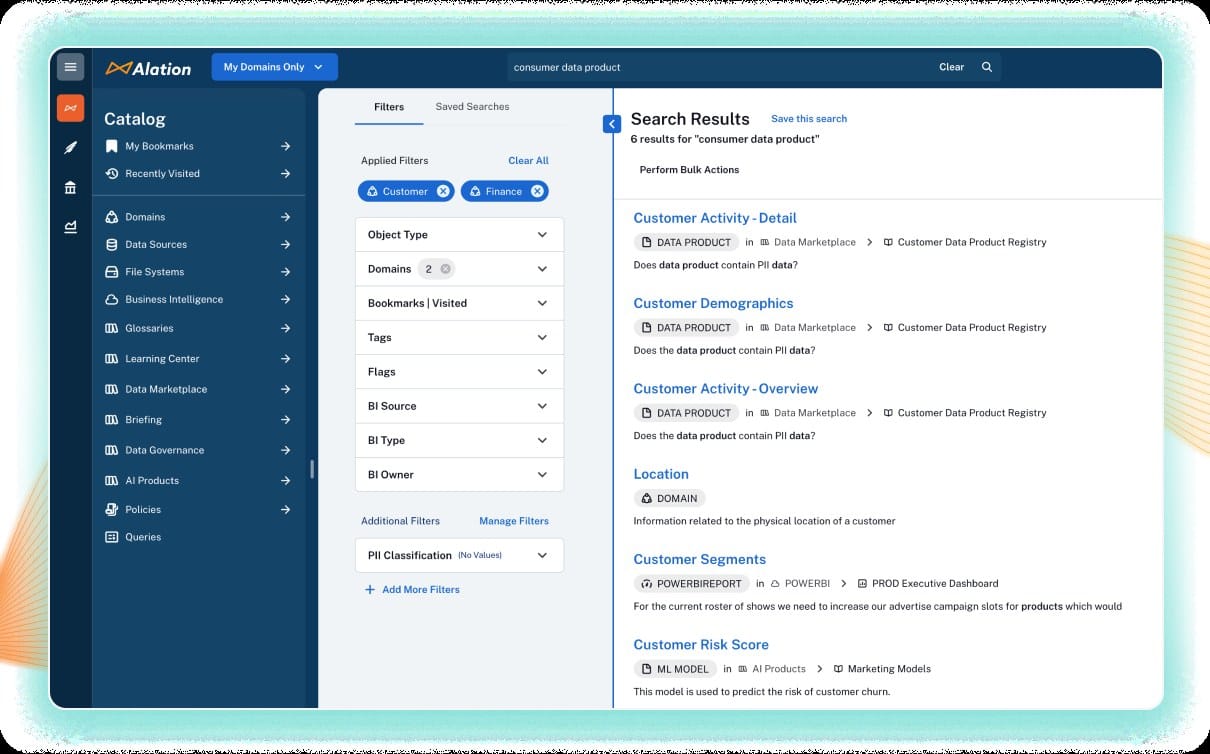
Alation popularised the modern data catalog and still leads on the thing that actually determines whether governance succeeds: whether analysts use it. Its behavioural approach watches query logs to work out which tables people genuinely rely on, then surfaces those first — so the catalog reflects real usage rather than what a steward remembered to document.
It raised a $123 million Series E in May 2025 led by Thoma Bravo with Sanabil Investments and Costanoa Ventures, and participation from Databricks Ventures, taking total funding to roughly $340 million at a valuation above $1.7 billion. It acquired Numbers Station, a Stanford-founded AI company, the same month. The platform now spans catalog, governance, lineage and data quality, with agent-oriented features layered on top.
Best for: organisations where analyst adoption, not policy definition, is the bottleneck.
Pros
- Behavioural analysis of query logs means the catalog ranks what people actually query
- Strongest user experience for non-engineer analysts, which drives the adoption governance depends on
- Well capitalised and independent after a $123M round, with Databricks Ventures on the cap table
- Both SaaS and customer-managed deployment options
Cons
- Policy enforcement and stewardship workflow are less deep than Collibra's; it started as a catalog
- Pricing is on request and sits at the enterprise end
- Behavioural indexing works best where SQL query logs are rich — weaker for unstructured or streaming data
- Data quality arrived later than at the suite vendors and is less mature
5. Atlan
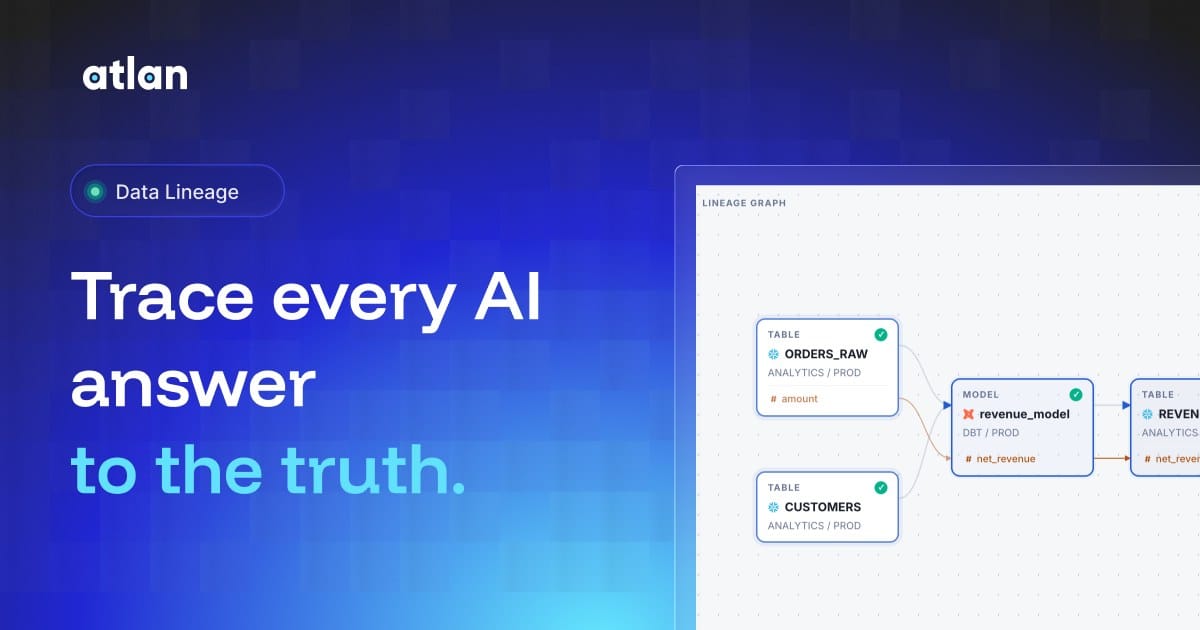
Atlan built the "active metadata" argument: metadata shouldn't just be documentation, it should trigger action — pushing lineage into Slack, failing a pipeline when a contract breaks, tagging PII downstream automatically. In 2026 the company repositioned around AI, describing itself as a context layer with an Enterprise Data Graph, Context Agents and a Context Engineering Studio. Underneath, it remains a connector-rich catalog with strong column-level lineage.
Atlan raised a $105 million Series C in May 2024 at a $750 million valuation, led by GIC with Meritech Capital, bringing total funding past $206 million. It names Cisco, Autodesk, Unilever, Ralph Lauren, FOX, News Corp, Nasdaq, Plaid and HubSpot as customers, and says it serves over 400 enterprises. It was placed as a Leader in the 2026 Gartner Magic Quadrant for Data and Analytics Governance and the Forrester Wave for Data Governance in Q3 2025.
Best for: cloud-native data teams that want metadata to drive automation, not just documentation.
Pros
- Column-level lineage and an open API surface designed for programmatic use
- Genuinely good integration into the tools teams work in, including Slack and Teams
- Named Leader in both the 2026 Gartner MQ for D&A Governance and the Q3 2025 Forrester Wave
- Fast release cadence and a modern interface that data teams adopt without much training
Cons
- The 2026 repositioning around "context" makes it harder to work out what you are actually buying
- Newest and smallest of the enterprise options here, with a shorter track record in heavily regulated deployments
- SaaS-only, which rules it out where self-hosting is mandatory
- Last disclosed valuation ($750M, May 2024) is well below Collibra's and the pricing is still enterprise-tier
6. Databricks Unity Catalog
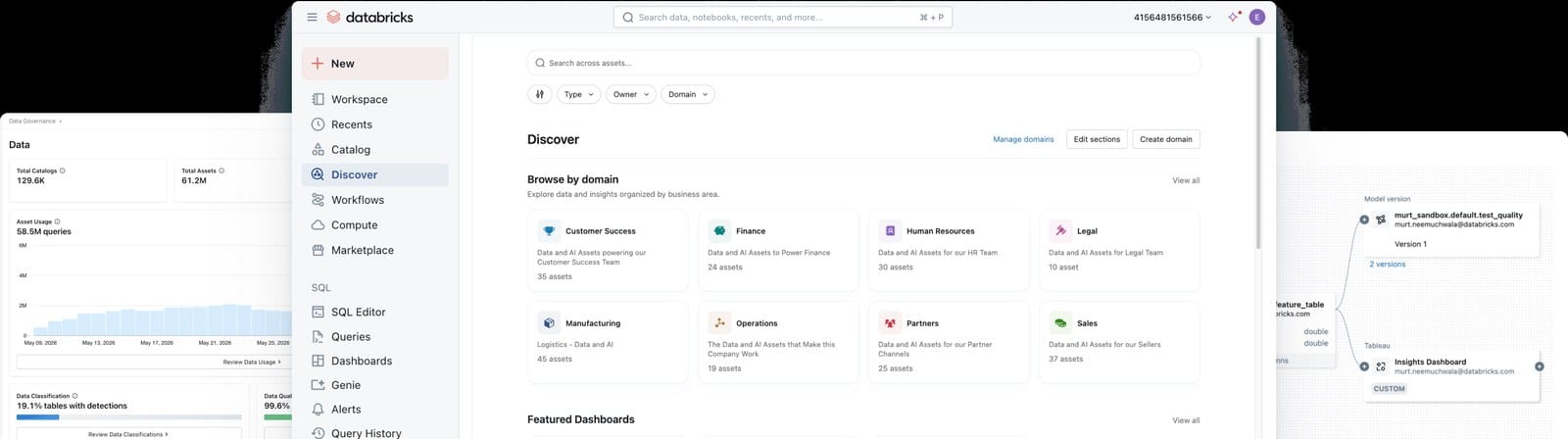
Databricks Unity Catalog governs a different layer than the catalogs above. Rather than indexing metadata across an estate, it is the permission and lineage authority for the lakehouse itself: tables, volumes, ML models and functions, with access control enforced at query time and lineage captured automatically as jobs run. If a user lacks grants, the query fails — a materially different guarantee from a catalog that documents who should have access.
Databricks open-sourced Unity Catalog in June 2024 under Apache 2.0, with the OSS project now hosted by the LF AI & Data Foundation at unitycatalog.io. It implements the Iceberg REST Catalog API, so Iceberg-compatible engines can read governed tables without going through Databricks compute, and added native Iceberg managed tables in 2025.
Best for: enforcing governance where the data physically lives, in a Databricks or Iceberg lakehouse.
Pros
- Enforces access at query time rather than documenting intent — governance that actually blocks
- Automatic column-level lineage captured from job execution, with no separate scanning step
- Apache 2.0 open source with an OpenAPI spec, server and clients, governed by LF AI & Data
- Iceberg REST Catalog support means non-Databricks engines can read the same governed tables
Cons
- Not a business-user catalog: no stewardship workflow, glossary depth or policy approval process
- The managed version is tied to Databricks; the OSS build is considerably less capable
- Coverage of sources outside the lakehouse is limited compared with a dedicated metadata platform
- Most organisations end up pairing it with one of the tools above rather than replacing them
7. DataHub
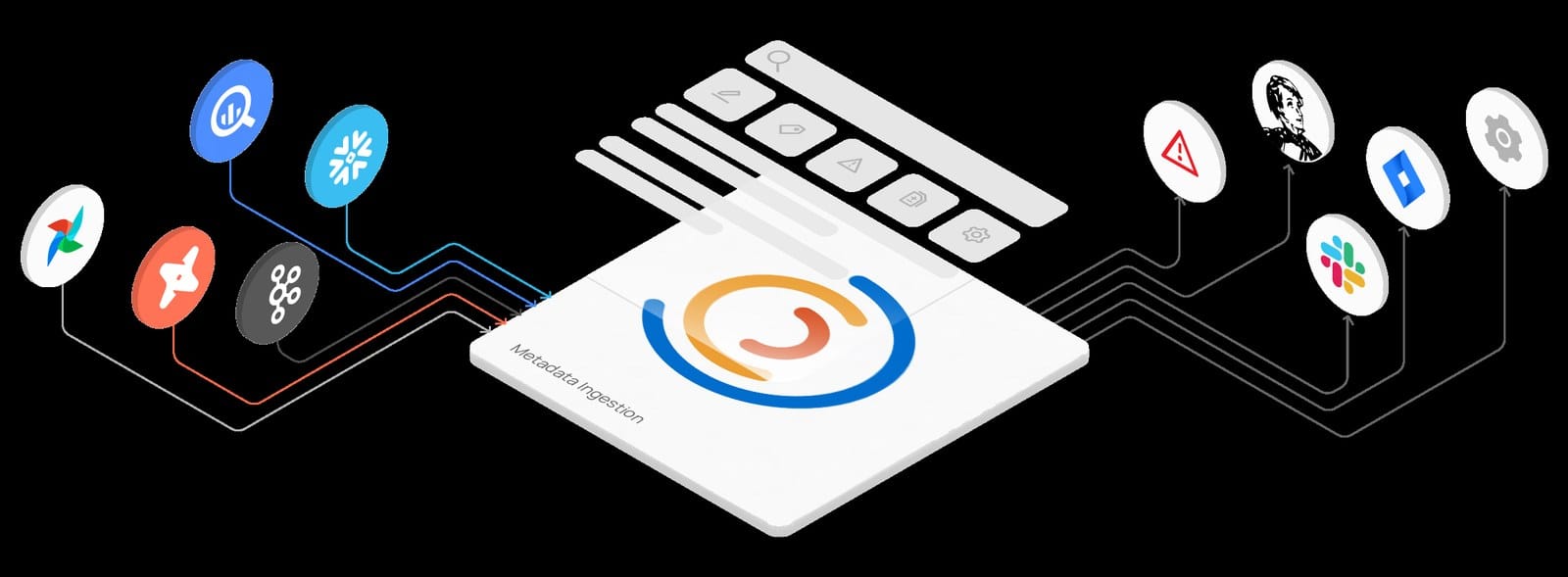
DataHub is the open-source metadata platform originally built inside LinkedIn and now developed by the company of the same name — which was called Acryl Data until it rebranded alongside a $35 million Series B in May 2025, bringing total funding to $65 million. The architecture is a metadata graph fed by a streaming ingestion backbone: change events flow through Kafka into a graph store and a search index, with every table, dashboard, pipeline and user modelled as an entity with extensible aspects.
That design is the reason engineering teams pick it. The metadata model is extensible without forking, ingestion is declarative, and the whole thing is Apache 2.0, so a team that wants governance running inside its own VPC can have it without a procurement cycle. DataHub Cloud is the managed option for teams that don't want to operate Kafka, Elasticsearch and a graph store themselves.
Best for: engineering-led teams that want to self-host and extend their metadata layer.
Pros
- Apache 2.0 licensed with no seat limits, feature gating or vendor lock-in in the OSS build
- Extensible entity/aspect metadata model — you can add custom asset types without forking
- Large, active open-source community with connectors contributed for most of the modern data stack
- Managed DataHub Cloud exists if you later want to stop operating the infrastructure
Cons
- Self-hosting means running Kafka, a search index and a graph store; this is real platform work
- Business-user experience and stewardship workflow are weaker than the commercial catalogs
- Smallest company here ($65M raised total), which matters for long-horizon enterprise commitments
- Enterprise features like fine-grained access control and SLAs sit in the paid cloud tier
How to choose
You are a regulated enterprise with auditors. Collibra, or Informatica if MDM and data quality are in the same programme. Budget for implementation, not just licences.
Your estate is Microsoft. Start with Microsoft Purview. It is the only option here you can price before a sales call, and the overlap with E5 licensing you already own is real. Validate its connector coverage against your non-Microsoft sources first.
Adoption is your problem, not policy. Alation. If analysts ignored your last catalog, behavioural ranking of real query activity is the differentiator that matters.
You have a modern cloud stack and want automation. Atlan, for the API surface and lineage depth — provided SaaS-only works for you.
You are a Databricks or Iceberg shop. Unity Catalog for enforcement at the data layer, then add a metadata management tool above it if business users need a glossary and stewardship workflow. These are complements, not substitutes.
You want open source. DataHub if you want the larger community and a commercial backstop. OpenMetadata is the main alternative — also Apache 2.0, backed by Collate, which raised a $10 million Series A in July 2025 and joined the Linux Foundation as a Silver Member in March 2026.
One practical note for every path: governance tools inherit the mess of the systems beneath them. If your ETL and data integration layer produces undocumented tables and your orchestration has no ownership metadata, a catalog will document that mess faithfully. Fix the upstream contracts first.
Frequently Asked Questions
What are data governance tools?
Data governance tools are platforms that catalog an organisation's data assets, record where data comes from and how it is transformed, enforce access and privacy policies, and track data quality. They give data stewards a system of record for who owns which dataset, what it means, and who may use it.
What is the difference between a data catalog and a data governance platform?
A data catalog indexes and describes data assets so people can find and understand them. A data governance platform adds policy enforcement, stewardship workflow, privacy controls and quality monitoring on top. Most vendors now sell both, but catalog-first tools like Alation and Atlan are shallower on policy workflow than suites like Collibra.
How do I choose the right data governance tool?
Start with your constraint, not the feature grid. If auditors drive the purchase, choose the suite with the deepest workflow. If adoption is the failure mode, choose for usability. If your stack is single-vendor, the native option is usually cheapest. Run a proof of concept against your five messiest real data sources.
What are the best open source data governance tools?
DataHub and OpenMetadata are the two leading options, both Apache 2.0 licensed with commercial backers (DataHub and Collate respectively). Apache Atlas remains in use in Hadoop-era estates. All require you to run the supporting infrastructure yourself unless you buy the vendor's managed tier.
Can you integrate data governance with data quality tools?
Yes, and most platforms now include data quality natively — Collibra, Informatica, Alation and Atlan all ship quality capabilities. Where you use a separate tool, integration is typically via API or metadata ingestion so quality scores appear against assets in the catalog rather than in a second interface.
Editor's note — sources: Collibra newsroom; Microsoft Purview data governance billing documentation; Salesforce press release on completing the Informatica acquisition; Alation news and press; Atlan Series C announcement; Databricks blog on open-sourcing Unity Catalog; DataHub Series B coverage; Collate on joining the Linux Foundation. Funding, pricing and feature claims verified as of September 2026.