
Top 7 ETL and Data Integration Platforms in 2026
Seven ETL and data integration platforms compared on connectors, deployment, pricing, and real trade-offs: Fivetran, Airbyte, Matillion, Estuary, Hevo Data, Boomi Data Integration, and Meltano.


Seven platforms that move data from source systems into warehouses and lakes — compared on connectors, deployment, pricing, and where each one actually falls short.
Every analytics or AI project starts with the same unglamorous problem: getting data out of the systems that produce it and into a warehouse or lake where it can be queried. ETL and ELT platforms exist to solve that problem without a team of engineers hand-writing and maintaining API integrations. The market splits along a few real lines: fully managed usage-based platforms like Fivetran, open-source alternatives like Airbyte and Meltano that trade convenience for control, low-code transformation-heavy tools like Matillion, and a newer set of platforms — Estuary chief among them — built around real-time change data capture rather than scheduled batch syncs. Once data lands in the warehouse, it typically feeds into data orchestration and workflow platforms, ML feature stores, or enterprise RAG platforms further downstream — this roundup covers the layer that gets it there in the first place. Here are seven worth evaluating in 2026, ranked on breadth of connectors, deployment flexibility, pricing transparency, and verifiable track record.
How we picked these
We looked at platforms with a live, actively maintained product, a public pricing page or a documented pricing model (even if the final number requires a sales call), and a connector catalog broad enough for real production use — not a single-source utility. We read each company's own site, documentation, pricing pages, and changelog, and cross-checked funding, ownership, and customer claims against company press releases and reputable outlets where those details were publicly stated. We excluded platforms whose current activity or pricing we couldn't verify from a primary source. Ranking runs roughly from broadest managed reach and market maturity down to the most specialized or smallest-scale option — not alphabetical, and not based on any payment or sponsorship (none of the platforms below paid for placement or review access).
Quick comparison
| Company | Best for | Deployment | Pricing model |
|---|---|---|---|
| Fivetran | Fully managed ingestion + transformation at enterprise scale | Cloud-hosted; hybrid option for on-prem sources | Usage-based (Monthly Active Rows) |
| Airbyte | Open-source control and self-hosting | Self-hosted (Docker/Kubernetes) or Airbyte Cloud | Free self-hosted; credit-based cloud |
| Matillion | Visual low-code transformation alongside ingestion | Cloud SaaS (Data Productivity Cloud) | Flat monthly/annual subscription |
| Estuary | Real-time streaming CDC | Public cloud, private (customer VPC), or BYOC | Usage-based (per GB moved) |
| Hevo Data | No-code pipelines with predictable pricing | Cloud-hosted | Tiered flat-rate plans by event volume |
| Boomi Data Integration | Teams already standardized on Boomi's iPaaS | Cloud-hosted, part of Boomi Enterprise Platform | Credit-based (Boomi Data Units) |
| Meltano | Git-native, CLI-first open-source ELT | Self-hosted (CLI, Docker) | Free and open source; paid support optional |
1. Fivetran
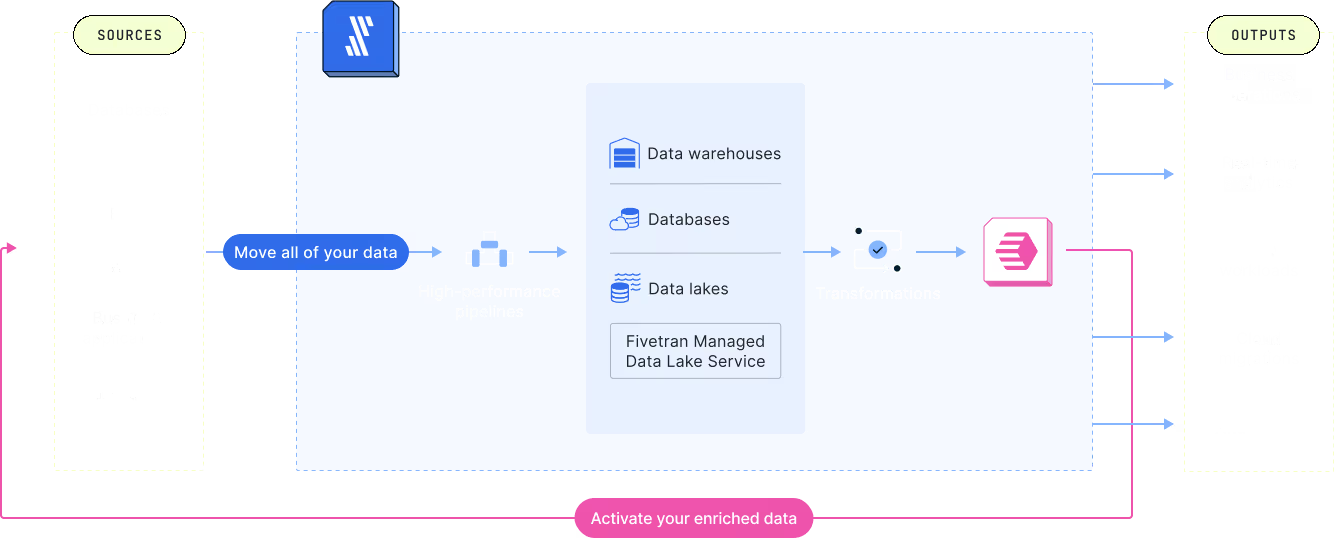
Fivetran is a fully managed data movement platform that automatically extracts and loads data from hundreds of SaaS applications, databases, files, and event streams into a customer's warehouse or lake. Pipelines are pre-built and largely configuration-only: point Fivetran at a source and destination, and it handles schema detection, schema drift, and incremental syncs without custom code. In June 2026, Fivetran completed an all-stock merger with dbt Labs — announced the previous October — folding dbt's transformation and semantic-modeling technology into the platform; the combined company said it was approaching $600 million in annual recurring revenue at close, according to Fivetran's own press release. Fivetran remains privately held, last valued at $5.6 billion in a 2021 Series D round.
Best for: enterprise teams that want a single, fully managed platform covering ingestion, transformation, and governance without touching infrastructure.
Pros: - Hundreds of pre-built, fully managed connectors spanning SaaS, database, SAP, file, and streaming sources - Hybrid deployment option lets sensitive sources stay inside a customer's own environment - SOC 1/SOC 2, HIPAA BAA, ISO 27001, PCI DSS Level 1, and HITRUST certifications - Now includes dbt's transformation and semantic layer natively, post-merger
Cons: - Usage-based Monthly Active Rows pricing can spike unpredictably as data volume grows, and is a frequent complaint in third-party pricing comparisons - No self-hosted or open-source option — the platform is fully vendor-managed - Free tier is capped and not viable for production workloads - Post-merger integration of dbt is recent enough that some tooling and pricing changes are still settling
2. Airbyte
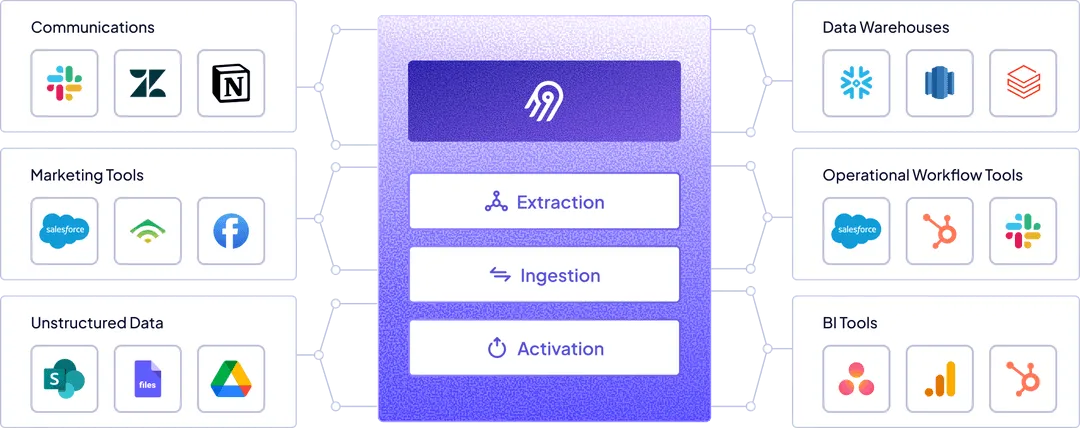
Airbyte is an open-source data movement platform, released under an open-core license, that can be self-hosted via Docker or Kubernetes or run as a managed Airbyte Cloud service. It ships more than 600 pre-built connectors and a no-code Connector Builder for building custom ones in hours rather than months. The company raised a $150 million Series B in December 2021 led by Altimeter Capital and Coatue Management, valuing it at $1.5 billion. Airbyte has recently repositioned part of its product around what it calls a "context layer for AI agents," adding MCP support so agents can query synced data directly rather than only downstream systems consuming it.
Best for: engineering teams that want open-source control, self-hosting options, or a foundation for AI-agent data pipelines.
Pros: - Open-source core with no per-row licensing fee when self-hosted - Largest connector catalog among the platforms here, at 600+ - Deployment flexibility across cloud, hybrid, and fully on-prem for data-sovereignty requirements - SOC 2 compliance and a 99.99% uptime SLA on the managed Cloud tier
Cons: - Self-hosting is only free in license terms — running it reliably requires real Kubernetes and DevOps investment - Connector quality varies across the long tail of community-maintained integrations - Cloud pricing is credit-based, which some customers find harder to forecast than flat per-row pricing - The "AI agent context layer" pivot is new enough that documentation and positioning are still evolving
3. Matillion
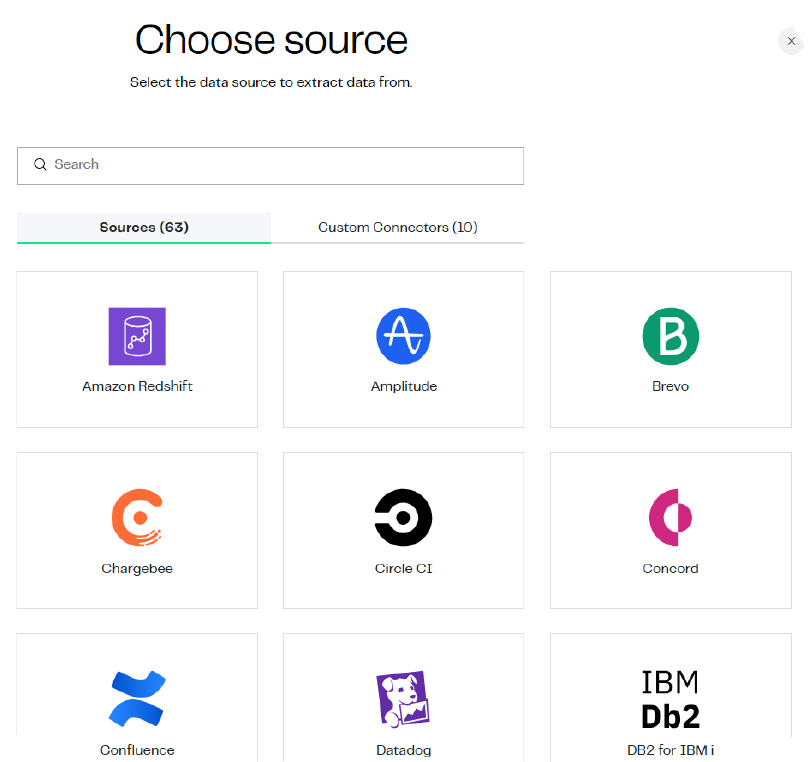
Matillion is a cloud-native data integration platform sold as the Data Productivity Cloud, combining connector-based ingestion with a visual, low-code transformation canvas that pushes SQL down into Snowflake, Databricks, BigQuery, or Redshift. Unlike pure EL tools, Matillion is built for teams that want to design multi-step transformation logic — joins, aggregations, conditional branching — without leaving the platform, alongside options to write raw SQL, Python via Snowpark, or dbt. The company raised a $150 million Series E in 2021 led by General Atlantic at a reported $1.5 billion valuation, and has since introduced Maia, an AI agent layer for automating pipeline-building tasks.
Best for: data teams that need a visual, low-code canvas for complex transformations alongside ingestion.
Pros: - Visual transformation designer handles complex ETL logic that pure EL tools push entirely into the warehouse - Native SQL pushdown to each supported cloud data platform for performance - Git integration for version-controlling pipeline logic - dbt Core integration lets teams mix low-code and high-code transformation in one pipeline
Cons: - Smaller connector catalog than Fivetran or Airbyte, built around hundreds rather than 600+ sources - Pricing isn't published as a self-serve calculator — plans start around $1,000/month and require a sales conversation beyond the entry tier - More complex tool overall than a pure ELT product, with a steeper learning curve for teams that only need simple ingestion - Company revenue and funding figures reported by third-party trackers are inconsistent between sources, making exact current scale harder to verify independently than for larger peers
4. Estuary
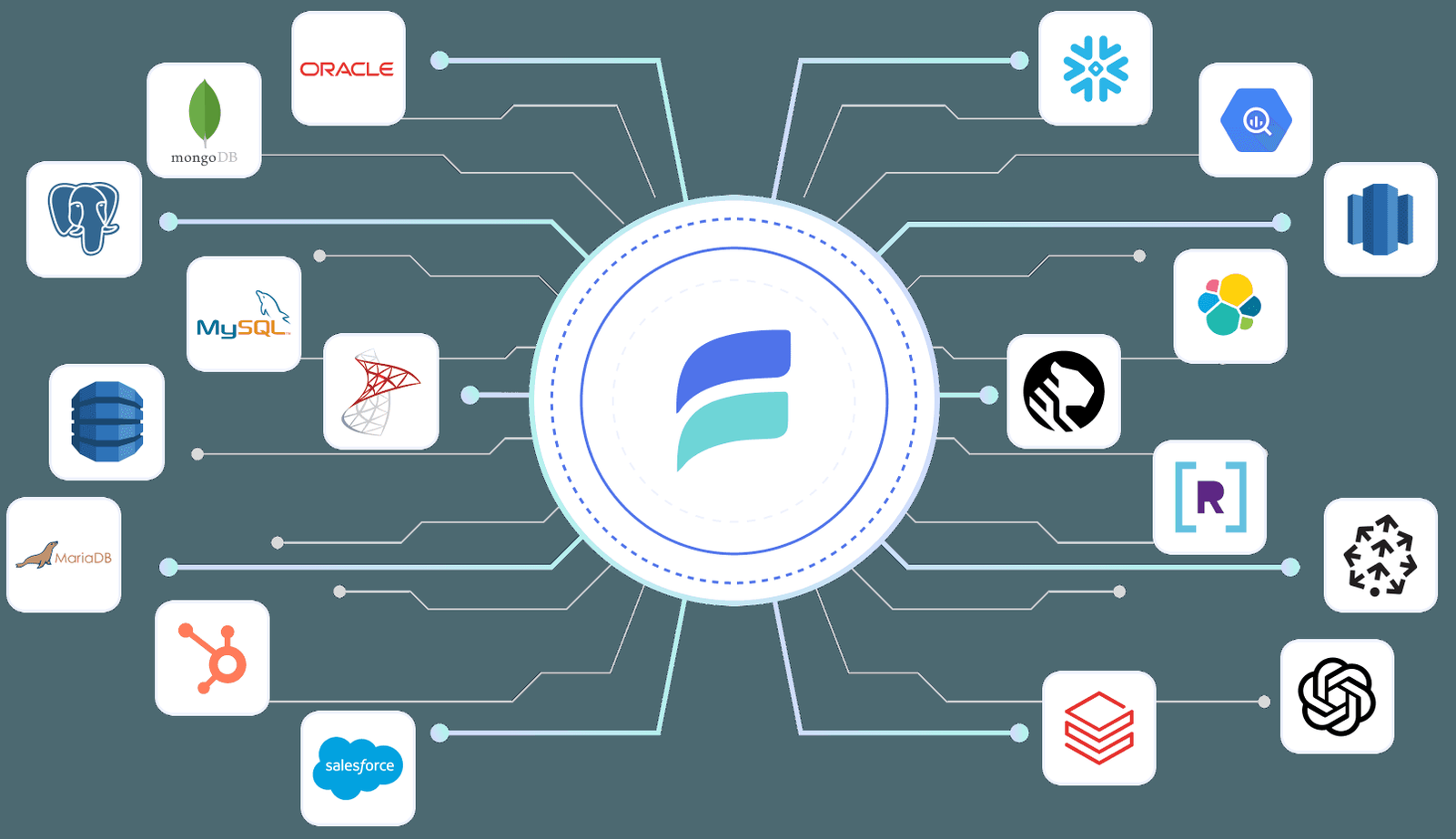
Estuary (formerly Estuary Flow) is a managed platform that unifies change data capture, streaming, and batch integration into a single system, built around what it calls "right-time" data movement rather than scheduled batch-only syncs. It supports 200-plus connectors, sub-100-millisecond latency for streaming pipelines, and deployment as a public cloud service, inside a customer's private cloud, or bring-your-own-cloud. The company reports more than 5,500 active users and moving over 7 GB per second at peak, and holds SOC 2 Type II certification along with HIPAA, GDPR, CCPA, and CPRA compliance. Customers named on its site include Glossier, Xometry, and Prodege.
Best for: teams that need genuine sub-second streaming CDC, not just scheduled batch syncs.
Pros: - True streaming CDC with sub-100ms latency, not just frequent batch polling - Single platform covers batch, streaming, and CDC rather than requiring separate tools for each - Flexible deployment including private and bring-your-own-cloud options for data residency - SOC 2 Type II plus HIPAA, GDPR, CCPA, and CPRA compliance out of the box
Cons: - Usage-based per-GB pricing means costs scale with data volume and can be hard to estimate exactly without running the calculator or contacting sales - Smaller connector catalog (200+) than Fivetran or Airbyte - Younger and smaller company than the more established platforms on this list, with a shorter public track record - Private and BYOC deployment modes are likely priced above the public self-serve tiers, based on the plan structure published on its pricing page
5. Hevo Data
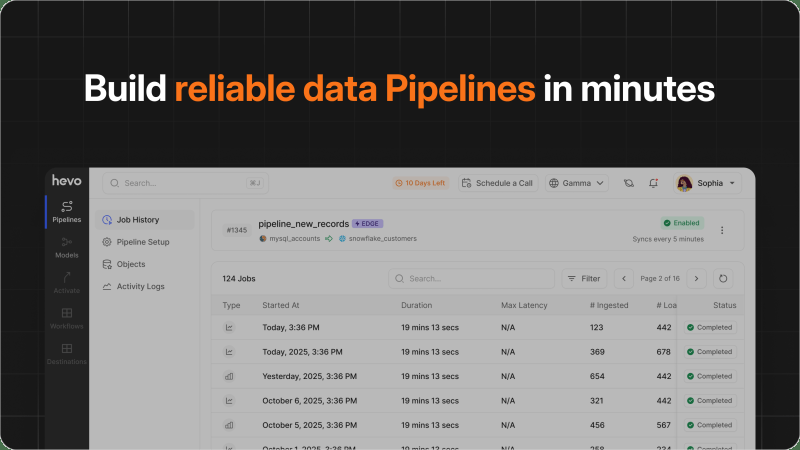
Hevo Data is a no-code data integration platform built around log-based change data capture, offering more than 150 pre-built connectors for databases, SaaS applications, and files. It positions itself against usage-based competitors with flat, tiered pricing based on event volume rather than rows or credits, and includes a Reliability Engine for automatic retries plus a self-healing schema feature that adapts to upstream schema drift without manual intervention. The company has raised roughly $43-44 million across four funding rounds, most recently a $30 million Series B in 2021, and says it is trusted by more than 2,000 companies worldwide, including ThoughtSpot, Postman, and DoorDash.
Best for: mid-market teams that want no-code pipelines with flat, predictable pricing instead of usage-based billing surprises.
Pros: - Transparent, tiered flat-rate pricing pitched explicitly as an alternative to usage-based billing surprises - Log-based CDC for near real-time replication without hand-rolled polling logic - SOC 2 Type II, GDPR, and HIPAA compliance - 24x7 support staffed by engineers rather than tiered ticket queues, per the company's own claims
Cons: - Smaller connector catalog (150+) than Fivetran, Airbyte, or Estuary - Has raised meaningfully less capital than Fivetran or Matillion, with no funding round since 2021 as of this writing - Transformation options are more limited than Matillion's visual canvas — dbt, SQL, or Hevo's own transformer jobs, but no drag-and-drop pipeline designer - Enterprise-grade features like dedicated VPCs and full audit trails sit behind its higher, custom-priced tier rather than being available by default
6. Boomi Data Integration
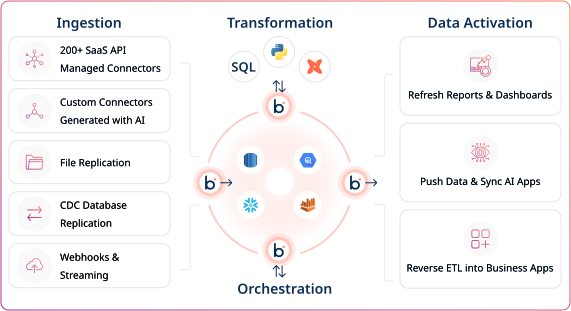
Boomi Data Integration is the product formerly known as Rivery, which Boomi acquired in December 2024 and folded into its broader Boomi Enterprise Platform. It offers no-code and custom-code ELT with ingestion, transformation, orchestration, and reverse-ETL activation in one interface, billed through Boomi Data Units — a credit system that replaced Rivery's earlier RPU pricing. Since the acquisition, the product has been positioned less as a standalone ELT tool and more as the data layer feeding Boomi's wider integration, API management, and agentic-AI tooling, including a Data Connector Agent the company says can build custom REST connectors 30 times faster than manual development.
Best for: organizations already standardized on Boomi's iPaaS platform who want data integration bundled in rather than run as a separate tool.
Pros: - Ingestion, transformation, orchestration, and reverse ETL in one interface rather than separate products - Now backed by Boomi's broader platform, including native ties into Data Hub and Agentstudio for teams building on that stack - CDC replication into cloud data warehouses configurable in a few clicks, per the product's own documentation - Boomi holds SOC 2 and ISO certifications at the platform level
Cons: - Post-acquisition, the product's roadmap now sits inside Boomi's broader iPaaS strategy rather than running independently — a real shift from its life as standalone Rivery - Pricing beyond the entry pay-as-you-go tier requires a sales conversation, with no public rate card for Professional or Enterprise plans - Smaller connector and community ecosystem than Fivetran or Airbyte - Best fit narrows mainly to organizations already invested in or evaluating the wider Boomi platform, rather than teams wanting a standalone best-of-breed ELT tool
7. Meltano
Meltano is an open-source, CLI-first data integration engine built on the Singer taps-and-targets standard, designed for data engineers who want to define pipelines as code rather than click through a GUI. Projects are configured in a git-native meltano.yml file, integrate dbt for transformation, and can pull from MeltanoHub's catalog of 600-plus community-maintained taps and targets. Originally spun out of GitLab in 2021 and now maintained independently, the project remains actively developed — its latest release, v4.2.0, shipped in April 2026, and its GitHub repository has logged more than 12,700 commits under an MIT license. The project raised $12.4 million in seed funding led by GV, with an extension from Venrock, and its community numbers more than 2,500 data professionals on Slack and GitHub, per its own README.
Best for: data engineers who want a git-native, CLI-first, fully open-source ELT stack they can version and self-host end to end.
Pros: - Fully open source (MIT license) with no paid tier required to run it in production - Git-native configuration makes pipelines reviewable and version-controlled like any other code - Built on the widely adopted Singer taps/targets standard, giving access to a large ecosystem of community connectors - Actively maintained, with regular releases and a large, long-running commit history
Cons: - No polished managed cloud offering — running Meltano well still means operating your own CLI/Docker deployment - Requires real comfort with YAML and the command line; not aimed at non-technical users - Smaller company behind it than Airbyte or Fivetran, so feature velocity and support responsiveness are more limited - Connector quality across the Singer ecosystem varies, since many taps and targets are community-maintained rather than vendor-tested

How to choose
Start with how much infrastructure your team wants to own. If the answer is none, Fivetran, Hevo Data, or Boomi Data Integration hand you a managed pipeline with no servers to run; if the answer is "we want full control and no vendor lock-in," Airbyte or Meltano let you self-host the entire stack. If your transformation logic is genuinely complex — multi-step joins, conditional branching, legacy SQL migration — Matillion's visual canvas will save more time than any pure EL tool. If your use case actually needs sub-second freshness — fraud detection, real-time personalization, operational dashboards — Estuary's streaming CDC is built for that in a way scheduled batch tools aren't, even polling every few minutes. And if pricing predictability matters more than raw feature breadth, compare Hevo's flat tiers directly against Fivetran's Monthly Active Rows model before committing, since usage-based pricing is the single biggest source of unplanned cost on this list. It's also worth pairing any of these with a look at workflow orchestration platforms for data and AI pipelines once you're moving beyond simple point-to-point syncs. None of these decisions are permanent — most teams outgrow their first ETL choice at least once, and migration paths between these vendors are more mature than they were even two years ago.
Frequently Asked Questions
What's the difference between ETL and ELT? ETL transforms data before loading it into the destination; ELT loads raw data first and transforms it inside the warehouse afterward, using the warehouse's own compute. Most platforms on this list are ELT-first, since modern cloud warehouses make in-warehouse transformation cheap and fast.
Is Fivetran's pricing based on the number of rows synced? Fivetran bills on Monthly Active Rows (MAR) — unique rows that changed at least once during the billing month, not total rows moved. A row synced ten times in a month still counts once, but volatile tables can drive MAR higher than expected.
Can I self-host an open-source ETL tool instead of using a managed service? Yes — Airbyte and Meltano are both open source and can be self-hosted via Docker or Kubernetes at no licensing cost. Factor in the real engineering time to run either reliably; third-party guides commonly estimate 20-40 hours a month for self-hosted Airbyte at moderate scale.
Do any of these platforms handle real-time streaming, not just batch syncs? Estuary is built specifically around sub-100ms streaming change data capture rather than scheduled batch polling. Several others, including Matillion and Boomi Data Integration, offer CDC-based replication, but with less emphasis on true streaming latency.
How do I estimate the real cost of a usage-based platform before committing? Ask each vendor for a cost calculator or trial period against your actual data volume rather than list pricing alone — Hevo and Estuary both publish public calculators, and Fivetran and Boomi will run a usage estimate against a sample of your sources on request.
Editor's note — sources: Fivetran platform overview, Fivetran press release on the dbt Labs merger, Airbyte product platform page, Matillion features page, Estuary product page, Hevo Data pipeline page, Boomi's Rivery-to-Boomi Data Integration announcement, and Meltano's GitHub repository.