
Top 7 Healthcare AI Companies Transforming Clinical Care in 2026
Tempus AI, Abridge, Microsoft Dragon Copilot, Aidoc, PathAI, Viz.ai, and Butterfly Network, ranked by clinical adoption, FDA clearances, and funding as of August 2026.


Who this is for: health system IT and clinical leaders, investors tracking medical AI, and operators evaluating diagnostic or documentation tools. What's changed: FDA clearances for AI in radiology and pathology kept accelerating through 2026, ambient documentation consolidated into a handful of well-funded leaders, and one of the biggest names on this list just agreed to be acquired.
If you're trying to figure out which healthcare AI companies actually matter in 2026, the field has split into two camps: software that touches a patient's diagnosis or record today, and software still mostly aimed at drug discovery years out. That split matters because most hospital AI pilots still don't make it to a paying, scaled deployment — the companies below are the ones that crossed that line. This roundup covers the first camp — companies whose AI runs inside hospitals, labs, and clinics right now, with real regulatory clearances and named customers. We picked seven: Tempus AI, Abridge, Microsoft's Dragon Copilot (formerly Nuance DAX), Aidoc, PathAI, Viz.ai, and Butterfly Network. Here's how they compare, ranked by scale, funding, and clinical adoption as of August 2026.
How we picked these
Medical AI is a sprawling category — genomics, drug discovery, imaging, ambient scribing, robotic surgery, and more all get lumped under the label. To keep this list coherent, we narrowed to companies whose AI is deployed directly in clinical workflows today: diagnostic imaging, digital pathology, and clinical documentation. That excludes pure AI drug-discovery companies like Recursion Pharmaceuticals, Insitro, Isomorphic Labs, and Owkin, whose work is real but runs on a different timeline and business model (biopharma partnerships and internal pipelines rather than hospital deployment).
Within that lane, we ranked by four factors: scale of deployment (how many hospitals or health systems actually use the product), regulatory validation (FDA clearances, where applicable), funding and financial transparency (public filings beat unverified estimates), and category influence (whether the company set the template others followed). We relied on company press releases, SEC and FDA filings, and coverage from outlets including Fierce Healthcare, MedTech Dive, STAT News, and Reuters. Where a number couldn't be verified through a primary or reputable secondary source, we left it out rather than guess. This is not a paid or sponsored list, and none of these companies reviewed it before publication.
Quick comparison
| Company | Best for | Focus area | Business model |
|---|---|---|---|
| Tempus AI | One AI platform across genomics, diagnostics, and drug-development data | Precision medicine, diagnostics | Public (NASDAQ: TEM); lab billing, data licensing |
| Abridge | Health systems standardizing ambient documentation on Epic | Ambient AI scribing | Enterprise SaaS |
| Microsoft Dragon Copilot | Health systems on Microsoft Cloud for Healthcare wanting dictation plus ambient AI | Clinical documentation, voice AI | Enterprise licensing |
| Aidoc | One platform running many FDA-cleared imaging and cardiology algorithms | Radiology and imaging triage | Enterprise SaaS, per-hospital |
| PathAI | FDA-cleared digital pathology infrastructure for labs and biopharma | Digital pathology | Enterprise/lab licensing |
| Viz.ai | The most clinically validated imaging AI for stroke and neurovascular care | Disease detection, care coordination | Enterprise SaaS, hospital subscription |
| Butterfly Network | Affordable handheld imaging with built-in AI for point-of-care settings | Handheld ultrasound plus AI | Public (NYSE: BFLY); device plus subscription |
1. Tempus AI
Tempus AI is a Chicago-based, publicly traded (NASDAQ: TEM) precision-medicine company combining genomic sequencing, diagnostics, and AI-driven data analysis for oncology and, increasingly, cardiology. It reported roughly $1.27 billion in 2025 revenue, up about 80% year over year, with fiscal 2026 guidance of $1.59–$1.60 billion. Its business spans diagnostic testing billed to payors, a data-licensing segment serving biopharma, an oncology-focused clinical intelligence platform called Next, and Lens, an agentic AI platform the company says is used by 19 of the top 20 biopharma companies for trial design. In August 2025, Tempus acquired digital pathology company Paige for $81.25 million, adding roughly seven million digitized pathology slides to its data assets.
Best for: Health systems and biopharma companies that want one vendor spanning genomic testing, diagnostics, and drug-development data.
Pros - Publicly traded with audited financials and SEC filings, more transparent than most private competitors here. - Multiple FDA-cleared cardiovascular AI tools that flag atrial fibrillation, low ejection fraction, and, as of August 2026, pulmonary hypertension from standard ECGs. - Diversified revenue across diagnostics, data licensing, and biopharma partnerships rather than one product line.
Cons - Growth has leaned heavily on acquisitions (Paige, Personalis, OneOme), raising integration risk and complicating revenue comparisons. - Its FDA-cleared ECG tools are explicitly not standalone diagnostics; results must be interpreted alongside other clinical information. - Unusually broad scope — diagnostics, data licensing, and now pathology — can make it harder to evaluate against single-purpose rivals.

2. Abridge
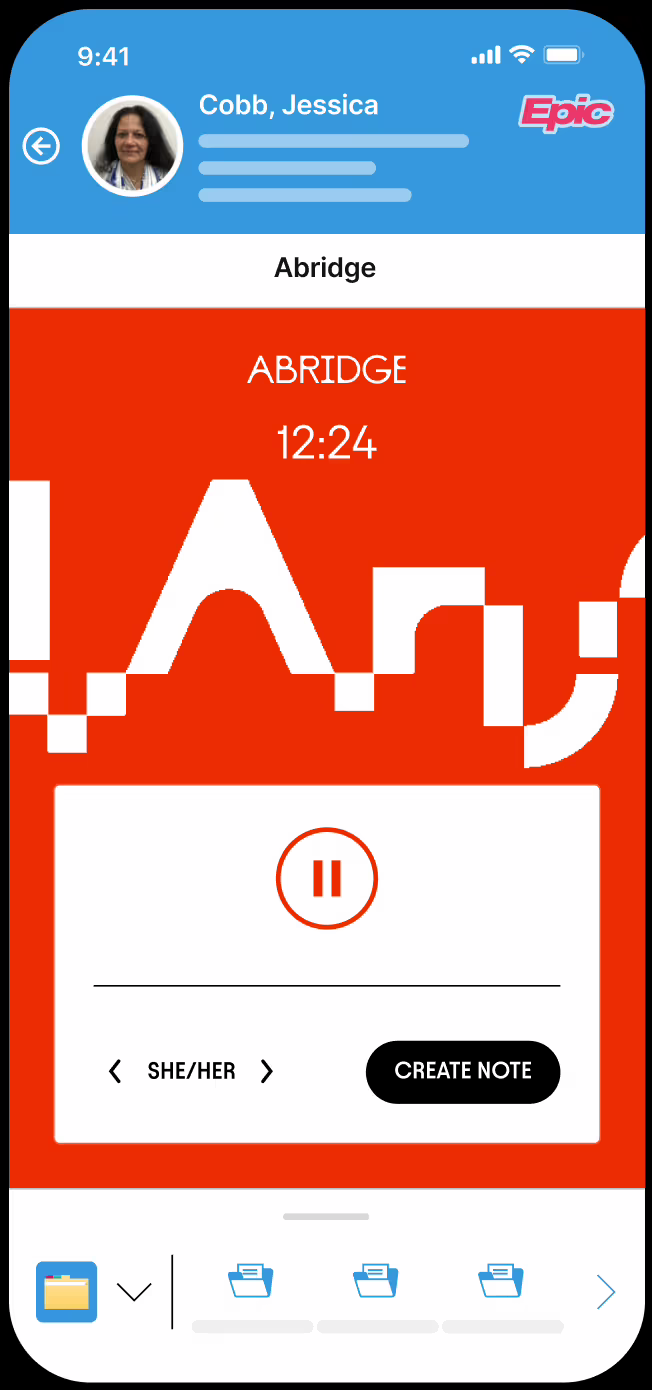
Abridge makes ambient AI software that listens to a patient-clinician conversation and drafts a structured clinical note in real time, integrated directly into Epic. Founded by cardiologist Shiv Rao, the company raised a $250 million Series D in February 2025 at a $2.75 billion valuation, then a $300 million Series E four months later at $5.3 billion, followed by a reported $316 million Series E extension in April 2026. At its Series E announcement, Abridge said its technology was deployed in more than 150 health systems, up 50% from the 100 it reported four months earlier, and that it expected to support more than 50 million medical conversations in 2025. Johns Hopkins Medicine, Mayo Clinic, and Sutter Health have publicized large-scale rollouts.
Best for: Large health systems standardizing on one ambient documentation vendor across outpatient, emergency, and inpatient settings.
Pros - Deep, purpose-built Epic integration rather than a bolt-on tool, per health system case studies and Fierce Healthcare reporting. - Rapid, well-documented adoption: named academic medical centers including Johns Hopkins and Mayo Clinic have publicly confirmed large rollouts. - Among the best-capitalized companies in ambient AI, with runway to build adjacent products.
Cons - Pricing is not published; Abridge sells through enterprise contracts negotiated per health system. - Its AI-drafted notes require clinician review before finalization — errors in the draft remain the clinician's liability to catch. - Clinical documentation software isn't FDA-regulated, so quality assurance rests on internal and customer-reported evaluation rather than independent review.
3. Microsoft Dragon Copilot (formerly Nuance DAX)
Microsoft acquired speech-recognition pioneer Nuance Communications for $19.7 billion in a deal that closed in March 2022, folding Nuance's Dragon Medical dictation software and Dragon Ambient eXperience (DAX) technology into what's now sold as Dragon Copilot. In March 2025, Microsoft merged the two into one tool combining Dragon Medical One's voice dictation with DAX's ambient conversation capture, plus generative AI for surfacing clinical information and drafting referral letters and after-visit summaries. Microsoft says DAX's ambient technology had already been used in more than 3 million patient conversations across 600 healthcare organizations the month before launch. The unified product became generally available in the US and Canada in May 2025, followed by the UK, Germany, France, and the Netherlands.
Best for: Health systems already on Microsoft Cloud for Healthcare wanting dictation and ambient AI documentation from one enterprise vendor.
Pros - Backed by Microsoft's scale — Dragon Medical has been in clinical use for years before the AI additions. - Microsoft cites a July 2024 survey of 879 clinicians across 340 organizations showing 70% reported reduced burnout and 93% of surveyed patients reported a better visit experience. - Multi-country rollout beyond the US, combining dictation and ambient scribing in one interface.
Cons - Sold exclusively through enterprise agreements; per-seat list pricing isn't broadly published. - Deep reliance on Microsoft's cloud and EHR partner ecosystem could make switching away later a heavier lift than with smaller point solutions. - Like Abridge, output still requires clinician review before it's finalized — it drafts, it doesn't diagnose.
4. Aidoc
Aidoc builds AI that flags abnormal findings in medical images — strokes, pulmonary embolisms, aortic disease, and more — and routes them to the right care team, running on its aiOS enterprise platform. The company says its software supports clinical decisions across nearly 2,000 hospitals worldwide and has analyzed more than 120 million patient cases, with named customers including Sutter Health, WellSpan Health, and Mercy. Aidoc holds 17 FDA-cleared algorithms, the most of any company in this category, built on its CARE foundation model, which received what the company describes as the first FDA clearance for a comprehensive foundation-model-based triage system in January 2026. Aidoc has also picked up two FDA Breakthrough Device Designations within a year: CARE Triage in September 2025, and First Read, a tool designed to draft preliminary chest radiograph reports, in June 2026. The company raised a $150 million Series E led by Goldman Sachs in April 2026.
Best for: Hospitals wanting one platform to run many FDA-cleared imaging algorithms across radiology, neuro, and cardiology.
Pros - The largest portfolio of FDA-cleared algorithms on a single platform among the companies here (17, per the company). - Backed by a $150 million round led by Goldman Sachs in 2026, a notable institutional signal for a private clinical AI company. - Broad, named hospital customer base with multi-year deployments.
Cons - Breakthrough Device Designation is not FDA clearance — First Read is explicitly investigational, not yet cleared for clinical use. - With 17 algorithms spanning many clinical areas, validation depth likely varies by algorithm; no uniform accuracy benchmark is published across the portfolio. - Enterprise pricing isn't published; adoption requires hospital-level subscription and EHR integration.

5. PathAI
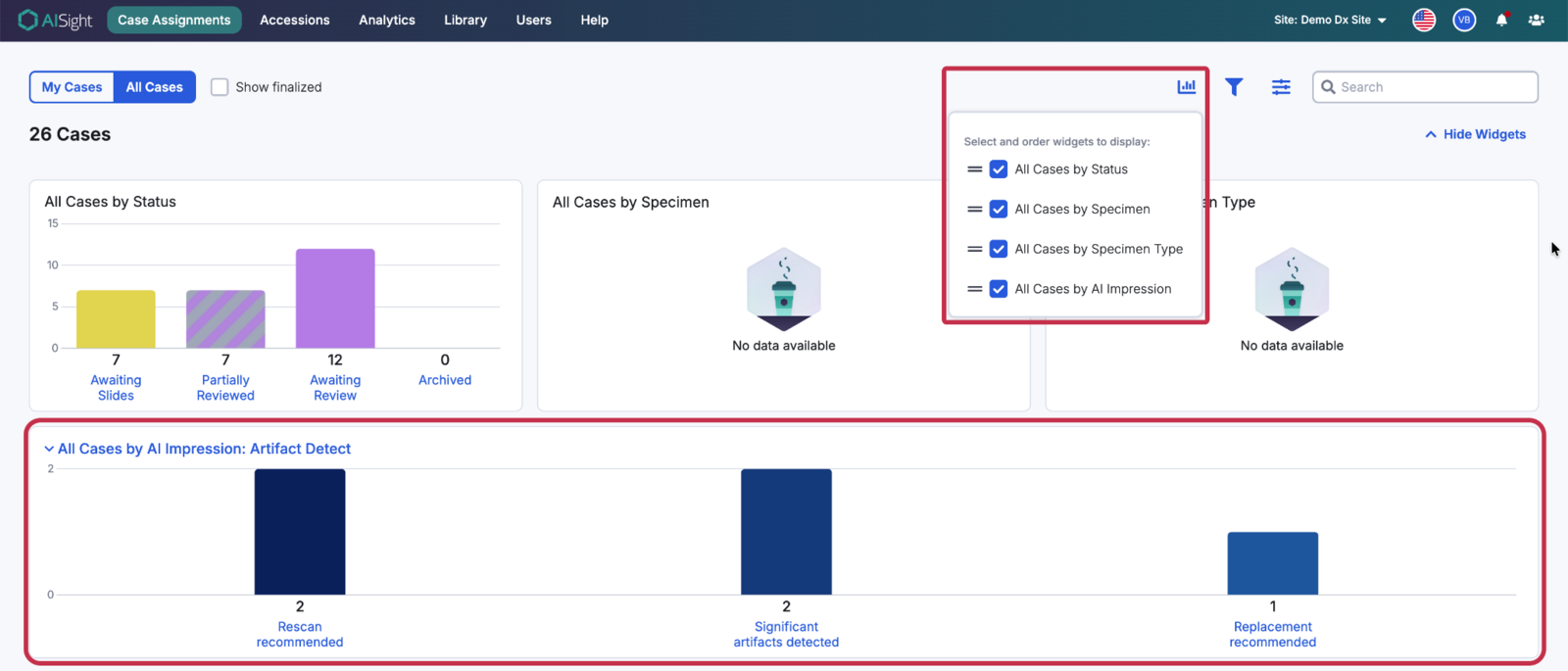
PathAI builds AI-powered digital pathology software used by biopharma companies for drug development and by clinical labs for primary diagnosis. Its flagship platform, AISight Dx, is FDA 510(k)-cleared for primary diagnosis in the US (initial clearance in 2022, expanded in June 2025) and CE-IVD marked in the EU, UK, and Switzerland. In February 2026, Labcorp announced an expanded collaboration to deploy AISight Dx nationwide across its anatomic pathology labs. PathAI's biopharma business includes a partnership with Roche dating to 2021 that scaled up in 2024 to include AI-enabled companion diagnostics — a relationship that culminated in Roche agreeing, in May 2026, to acquire PathAI outright for $750 million upfront plus up to $300 million in milestone payments, with the deal expected to close in the second half of 2026.
Best for: Reference labs and biopharma companies needing FDA-cleared digital pathology infrastructure rather than a research-only tool.
Pros - One of a small number of companies with FDA clearance for AI-assisted primary diagnosis in pathology, not just research use. - A validated, multi-year commercial relationship with Roche that now culminates in a full acquisition. - Nationwide deployment path through Labcorp gives it reach beyond boutique lab partnerships.
Cons - The pending Roche acquisition means PathAI's independent roadmap and pricing will likely be reshaped once the deal closes. - Its model ties much of its future revenue to pharma R&D and approval timelines outside its control. - Primarily accessible to large reference labs and biopharma partners rather than smaller independent pathology practices.
6. Viz.ai
Viz.ai pioneered AI-powered disease detection and care coordination in imaging, starting with a 2018 FDA de novo clearance for stroke and large vessel occlusion detection — the first AI clinical decision support software cleared for stroke and the first to receive a CMS New Technology Add-on Payment. Its Viz.ai One platform is now deployed across roughly 1,800 hospitals and health systems in the US and Europe, spanning suites for neuro, vascular, cardiac, pulmonary, radiology, trauma, and oncology. In June 2025, the company added FDA 510(k) clearance for Viz Subdural Plus, which automatically quantifies subdural hemorrhage volume and midline shift on CT scans. In October 2025, it launched Viz Assist, a multimodal AI agent combining ambient listening, EHR data, and its cleared imaging AI. Viz.ai's last disclosed equity round was a $100 million Series D in April 2022 at a $1.2 billion valuation, with a $40 million debt round in March 2023.
Best for: Stroke and neurovascular programs wanting the most clinically established AI detection platform in the category.
Pros - The longest continuous FDA clearance history of any company here, dating to 2018. - Broadest hospital footprint among pure clinical-imaging AI vendors on this list, at roughly 1,800 sites. - Continues adding narrowly scoped, specific FDA clearances rather than relying on one broad claim.
Cons - No new equity round has been publicly disclosed since 2022, even as the company has expanded into cardiology, pulmonology, and oncology. - Each clinical suite carries its own separate FDA clearance, so broad adoption means managing many discrete cleared devices, not one unified claim. - Rapid expansion beyond its original stroke focus raises the question of whether validation depth is even across all modules.
7. Butterfly Network
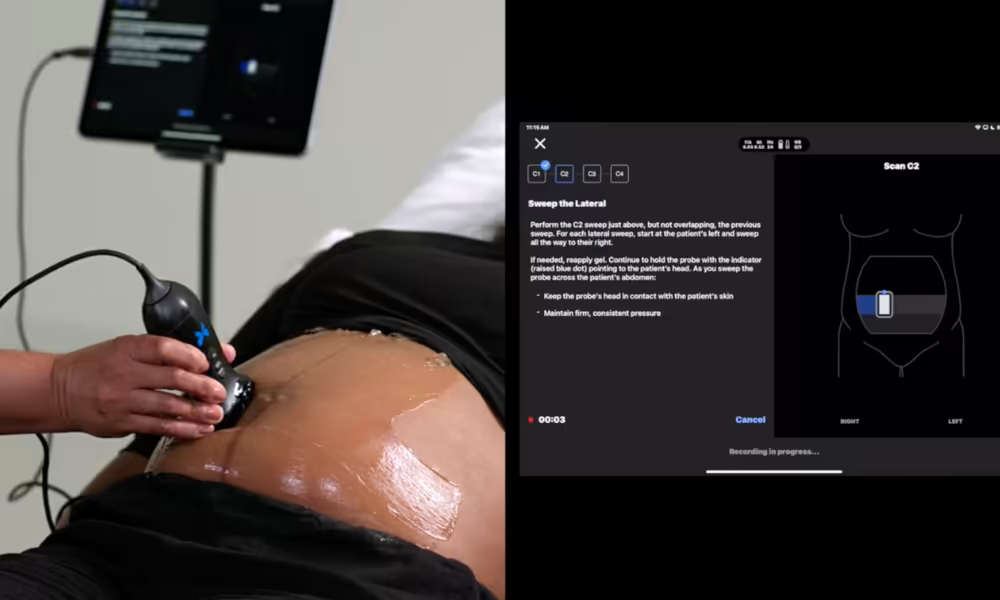
Butterfly Network (NYSE: BFLY) is a publicly traded medical device company making handheld, whole-body ultrasound probes built on its proprietary Ultrasound-on-Chip semiconductor technology, paired with AI software. It launched the first handheld single-probe whole-body ultrasound system in 2018, followed by the iQ+ in 2020 and iQ3 in 2024. In March 2026, Butterfly received its first FDA clearance for an AI feature: a fully automated Gestational Age Tool using a blind-sweep AI method — built on deep-learning models developed at the University of North Carolina at Chapel Hill — to estimate pregnancy dating in under two minutes without requiring image interpretation by the user. The company says the model was trained on more than 21 million images and validated for pregnancies between 16 and 37 weeks. The tool is already deployed in Malawi and Uganda with Gates Foundation support, and the company is positioning it for both global maternal-health gaps and underserved rural US areas.
Best for: Point-of-care and global-health settings needing affordable, portable imaging with a built-in AI assist.
Pros - Publicly traded (NYSE: BFLY) with SEC-filed financials, more transparent than most private device or software competitors. - Its Gestational Age Tool is the first FDA-cleared blind-sweep AI ultrasound tool of its kind, targeting a genuine care gap: the company cites federal data showing nearly half of US rural counties lack hospital obstetric services. - Real-world deployment already underway in Malawi and Uganda, backed by Gates Foundation funding, not just a US pilot.
Cons - Its AI capability is a single, narrowly scoped clearance rather than a broad diagnostic imaging suite like the radiology-focused companies here. - Using the AI feature requires Butterfly's proprietary probe plus a paid membership tier, a closed hardware-and-subscription ecosystem rather than software for existing equipment. - Global maternal-health deployment is currently limited to specific grant-funded programs rather than broad international availability.
How to choose
Start with the problem you're solving rather than the category label. Ambient documentation (Abridge, Microsoft Dragon Copilot) addresses clinician burnout and note-writing time, and the deciding factor is usually your existing EHR — both are built around deep Epic integration, so the practical question is which one your IT and compliance teams can stand up fastest and negotiate best terms with. Diagnostic imaging AI (Aidoc, Viz.ai) addresses speed-to-diagnosis for time-sensitive conditions; Viz.ai has the deepest track record in neurovascular care, while Aidoc's broader algorithm portfolio suits systems wanting one vendor across more specialties. Digital pathology (PathAI, and Tempus following its Paige acquisition) matters most for reference labs and biopharma companies running large-scale diagnostic or drug-development workloads.
For investors, this category has two risk profiles as of August 2026. Ambient documentation is riding real clinician demand, but valuations (Abridge at $5.3 billion) are running well ahead of disclosed revenue, and since the products aren't FDA-regulated, due diligence rests more on customer retention data than a regulatory stamp — the same gap between pilot enthusiasm and paid-production revenue that shows up across enterprise AI more broadly. Imaging and pathology AI is slower-moving and more heavily regulated — FDA clearance is a real moat but also means slower iteration, and consolidation is already underway, as shown by Roche's planned acquisition of PathAI and Tempus's acquisition of Paige. Either way, don't take a vendor's hospital-count or accuracy claims at face value without checking whether they're backed by a named customer, a peer-reviewed study, or an FDA filing. And because these tools sit close to patient data and clinical decisions, the same scrutiny hospitals apply to AI guardrails and security platforms elsewhere in their stack is worth applying here too.
Frequently Asked Questions
What is the most widely deployed AI company in healthcare right now?
By hospital count, Viz.ai (roughly 1,800 hospitals and health systems across the US and Europe) and Aidoc (nearly 2,000 hospitals worldwide) report the broadest deployment among clinical-imaging AI vendors, as of their respective 2025–2026 disclosures. Microsoft's Dragon Copilot also has broad reach through its Nuance-derived Dragon Medical base, though it hasn't published a comparable hospital count.
Which healthcare AI companies have FDA clearance?
Tempus AI, Aidoc, PathAI, Viz.ai, and Butterfly Network each hold at least one FDA clearance or de novo authorization for specific AI products, ranging from ECG analysis to imaging triage to digital pathology to obstetric ultrasound. Abridge and Microsoft's Dragon Copilot are documentation tools, a category that generally doesn't require FDA clearance since they don't make diagnostic claims.
Is ambient AI clinical documentation the same as a medical device?
No. Ambient scribes like Abridge and Microsoft Dragon Copilot draft clinical notes from a recorded conversation, but a clinician must review and finalize every note before it enters the medical record. Because they don't make diagnostic or treatment claims, they aren't regulated as medical devices the way imaging or pathology AI often is.
How much does healthcare AI software typically cost?
None of the companies in this roundup publish detailed per-seat or per-hospital pricing, a pattern consistent with the broader move away from simple published rate cards across enterprise AI pricing. All seven sell primarily through enterprise contracts negotiated directly with health systems, labs, or biopharma partners, with Butterfly Network as a partial exception since it also sells hardware directly with published starting price ranges.
Why did PathAI agree to be acquired by Roche?
PathAI and Roche have collaborated on AI-enabled companion diagnostics since 2021, an arrangement that scaled up in 2024. In May 2026, Roche agreed to acquire PathAI outright for $750 million upfront plus up to $300 million in milestone payments, a deal the companies describe as accelerating Roche's use of AI in diagnostic pathology; it's expected to close in the second half of 2026.
Editor's note — sources: This article draws on primary sources including company press releases and product pages (Tempus AI, Abridge, Microsoft, Aidoc, PathAI, Viz.ai, Butterfly Network), SEC filings referenced via EDGAR, FDA clearance and Breakthrough Device Designation announcements, and reporting from Fierce Healthcare, MedTech Dive, STAT News, and MobiHealthNews. Funding and valuation figures are current as of August 2026 and were cross-checked against at least one company or reputable trade-press source; figures attributed to third-party research aggregators are labeled as estimates rather than confirmed company disclosures.