
Top 7 Workflow Orchestration Platforms for Data and AI Pipelines in 2026
Prefect's acquisition of Dagster Labs just reshuffled the identity of a category built on Apache Airflow's decade-old dominance, and forced every remaining player to sharpen its pitch.


On July 13, 2026, Prefect announced it was acquiring Dagster Labs — folding one of the two most-cited "modern Airflow alternatives" into the other. For a category that spent the last five years selling itself as the anti-Airflow, the acquisition was an admission: orchestration is consolidating, and the winners will be the platforms that can run everything from a nightly ETL job to a multi-day agentic AI workflow without falling over.
Workflow orchestration is the layer that decides what runs, when, in what order, and what happens when it fails. Apache Airflow, open-sourced by Airbnb in 2014, still runs a large share of the world's scheduled data pipelines. But Airflow's task-based DAG model was built for batch ETL, not for long-running AI agents, human-in-the-loop approvals, or workflows that need to survive a server restart mid-execution. That gap is what created the current field: durable-execution engines, asset-centric schedulers, Kubernetes-native workflow controllers, and now the acquisition consolidating some of them.
How we picked these
We ranked platforms on four things: production maturity (is it running real workloads at scale, not just demos), architectural breadth (does it handle both data-pipeline and long-running-process use cases), transparency about pricing and limitations, and independent adoption signals — funding, named customers, GitHub activity, or a paying customer base rather than marketing copy alone. We excluded pure job schedulers with no retry/state semantics and anything without a public changelog or usage data to verify claims against.
The 7 platforms
1. Prefect (now including Dagster)
Prefect built its pitch around "hybrid execution" — your code and data stay inside your own infrastructure while Prefect's control plane handles scheduling, retries, and observability over the network. That architecture is why it's landed with teams like Cash App, Cox Automotive, and dbt Labs, and why the Prefect Cloud product page leads with a case study claiming a 73.78% infrastructure-cost reduction for logistics company Endpoint. On July 13, 2026, Prefect announced its acquisition of Dagster Labs, the company behind the asset-centric orchestrator Dagster — a deal covered by Businesswire and Prefect's own announcement post. The stated rationale: combine Prefect's Python-native, dynamic-workflow strengths with Dagster's asset-lineage and data-quality tooling under one roof, rather than making customers choose.
Best for: teams that want a Python-first orchestrator with managed cloud hosting and don't want to run their own scheduler infrastructure.
Pros: hybrid execution keeps sensitive data in your own network; dynamic, code-first workflow definitions (no rigid DAG-file format); now absorbs Dagster's asset-lineage capabilities; per-user rather than per-run pricing philosophy reduces the incentive to under-schedule jobs.
Cons: the Dagster integration is brand-new as of mid-2026 and the merged product roadmap isn't fully public yet, so teams evaluating "Dagster-style" asset lineage today are betting on an integration still in progress; Prefect Cloud's hosted control plane is a dependency even in hybrid mode.
2. Temporal
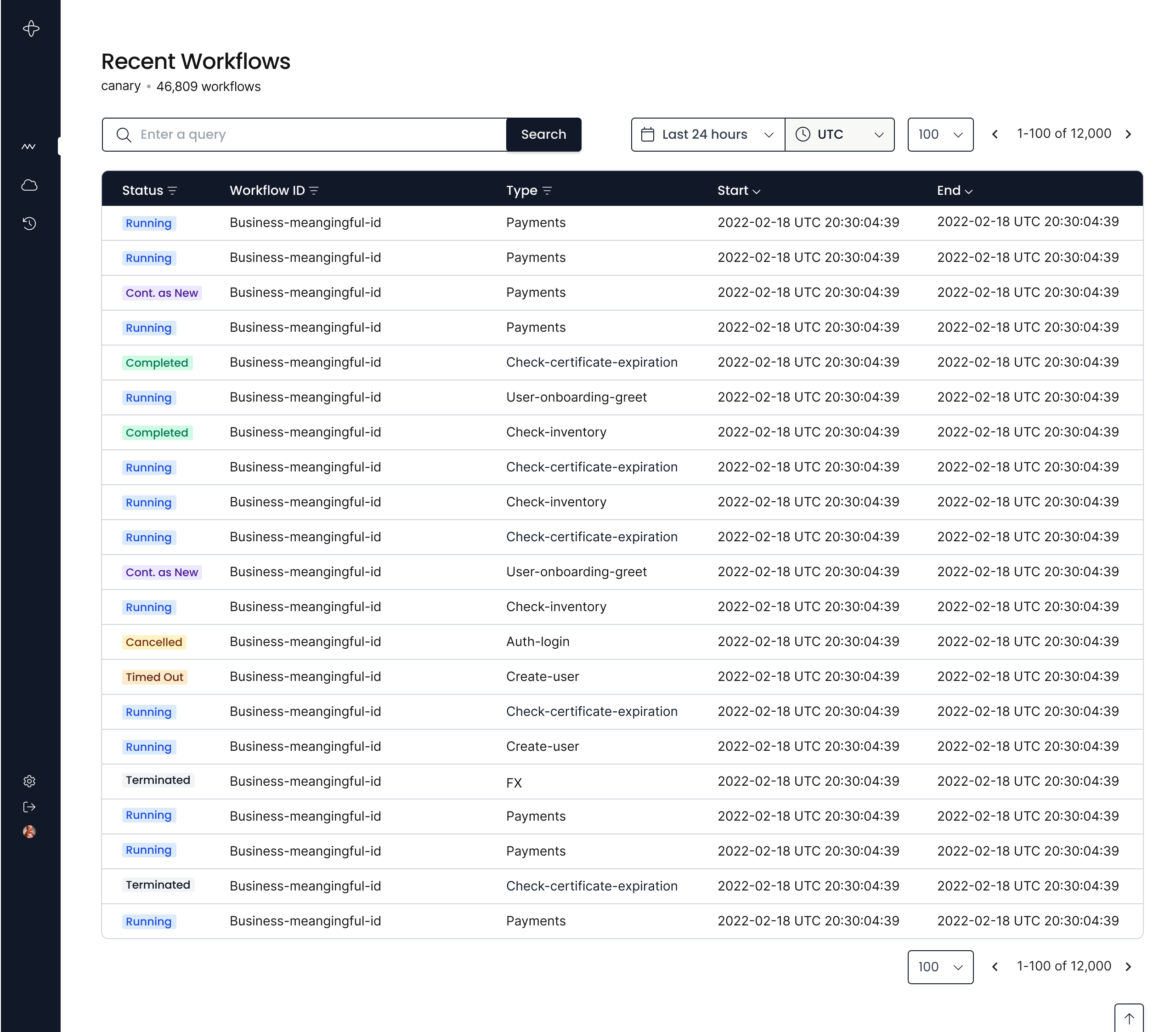
Temporal isn't a data-pipeline scheduler in the Airflow sense — it's a durable execution engine. Code you write as an ordinary function becomes fault-tolerant: state is automatically checkpointed, so a workflow that fails on step 40 of 100 resumes at step 40, not step 1, even after a full process crash. That primitive made it the default choice for teams building long-running, stateful business processes — order fulfillment, loan underwriting, multi-day agent loops — rather than nightly batch jobs. Temporal's product page lists native retries, timers, schedules, and "human in the loop" signals as first-class primitives, with SDKs across Go, Java, Python, TypeScript, and .NET.
Best for: mission-critical, long-running processes that must survive crashes and partial failures without losing state — not scheduled batch ETL.
Pros: automatic state persistence and replay means no custom checkpointing logic; strong multi-language SDK support; built-in visibility into running and historical executions via the Temporal Web UI; open-source core with a managed Temporal Cloud option.
Cons: the durable-execution programming model (deterministic workflow code, separate "activities" for side effects) has a real learning curve compared to writing a plain DAG; it's the wrong tool for simple, scheduled data pipelines where Airflow-style tools are simpler to reason about.
3. Astronomer
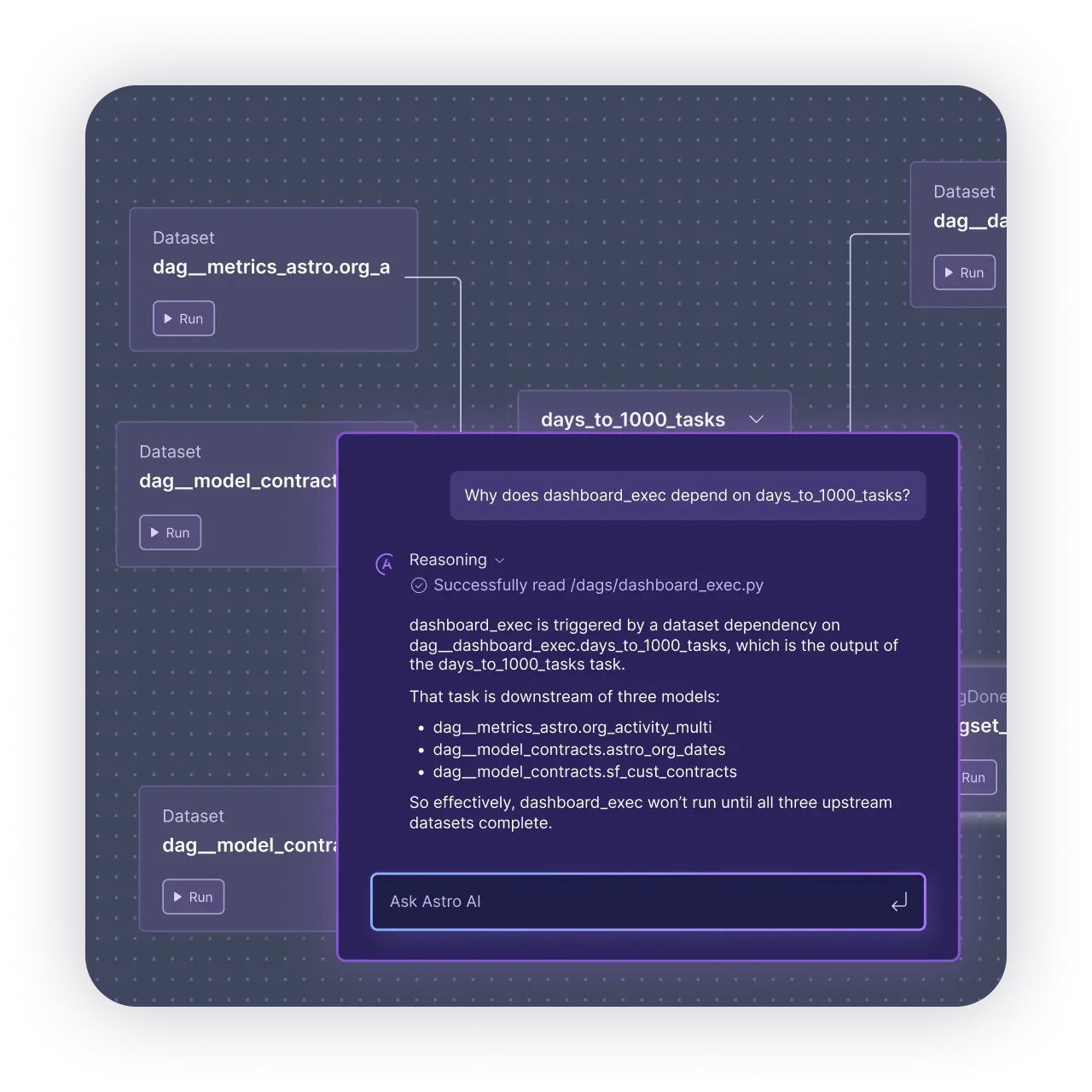
Astronomer is the largest commercial steward of Apache Airflow, the project that effectively defined this category. Rather than replacing Airflow, Astronomer wraps it in a managed platform — Astro — that handles the cluster operations, upgrades, and observability that made self-hosted Airflow painful to run at scale. Its own comparison page against other managed-Airflow vendors makes the case directly: if your team has years of DAGs already written in Airflow's task-dependency syntax, migrating to a fundamentally different orchestration model is expensive, and a managed layer on top of what you already run is the lower-risk path.
Best for: organizations with an existing, substantial investment in Apache Airflow DAGs who want to stop operating Airflow infrastructure themselves.
Pros: full compatibility with the enormous existing Airflow ecosystem of providers and operators; managed infrastructure removes the operational burden of running Airflow's metadata database and scheduler at scale; strong CI/CD and local-development tooling via the Astro CLI.
Cons: inherits Airflow's core architectural constraints — it's still fundamentally a task-based DAG scheduler, not a durable-execution engine, so it's a poor fit for long-running, stateful processes; teams starting from zero with no Airflow history have less reason to choose it over a newer, purpose-built alternative.
4. Argo Workflows (Akuity)
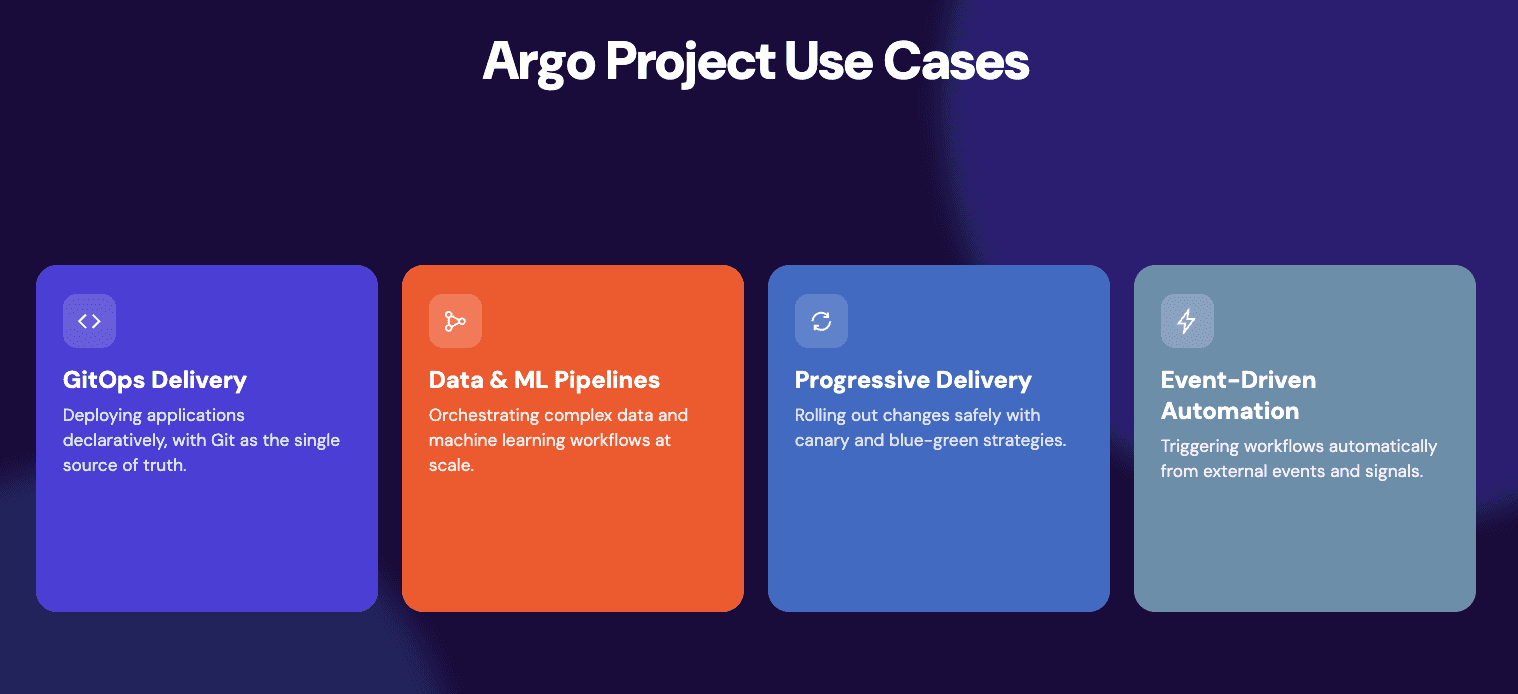
Argo Workflows is the CNCF-graduated, Kubernetes-native workflow engine — each step in a workflow runs as its own container in its own pod, defined in Kubernetes custom resources rather than a separate scheduler process. That makes it the natural choice for teams that have already standardized their infrastructure on Kubernetes and don't want to run a second, non-Kubernetes-native control plane alongside it. Akuity, founded by former Argo maintainers, commercializes it with a managed control plane and enterprise support, positioning itself as the managed layer for both Argo CD and Argo Workflows.
Best for: Kubernetes-native platform teams running CI/CD pipelines, ML training jobs, or batch processing entirely within an existing Kubernetes cluster.
Pros: no separate infrastructure to run — workflows are Kubernetes resources, scheduled by Kubernetes itself; strong container-native parallelism (fan-out/fan-in patterns are a core primitive); free and open source at its core, with CNCF graduation as a maturity signal; wide adoption across CI/CD and MLOps use cases.
Cons: tightly coupled to Kubernetes — not a realistic option for teams without a Kubernetes cluster already in place; YAML-based workflow definitions get verbose fast for complex, deeply nested pipelines compared to code-first alternatives like Prefect or Temporal.
5. Kestra
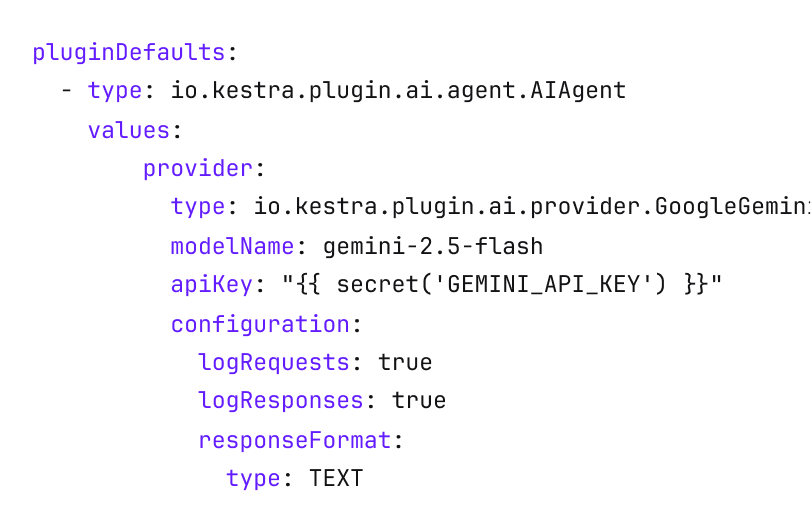
Kestra takes a declarative, language-agnostic approach: workflows are defined in YAML rather than a specific programming language's SDK, with a plugin system covering hundreds of integrations. That design choice trades some of the flexibility of a code-first tool like Prefect for something a broader mix of data engineers, analysts, and platform teams can read and modify without knowing Python or Go. Kestra is open source at its core, with a paid Enterprise Edition adding governance, RBAC, and multi-tenancy for larger organizations.
Best for: mixed-skill teams who want a single orchestration tool usable by both software engineers and less code-heavy data practitioners.
Pros: low barrier to entry — YAML plus a large plugin catalog covers most common integrations without custom code; language-agnostic, so tasks can shell out to any runtime; built-in event-driven triggers alongside traditional scheduling; active open-source community.
Cons: YAML-based definitions can become unwieldy for workflows with heavy conditional logic or dynamic task generation, where a code-first tool is more natural; younger and smaller than Airflow-era incumbents, so the plugin ecosystem, while broad, has less production mileage on the long tail of integrations.
6. Union.ai (Flyte)
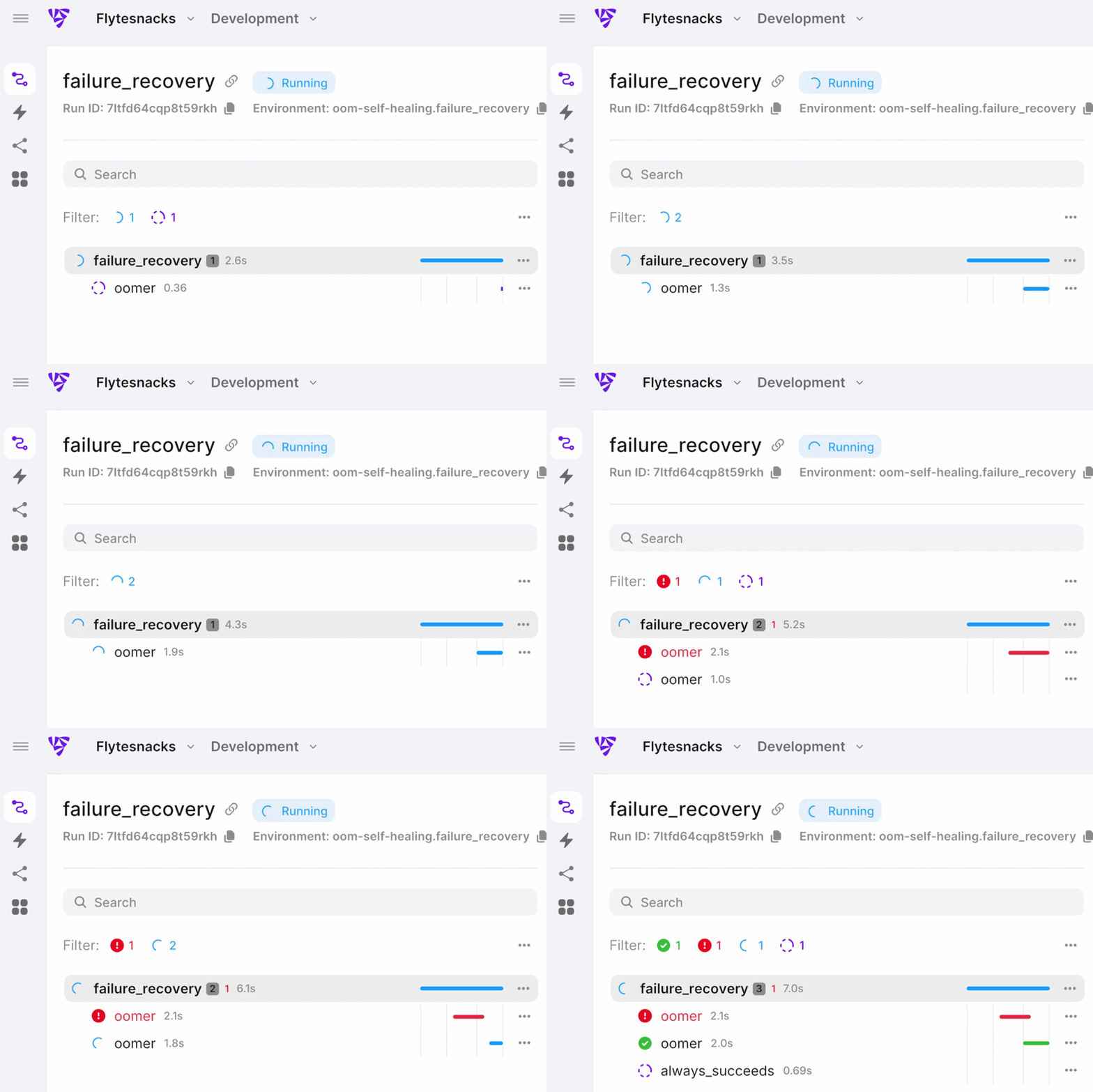
Union.ai is the commercial steward of Flyte, an open-source, Kubernetes-native orchestrator originally built inside Lyft for machine-learning pipelines and later donated to the Linux Foundation. Flyte's core differentiator is strong typing and caching baked into the workflow definition itself — every task's inputs and outputs are typed, so intermediate results can be cached and reused across pipeline runs, which matters when a single training pipeline can otherwise take hours to re-execute from scratch after a minor code change. Union.ai shipped Flyte 2 as a general-availability release in 2026, extending the project further toward general-purpose AI and agentic workflows rather than only ML training pipelines.
Best for: ML and AI teams running training, evaluation, or agentic pipelines who want strong typing, caching, and reproducibility built into the orchestration layer itself.
Pros: type-safe task interfaces catch pipeline errors before execution rather than mid-run; built-in caching meaningfully cuts iteration time on expensive ML pipelines; Kubernetes-native and cloud-agnostic; open-source core with Union.ai's managed serverless offering as an on-ramp.
Cons: the typed, ML-oriented design is a better fit for training and inference pipelines than for general business-process orchestration; like Argo, it assumes a Kubernetes-centric infrastructure, which is a real barrier for teams that aren't already there.
7. Outerbounds (Metaflow), now part of Anaconda

Metaflow, the open-source framework at the center of Outerbounds' platform, was originally built inside Netflix to let data scientists move from a laptop notebook to a production pipeline without rewriting their code for infrastructure. Outerbounds commercialized it, and on April 29, 2026, Anaconda announced it was acquiring Outerbounds, according to Anaconda's own press release and coverage from The New Stack. Anaconda's stated goal is to fold Metaflow's orchestration into a broader "AI-native development" platform spanning the full lifecycle from experimentation to production, with named Metaflow users including Realtor.com and GE HealthCare cited in the announcement.
Best for: data-science-first teams who want to go from notebook prototype to production pipeline with minimal infrastructure code, especially those already using the Anaconda ecosystem.
Pros: genuinely designed around the data scientist's workflow rather than a platform engineer's, with a low-friction path from local experimentation to cloud-scale execution; battle-tested at Netflix scale before being open sourced; now backed by Anaconda's broader distribution and enterprise sales reach post-acquisition.
Cons: the acquisition closed only months ago, and how deeply Metaflow gets integrated into Anaconda's wider product suite versus kept as a standalone tool is still an open question for teams planning multi-year infrastructure bets; historically narrower general-purpose workflow tooling (retries, human-in-the-loop, event triggers) compared to Temporal or Prefect.
How to choose
Start with what you're actually orchestrating. If it's scheduled, mostly-batch data pipelines and you already have Airflow DAGs, Astronomer removes the operational burden without a rewrite. If you're building long-running, stateful business processes — anything that has to survive a crash mid-execution and resume exactly where it left off — Temporal is purpose-built for that and nothing else on this list matches it. If your workloads are ML or AI pipelines and your infrastructure is already Kubernetes-native, Union.ai's Flyte or Argo Workflows both fit, with Flyte's typed caching mattering more the more expensive your training runs are. If you want one tool that reads as comfortably to a data analyst as to an engineer, Kestra's YAML-first model is the deliberate tradeoff. And if you're choosing a new, general-purpose orchestrator today with no legacy Airflow debt, Prefect's combination of Python-native ergonomics and its newly acquired Dagster asset-lineage tooling is the most actively-consolidating bet in the category.
Frequently asked questions
Is Apache Airflow itself still a good choice in 2026?
Airflow remains the most widely deployed orchestrator by installed base, and its ecosystem of providers and operators is unmatched. The tradeoff is operational: self-hosting Airflow at scale is genuinely hard, which is exactly the gap Astronomer and other managed-Airflow vendors are built to close.
What does the Prefect-Dagster acquisition mean for existing Dagster users?
As of this writing, Prefect has stated the intent to combine Dagster's asset-lineage capabilities into its platform, but the detailed migration path and long-term support timeline for standalone Dagster deployments had not been fully published at the time this article was written. Teams currently on Dagster should track Prefect's official communications directly rather than assume continuity of the standalone product.
Do I need Kubernetes to use any of these?
No. Prefect, Temporal, Astronomer, and Kestra can all run without a Kubernetes cluster (though Kubernetes execution is supported by several of them). Argo Workflows and Flyte are built around Kubernetes and assume you already run one.
What's the difference between a "workflow orchestrator" and a "durable execution engine"?
An orchestrator like Airflow, Astronomer, or Kestra schedules discrete tasks with defined dependencies, typically on a schedule. A durable execution engine like Temporal treats the entire workflow — including its in-memory state — as something that survives crashes and restarts automatically, which matters most for long-running, stateful processes rather than scheduled batch jobs.
The takeaway
The Prefect-Dagster deal is a signal, not an anomaly. A category that spent years multiplying — general orchestrators, ML-specific orchestrators, Kubernetes-native orchestrators, durable-execution engines — is starting to consolidate around a smaller number of platforms trying to cover more ground each. The tools that win from here won't be the ones with the cleverest DAG syntax; they'll be the ones that can absorb a competitor's best idea without breaking what already works in production. For any team choosing today, the safest bet is matching the tool to the shape of the workload you actually have — batch, event-driven, ML, or long-running — rather than the platform with the most funding announcements.
Related: for a head-to-head on the two most commonly confused options in this category, see Temporal vs Airflow.