
Best AI Model for Coding (November 2026)
Claude Sonnet 5.5 tops Terminal-Bench 4.0 at 70.6% for $2/$10 per million tokens - the best AI model for coding for most engineers. Opus 5.5 wins the hardest agents, GPT-6.1 Sol wins on value, DeepSeek V4.1 is the best open-weight coder. Ranked, priced and sourced, November 2026.


The best AI model for coding right now is Claude Sonnet 5.5 for most engineers — it leads Terminal-Bench 4.0 at 70.6% for $2/$10 per million tokens. Claude Opus 5.5 wins the hardest agentic work, GPT-6.1 Sol wins on value, and DeepSeek V4.1 is the best open-weight coder. Pick by task and budget, not one scoreboard.
TL;DR
- Best overall for most engineers: Claude Sonnet 5.5 — tops Terminal-Bench 4.0 at 70.6% at $2/$10 per 1M tokens. Opus 5.5 (66.4%) for the hardest multi-step agent tasks; DeepSeek V4.1 if you need open weights.
- The benchmark order that matters (Terminal-Bench 4.0): Sonnet 5.5 70.6% > Opus 5.5 66.4% > Gemini 4 Carbon 65.2% > GPT-6 Astra 57.9% > Grok 4.7 38.0%.
- What changed: SWE-bench Verified is dead as a tiebreaker. Vals AI archived it on September 1, 2026 after Claude Opus 5 hit 97%, calling performance "saturated." The field moved to Terminal-Bench 4.0, FrontierCode and FrontierSWE.
- Watch cost-per-task, not price-per-token: Grok 4.7 is cheap per token but burned ~81,000 output tokens per task in one independent test — roughly $3.74 a task.
What makes a model good at coding in 2026?
Agentic task completion, not pretty code generation. The best coding model today is the one that finishes a multi-step job — read the repo, run the terminal, fix the failing test, verify — without going off the rails.
That is why Terminal-Bench 4.0 replaced simple code-gen tests as the number engineers quote. It scores whether a model can drive a real terminal to completion.
Four things decide the winner for your stack:
- Agentic reliability over long tool-use chains (the Terminal-Bench axis).
- Context window, for loading large repos in one shot.
- Cost per finished task, which is not the same as price per token.
- Latency, which no leaderboard shows but every developer feels.
A model can top one benchmark and still be the wrong daily driver. Hold that thought — it's the core of our verdict.
Which model has the best coding benchmark score?
Claude Sonnet 5.5 has the best headline coding score: 70.6% on Terminal-Bench 4.0, ahead of its bigger sibling Claude Opus 5.5 at 66.4% (run at "xhigh" effort). Google's Gemini 4 Carbon sits at 65.2% in its own comparison, though access to Carbon is limited to a cybersecurity-defender preview.
| Model | Maker | Terminal-Bench 4.0 | Price (in/out per 1M) | Best for |
|---|---|---|---|---|
| Claude Sonnet 5.5 | Anthropic | 70.6% | $2 / $10 | Best daily driver; top of the board |
| Claude Opus 5.5 | Anthropic | 66.4% (xhigh) | $4 / $20 | Hardest multi-step agent work |
| Gemini 4 Carbon | 65.2% | $2 / $10 (intro) | Long context, security/defense | |
| GPT-6 Astra | OpenAI | 57.9% | $10 / $50 | Premium frontier reasoning |
| Grok 4.7 | xAI | 38.0% | $2 / $6 | Cheap per token, token-hungry |
| DeepSeek V4.1 Flash | DeepSeek | 31.2% | $0.30 / $1.20 | Best open weights, cheapest |
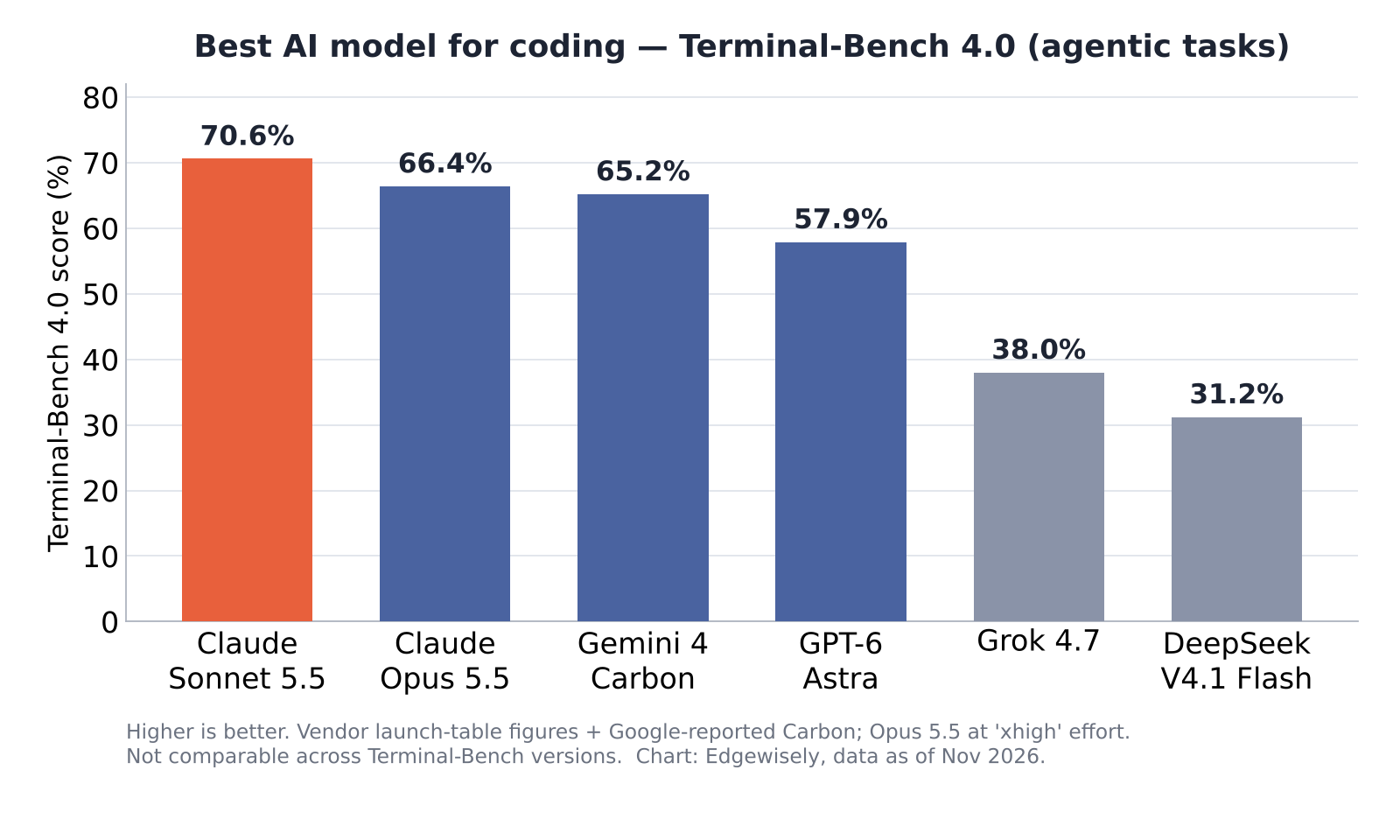
Terminal-Bench 4.0 = agentic terminal tasks. Anthropic, xAI and DeepSeek figures are vendor launch-table numbers (consolidated and checked Oct 10, 2026); Gemini 4 Carbon is Google's reported figure (Oct 28, 2026); Opus 5.5 at "xhigh" effort. Scores are not comparable across Terminal-Bench versions — the same model scored 89.4% on v2.1 and 19.1% on v4.0.
The old headline number no longer separates the leaders. Vals AI archived the SWE-bench Verified board on September 1, 2026, saying "performance on this benchmark has saturated." Its final top five: Claude Opus 5 at 97.0%, DeepSeek V4 Pro at 96.4%, GPT-5.6 Sol at 96.2%, Grok 4.6 at 95.6%, and GPT-5.6 Terra and GLM 5.3 tied at 95.4%.
Read that again: an open-weight model (DeepSeek) and a mid-tier OpenAI model were within a point of the best Claude. When five models cluster inside two points, the benchmark has stopped telling you anything. None of the newest frontier models — Opus 5.5, Sonnet 5.5, GPT-6.1, Gemini 4 — even report SWE-bench Verified anymore; OpenAI deprecated it in February 2026.
What does each coding model cost?
Pricing has compressed hard. $2 input / $10 output per million tokens is now the going rate for a frontier-class coding model — Claude Sonnet 5.5, GPT-6.1 Sol and Gemini 4 Carbon all land there.
| Model | Price (in/out per 1M) | Cache read | Note |
|---|---|---|---|
| Claude Opus 5.5 | $4 / $20 | $0.20 | Anthropic: ~40% cheaper than Opus 5 on typical workloads |
| Claude Sonnet 5.5 | $2 / $10 | $0.20 | Unchanged from Sonnet 5 |
| GPT-6.1 Sol | $2 / $10 | $0.10 | 1.05M-token context; Astra-level agentic at ~1/5 Astra's price |
| GPT-6 Astra | $10 / $50 | n/d | Premium frontier tier |
| Gemini 4 Carbon | $2 / $10 (intro) | ~$0.10 | Intro pricing; $4/$20 afterward |
| Grok 4.7 | $2 / $6 (<200K) | n/d | $4/$12 above 200K; 500K context |
| DeepSeek V4.1 Flash | $0.30 / $1.20 | n/d | MIT license; 1M context |
Prices from vendor pages and launch coverage, Sept–Oct 2026. GPT-6 Astra cache figures marked "n/d" are not cleanly disclosed.
The trap is reading those per-token numbers as cost. Grok 4.7 is the cautionary case. In Artificial Analysis testing cited by VentureBeat, Grok 4.7 at xHigh effort emitted roughly 81,000 output tokens per task — about 196% more than GPT-6 Astra — pushing its real cost to about $3.74 per task. GPT-5.6 Sol Max finished comparable work at about $1.99 a task.
GPT-6.1 Sol runs the other way. It is positioned as matching GPT-6 Astra on agentic coding at roughly one-fifth the price — $2/$10 against Astra's $10/$50 — with a 1.05M-token context. If you run agents at volume, that spread is your bill.
Which free or open model codes best?
DeepSeek V4.1 is the best free, open-weight coding model as of November 2026 — MIT-licensed, 1M-token context, and self-hostable with no per-token fee. Its larger predecessor, DeepSeek V4 Pro, scored 96.4% on the archived SWE-bench Verified board, second only to Claude Opus 5. For a deeper open-vs-closed breakdown, see our DeepSeek vs Claude comparison.
Three other open models are worth knowing: GLM-5.3 (Z.ai) tied 5th on that same board at 95.4%; Kimi K3 (Moonshot) leads the frontend-code arena; and Qwen3.8 (Apache-2.0) is the cleanest license for commercial self-hosting.
The honest caveat: on the harder Terminal-Bench 4.0, open models drop — DeepSeek V4.1 Flash scores 31.2% against Sonnet 5.5's 70.6%. Open weights are at the closed frontier on saturated tests and behind it on the hard agentic ones.
GPT vs Claude for coding: which wins?
Claude wins the agentic-coding benchmark; GPT wins on price-for-reach. On Terminal-Bench 4.0, Sonnet 5.5 (70.6%) and Opus 5.5 (66.4%) both beat GPT-6 Astra (57.9%).
But GPT-6.1 Sol changes the math for cost-sensitive teams: $2/$10 per million tokens, a 1.05M-token context, and near-Astra agentic coding at a fraction of the price. For a large repo and a tight budget, that context window alone can decide it.
Rule of thumb: reach for Claude when task completion and reliability matter most; reach for GPT-6.1 Sol when context size and cost-per-run matter most. Both are defensible daily drivers; the gap is narrower than either marketing page suggests. If low price is your top constraint, our cheapest AI API breakdown ranks the full field by cost.
Which coding model should you pick?
- Solo dev / daily driver: Claude Sonnet 5.5. Top Terminal-Bench 4.0 score, $2/$10, the best quality-per-dollar on the board.
- Hard autonomous agents (refactors, long task chains): Claude Opus 5.5. Anthropic says it stays strongest on complex, open-ended work; pay the $4/$20 when a wrong answer is expensive. See how it stacks up head-to-head in Grok vs Claude.
- Agents at high volume / tight budget: GPT-6.1 Sol. Near-Astra coding at ~1/5 the cost, huge context, cheap cache reads.
- Large codebases / security-sensitive work: Gemini 4 Carbon (or the publicly available Argon) for 1M+ context — but note Carbon's limited rollout.
- Privacy / self-hosting / zero per-token cost: DeepSeek V4.1 (MIT) or Qwen3.8 (Apache-2.0).
- Avoid for coding if you watch spend: Grok 4.7. Low per-token price, but heavy token consumption can make the per-task bill higher than pricier models.
Our take
The number everyone still asks for — "who leads SWE-bench Verified?" — is the wrong question, and has been since September. When Vals AI froze the board with five models inside two points and called it saturated, the benchmark stopped being a ranking and became a pass/fail gate. Every serious coding model now clears it. Quoting a 96% or 97% SWE-bench Verified score in November 2026 is like bragging about a passing grade.
So treat SWE-bench Verified as table stakes and judge on what still separates models: agentic reliability and cost per finished task. That reframing changes the verdict. Terminal-Bench 4.0 is harder, less saturated, and measures the thing you actually buy a coding model for — can it drive a terminal to a correct end state. On that axis there is real spread (70.6% down to 31.2%), and Claude leads it.
Here is the part the benchmarks hide. SWE-bench or Terminal-Bench leadership is not the same as best daily coding model. A leaderboard runs each task once, at maximum effort, with no latency penalty and no budget. Your editor loop runs thousands of times a day, at default effort, where a two-second lag and a doubled token bill are real costs. That is why Sonnet 5.5 topping the board and costing half of Opus is the quietly decisive result of this cycle: the cheaper, faster model is also the most capable on the headline test. When the value pick and the quality pick are the same model, you take it.
The cost story is the one most "best model" lists get wrong, and it deserves to be loud. Price per token is marketing; cost per finished task is your invoice. Grok 4.7 is the proof — genuinely cheap per token, genuinely expensive per task, because it burns ~81,000 output tokens to finish what GPT-6 Astra finishes in ~27,000. Anyone building a coding agent should benchmark on completed-task cost inside their own harness before trusting any sticker price, including the ones in our tables above. The vendors run their own harnesses at their own effort settings; your mileage will differ.
For builders, the implication is concrete. If you ship an IDE assistant or an autonomous agent, default to Sonnet 5.5 or GPT-6.1 Sol and reserve Opus 5.5 for the hard calls — a router that escalates only the gnarly tasks to the $4/$20 model captures most of the quality at a fraction of the spend. If you need open weights for privacy or cost control, DeepSeek V4.1 gets you to the saturated frontier, but accept that it still trails on genuinely hard agentic work; don't pretend that gap is closed.
A word on the model names, because this field churns. We verified every figure here against vendor pages and dated leaderboards in November 2026, and omitted anything we couldn't source — including current SWE-bench Verified scores for the newest models, which simply don't exist because nobody reports them. If a comparison quotes a crisp SWE-bench Verified number for Opus 5.5 or Gemini 4, be skeptical: it's almost certainly carried over from an older model or invented.
The verdict. Best for most engineers: Claude Sonnet 5.5 — top of Terminal-Bench 4.0 at half Opus's price. Best for the hardest agents: Claude Opus 5.5. Best value at volume: GPT-6.1 Sol. Best open: DeepSeek V4.1. Avoid for budget-sensitive coding: Grok 4.7, until its token appetite comes down. The "best AI model for coding" is a split decision — and that split, not any single score, is the answer. For model-by-job picks in other domains, see our guides to the best LLM for math and writing.
Frequently Asked Questions
What AI model is best for coding?
Claude Sonnet 5.5 is the best AI model for coding for most engineers as of November 2026. It tops Terminal-Bench 4.0 at 70.6% (Anthropic's figure) and costs $2/$10 per million tokens. For the hardest multi-step agent work, Claude Opus 5.5 edges ahead at $4/$20 per million tokens.
Which AI model is best for coding in 2026?
In late 2026, Claude leads: Sonnet 5.5 (70.6% Terminal-Bench 4.0) for daily work and Opus 5.5 (66.4%) for hard agent tasks. Google's Gemini 4 Carbon is close at 65.2%. GPT-6 Astra and GPT-6.1 Sol trail on that benchmark but suit premium reasoning and cost-sensitive, high-volume jobs respectively.
Which free AI model is best for coding?
DeepSeek V4.1 is the best free, open-weight coding model as of November 2026 — MIT-licensed, with a 1M-token context and self-hostable at no per-token cost. Its predecessor DeepSeek V4 Pro reached 96.4% on the archived SWE-bench Verified board. On harder Terminal-Bench 4.0, open models still trail the closed frontier.
What is the best Claude AI model for coding?
Claude Sonnet 5.5 is the best Claude model for everyday coding — it leads Terminal-Bench 4.0 at 70.6% for $2/$10 per million tokens. Claude Opus 5.5 ($4/$20) is stronger on complex, open-ended agent work, per Anthropic. Claude Haiku 5.5 handles cheap, high-volume edits at a fraction of the price.
Is GPT or Claude better for coding?
Claude is better for coding on the headline agentic benchmark as of November 2026: Sonnet 5.5 (70.6%) and Opus 5.5 (66.4%) both beat GPT-6 Astra (57.9%) on Terminal-Bench 4.0. GPT-6.1 Sol wins on price — $2/$10 with a 1.05M-token context — for cost-sensitive agent runs at volume.
Editor's note — sources: figures verified against vendor pages and dated leaderboards, November 2026; see linked sources throughout. Benchmark scores are not comparable across Terminal-Bench versions or testing harnesses. Vendor-reported scores are attributed as such.