
The 7 Best ML Feature Stores in 2026
This roundup is for ML platform teams, MLOps engineers, and data leads deciding how to manage the pipeline between raw data and model-ready features — and for anyone confused by a category that just went through a wave of consolidation, with Databricks buying two feature-store startups in 2025 and R


This roundup is for ML platform teams, MLOps engineers, and data leads deciding how to manage the pipeline between raw data and model-ready features — and for anyone confused by a category that just went through a wave of consolidation, with Databricks buying two feature-store startups in 2025 and Redis absorbing a third.
A feature store is the layer that turns raw, scattered data into the consistent, point-in-time-correct inputs a model actually trains and serves on. Ask "which ML feature store should we use" today and the honest answer starts with: it depends whether you want an open-source standard, a hyperscaler-native service, or a specialist platform, because the market just consolidated hard. Databricks acquired both Tecton and Fennel in 2025, folding two well-funded feature-engineering startups into its own Unity Catalog stack, and Redis bought Featureform in October 2025, relaunching it in April 2026 as Redis Feature Form. That leaves fewer independent feature-store vendors than there were twelve months ago — and a clearer set of categories: open source, cloud-native, and a handful of standalone specialists.
Below are the seven feature store platforms worth evaluating in 2026, chosen for genuine adoption, active development, and distinct positioning — not alphabetically, and not because any of them sponsored this piece.
How we picked these
We prioritized platforms with verifiable primary-source information: an official site, current documentation, a changelog or release history, and, where relevant, disclosed funding or acquisition status. We looked at four factors — maturity (how long the product has been in production use and how actively it ships), adoption (GitHub activity, named customers, or platform reach), capability breadth (offline plus online serving, point-in-time correctness, streaming support), and fit for a specific buyer profile (open source, AWS-native, GCP-native, enterprise on-prem, or real-time fintech). We excluded feature-store products that have been folded into a parent platform and no longer exist as a standalone offering (Tecton and Fennel, both acquired by Databricks in 2025).
Quick comparison
| Company | Best for | Deployment | Pricing model |
|---|---|---|---|
| Feast | Open-source, vendor-neutral feature definitions | Self-hosted (Kubernetes, VMs); Apache-2.0 | Free open source |
| Hopsworks | Regulated or air-gapped enterprises | Managed SaaS, self-hosted, or on-prem/air-gapped | Pay-as-you-go credits ($0.35/credit) plus enterprise licensing |
| Databricks Feature Store | Teams already on Databricks/Unity Catalog | Managed, part of the Databricks platform | Databricks Units (DBU) consumption |
| Amazon SageMaker Feature Store | AWS-native ML teams | Fully managed AWS service | Usage-based: per read/write request plus storage |
| Google Vertex AI Feature Store | GCP-native teams building on BigQuery | Fully managed GCP service | Usage-based: per 1,000 serving requests |
| Chalk | Real-time fintech and risk models | Deployed in the customer's own cloud | Pricing on request |
| Redis Feature Form | Teams already running Redis at scale | Managed or self-hosted, built on Redis | Pricing on request (part of Redis Enterprise) |
1. Feast
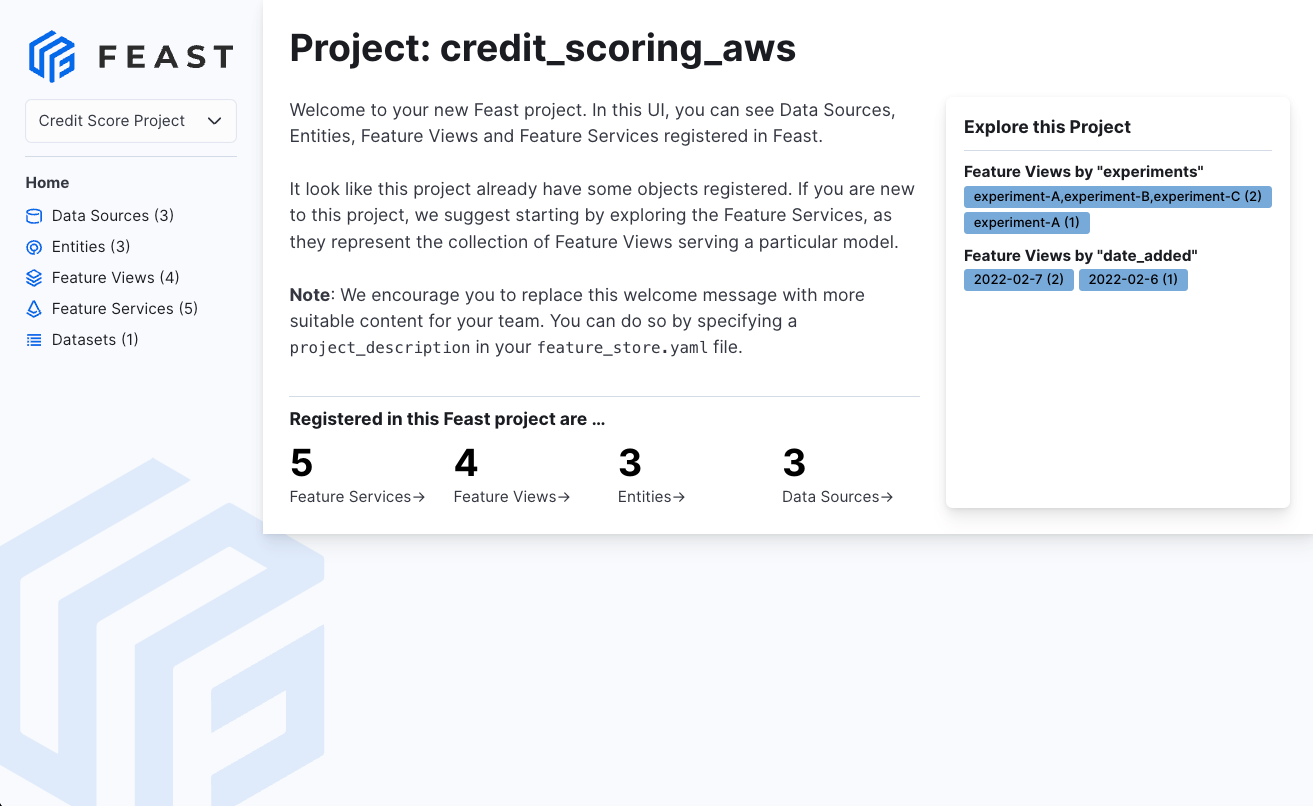
Feast (Feature Store) is an open source feature store originally built at Gojek and Google, donated to the Linux Foundation AI & Data Foundation in 2020, where it remains an active incubation-stage project. It separates an offline store (for historical, point-in-time-correct training data) from an online store (for low-latency serving), and it plugs into a long list of existing infrastructure — Snowflake, BigQuery, Redshift, Spark, Postgres, and more than a dozen online stores including Redis, DynamoDB, and Bigtable — rather than requiring a new dedicated database. As of August 2026, the project reports more than 12 million downloads, 293 contributors, and 7,100+ GitHub stars, with adopters and contributors including Robinhood, Discord, Cloudflare, Walmart, Shopify, and NVIDIA named on its site. Feast is licensed Apache-2.0 and is free to run yourself; commercial support is available through vendors that build on top of it rather than from a single company that owns the project.
Best for: Teams that want a vendor-neutral, open-source feature-store standard they can self-host on any cloud or on-prem.
Pros - Apache-2.0 license with no vendor lock-in; you own the deployment - Broad integration surface — 10+ offline stores, 20+ online stores, including vector databases like Milvus and Qdrant - Governed by the Linux Foundation AI & Data Foundation, reducing single-vendor risk - Active release cadence (v0.63.0 as of May 2026, 130+ releases)
Cons - You operate and scale it yourself; there's no first-party managed cloud offering from the project itself - Feature transformation orchestration is thinner than in commercial platforms — you often still need Spark, Flink, or a scheduler alongside it - Some advanced capabilities (streaming transformations, batch transformation) are still marked alpha or in progress on the public roadmap - Governance and access-control features are more basic than enterprise-focused competitors
2. Hopsworks
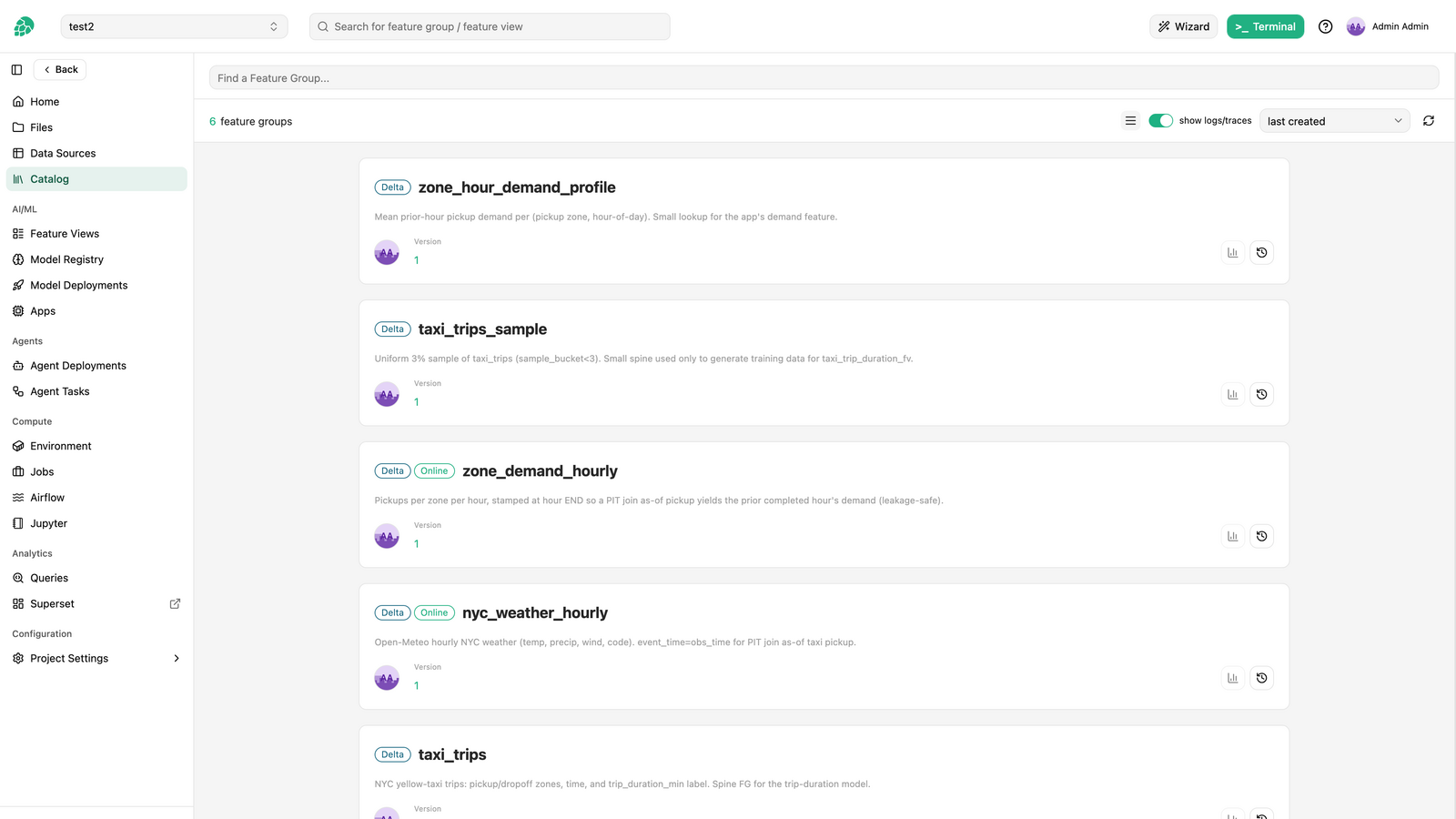
Hopsworks, built by Swedish company Hopsworks AB, positions itself as an "AI Lakehouse" with the feature store as its original and central capability. Its online store is powered by RonDB, a distributed key-value store the company says delivers sub-millisecond feature retrieval, and it works directly with open table formats — Delta, Iceberg, and Hudi — without requiring data migration. Hopsworks can be deployed as a managed cloud service, self-hosted on Kubernetes across AWS EKS, GCP GKE, or Azure AKS, or run fully on-premises in air-gapped environments, which the company markets specifically toward government, defense, and financial-services customers. Named customers on its site include Zalando (used to power real-time personalization across 25 countries), Ericsson, Saab, and Karolinska Institutet. Pricing follows a pay-as-you-go credit model at $0.35 per credit, with a free tier and no credit card required to start, according to Hopsworks' own pricing page as of August 2026.
Best for: Regulated or air-gapped enterprises that need a mature, self-hostable feature store with sub-millisecond serving.
Pros - One of the longest-running dedicated feature-store products still operating independently - Genuine on-premises and air-gapped deployment support, not just a marketing checkbox - Works natively with Delta, Iceberg, and Hudi tables without conversion - Named production customers across fintech, telecom, defense, and healthcare
Cons - Smaller company and community than the hyperscaler options or Feast; less third-party tooling and fewer public integrations - Credit-based pricing can be difficult to estimate upfront for teams new to the platform - Full self-hosted deployment (Kubernetes, RonDB) carries real operational overhead compared to a managed cloud service - Documentation and tutorials skew toward Python/Spark users; less guidance for teams on other stacks
3. Databricks Feature Store
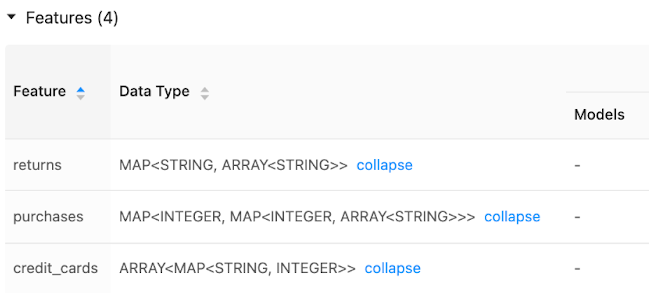
Databricks Feature Store is a central feature registry built into Unity Catalog, Databricks' governance layer. It supports two authoring paths: declarative Feature Views, where Databricks manages the compute pipeline for you (in public preview as of August 2026), and Feature tables, where teams write feature values to a governed Delta table themselves. Registering features in Unity Catalog gives teams lineage tracking, point-in-time joins for training, and an Online Feature Store (built on the newer Lakebase Postgres layer) for real-time serving. What changed the category most in 2025: Databricks acquired both Tecton and Fennel — two well-capitalized feature-engineering startups — and has said it's folding their real-time computation technology into this stack and into Agent Bricks, its AI agent product. That makes Databricks Feature Store the platform most directly shaped by the recent M&A wave, for better (more real-time capability inherited) or worse (less competition, more lock-in for Databricks customers).
Best for: Organizations already standardized on Databricks and Unity Catalog for governance, lineage, and ML lifecycle management.
Pros - Deep integration with Unity Catalog governance, lineage, and access control — no separate system to reconcile - Automatic feature lookup at training and inference time reduces training/serving skew - Inherited real-time feature engineering technology from the Tecton and Fennel acquisitions in 2025 - Works natively with Databricks' existing ETL (Lakeflow) and model-serving infrastructure
Cons - Only usable within the Databricks platform; not a fit if you're not already running Databricks - Requires Unity Catalog to be enabled; the legacy Workspace Feature Store is deprecated for non-Unity-Catalog workspaces - Feature Views, the recommended authoring path, is still in public preview, not GA, as of August 2026 - Pricing is tied to Databricks Unit consumption, which can be hard to isolate and forecast for feature-store workloads specifically
4. Amazon SageMaker Feature Store
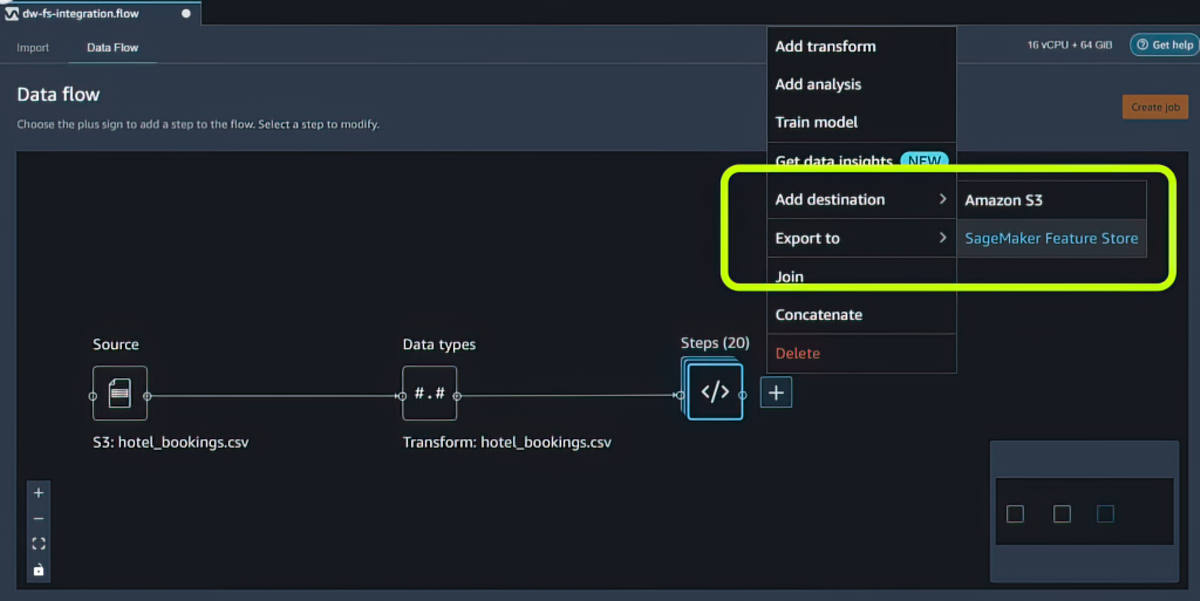
Amazon SageMaker Feature Store is AWS's fully managed feature repository, built to keep offline (training) and online (inference) feature values synchronized so they don't drift apart. It ingests from S3, Redshift, Lake Formation, Snowflake, and Databricks Delta Lake, and it supports point-in-time queries so teams can reconstruct exactly what a feature's value was at a specific historical moment, avoiding data leakage. Discovery runs through AWS Glue Data Catalog by default and is queryable via Amazon Athena. AWS publishes concrete usage-based pricing: charges apply per million read/write requests, per GB of storage per month, and per GB of data transfer, with a free tier that includes 10 million write units, 10 million read units, and 25 GB of standard online storage, according to AWS's own pricing documentation as of August 2026.
Best for: AWS-native ML teams that want a managed feature store without standing up separate infrastructure.
Pros - Transparent, publicly published usage-based pricing rather than "contact sales" - Native integration with SageMaker Studio, Glue Data Catalog, and Athena for discovery and querying - Supports fine-grained, row-level access control when combined with AWS Lake Formation - Free tier lets small teams evaluate it without upfront commitment
Cons - Tightly coupled to the AWS ecosystem; migrating off later means rebuilding both storage and pipeline logic - Costs scale with request volume and can become significant at high-throughput, low-latency use cases - Feature transformation logic still generally lives outside the service (Spark, Data Wrangler, or custom code), so it's a store more than a full feature-engineering platform - Cross-account sharing and some newer features (in-memory online store, provisioned capacity mode) were added incrementally and require checking version-specific documentation
5. Google Vertex AI Feature Store
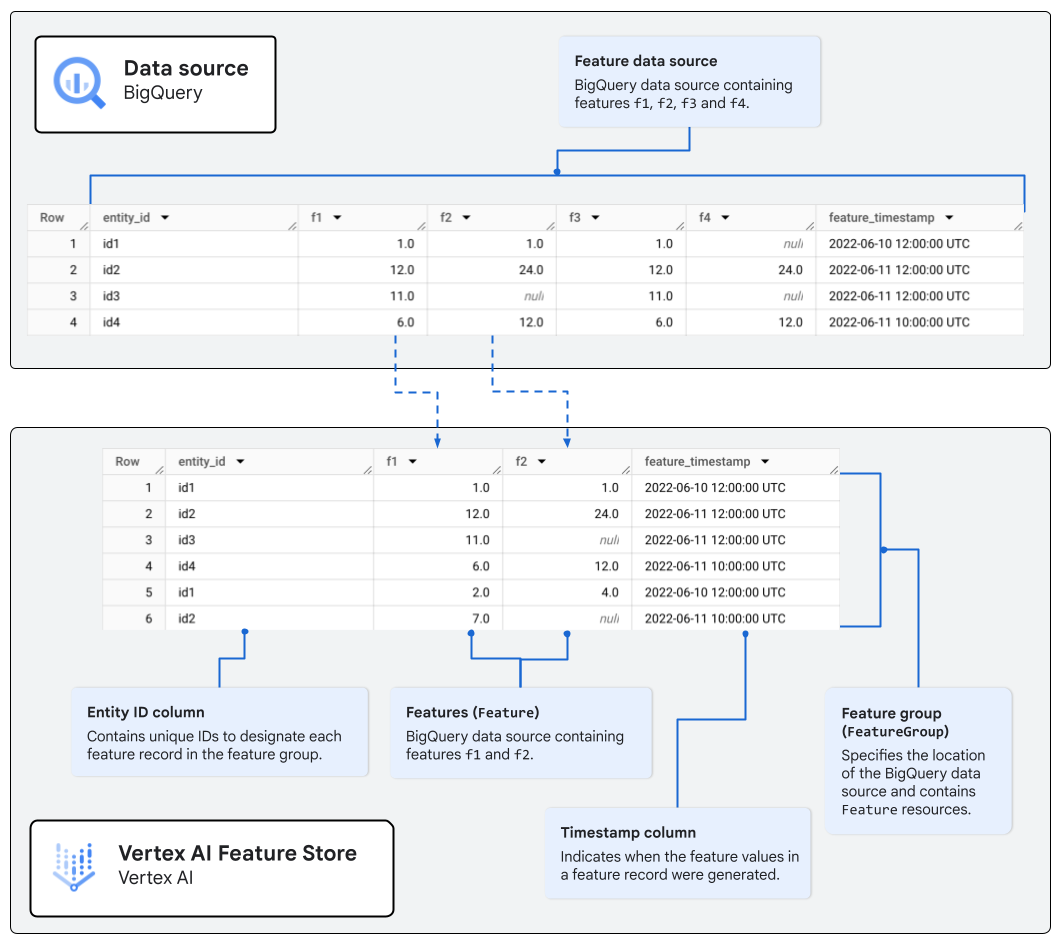
Vertex AI Feature Store is Google Cloud's managed feature-serving layer, built to work closely with BigQuery as the source of truth for feature data. Teams define feature groups and views over BigQuery tables, and Vertex AI handles low-latency online serving without a separate database to manage. Google publishes per-request pricing: $0.25 per 1,000 online serving requests and $0.005 per 1,000 batch serving requests, according to Google Cloud's pricing page as of August 2026. New Google Cloud customers also get $300 in credits valid for 90 days across Vertex AI services, which can offset early experimentation costs.
Best for: GCP-native teams building feature pipelines on top of BigQuery who want managed online/offline serving without extra infrastructure.
Pros - Simple, published per-request pricing for both online and batch serving - Uses BigQuery directly as the offline store, avoiding duplicate data pipelines for GCP-heavy teams - Managed service with no cluster or database to operate - Integrates with the rest of Vertex AI's model training and deployment tools
Cons - Locked into the GCP ecosystem and BigQuery specifically; less useful if your data lives elsewhere - Less standalone documentation and community content than Feast, Hopsworks, or the AWS equivalent, making troubleshooting harder outside official docs - Point-in-time correctness and feature versioning tooling is less mature in public documentation compared to dedicated feature-store products - Per-request pricing model means costs are variable and depend heavily on traffic patterns, making budgeting harder for spiky workloads
6. Chalk

Chalk is a San Francisco startup founded in 2022 that builds what it calls an "AI data platform" — a real-time feature and compute layer aimed at fraud, credit, and recommendation models that need fresh data at the moment of inference. Chalk deploys inside the customer's own cloud account rather than as a fully hosted multi-tenant SaaS, and it runs on a Rust-based execution engine that the company says can handle 100,000 queries per second at under 5 milliseconds of latency. Chalk raised a $50 million Series A in May 2025 at a $500 million valuation, according to Reuters, following a $10 million seed round in December 2023 led by General Catalyst, Unusual Ventures, and Xfund, bringing total disclosed funding to roughly $60 million. Chalk names Whatnot, Mission Lane, and other fintech and marketplace companies as customers on its site; Chalk's own case study quotes a Whatnot VP describing sustained throughput of "hundreds of millions of features per second" at a P99 latency of 100 milliseconds.
Best for: Fintech and risk teams that need ultra-low-latency real-time features deployed inside their own cloud rather than a shared multi-tenant service.
Pros - Deploys into the customer's own infrastructure and existing databases rather than requiring a new bespoke store - Well-capitalized ($500 million valuation as of its 2025 Series A) with active product development - Named, verifiable customers with specific published performance figures (Whatnot's case study) - Built-in observability for feature drift and data quality, not bolted on separately
Cons - Pricing is not published; prospective customers must book a demo to get a quote - Smaller and newer than the hyperscaler options, with a correspondingly smaller public documentation and community footprint - Deploy-in-your-cloud model shifts more operational responsibility (infrastructure, scaling, patching) onto the customer than a fully managed SaaS - Positioned primarily around real-time/fraud/risk use cases; less proven for batch-heavy, offline-first ML workflows
7. Redis Feature Form
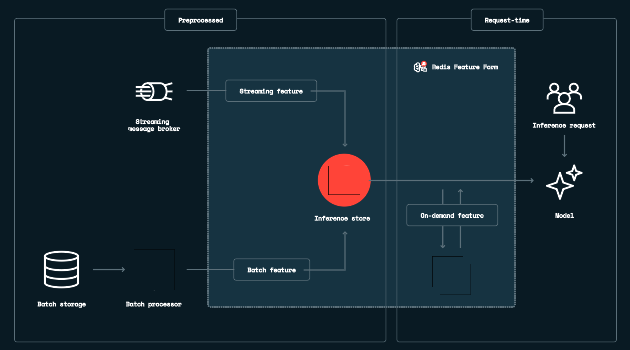
Redis Feature Form is the product formerly known as Featureform, an independent feature-store startup that Redis acquired in October 2025. Redis relaunched it in April 2026 as a more tightly integrated product, adding workspaces for multi-tenancy, atomic DAG-level updates for safer rollbacks, enhanced role-based access control, and a redesigned dashboard, according to Redis's own product announcement. The pitch is that teams define features as code, and Feature Form turns those definitions into orchestrated pipelines across existing systems like Snowflake and Databricks, while keeping a Redis online store updated for low-latency retrieval — leaning on Redis's existing reputation as a caching and real-time data layer. Redis cites DoorDash reporting a 38% decrease in serving latency and iFood reporting sub-millisecond reads per feature lookup as production results, though these figures describe Redis's broader use as an online feature store rather than Feature Form specifically.
Best for: Teams already running Redis at scale who want a governed feature-definition and orchestration layer bolted directly on top of it.
Pros - Backed by Redis's operational maturity and existing footprint in over 10,000 customer environments - Newly added enterprise controls (workspaces, RBAC, audit logs, atomic DAG updates) address real gaps from the pre-acquisition Featureform product - Works with existing offline systems (Snowflake, Databricks, Spark) rather than requiring a data migration - Can pair with Feast as an offline store while using Redis purely for online serving, for teams that want to mix and match
Cons - The newest and least battle-tested version of the product in this list — Redis Feature Form only shipped its current enterprise-focused release in April 2026 - Pricing is not published separately from Redis Enterprise's broader licensing, making cost comparison difficult - Some cited performance figures (DoorDash, iFood) describe Redis generally as an online store, not the Feature Form orchestration layer specifically, so they shouldn't be read as Feature Form benchmarks - Post-acquisition product direction is still new enough that long-term roadmap commitment is less certain than for products with a longer independent or single-owner track record
How to choose
Start with where your data and models already live. If you're deep in Databricks, evaluate Databricks Feature Store first — you'll get governance and lineage for free and inherit the real-time engineering Databricks bought in 2025. If you're AWS- or GCP-native, SageMaker Feature Store or Vertex AI Feature Store remove the need to run separate infrastructure, and both publish real usage-based pricing you can model before committing. If you want to avoid vendor lock-in entirely, or you're building on a mix of clouds and on-prem systems, Feast is the default open-source answer, with Hopsworks as the option if you need a more complete platform with genuine on-premises and air-gapped support. If your bottleneck is real-time serving latency for fraud, credit, or recommendation models specifically, look at Chalk or Redis Feature Form — but budget time to get a real quote, since neither publishes list pricing. Whichever you pick, ask for a reference customer at your scale and confirm point-in-time correctness (not just online serving speed) before you commit, since that's the property that actually prevents training/serving skew.
If feature stores are one piece of your ML infrastructure stack, a few adjacent categories are worth the same scrutiny: our rundowns of GPU cloud providers for AI training and inference, LLM fine-tuning platforms, vector databases, synthetic data platforms for AI training, and AI agent frameworks for production cover the surrounding stack most ML teams end up assembling alongside a feature store.
Frequently Asked Questions
What is a feature store in machine learning?
A feature store is infrastructure that stores, manages, and serves the input variables ("features") used to train and run ML models. It keeps an offline store for historical training data and an online store for low-latency serving, ensuring both use identical feature definitions so training and production don't drift apart.
Is Feast free to use?
Yes. Feast is licensed Apache-2.0 and free to download and self-host. You pay only for the infrastructure you run it on (compute, storage, and whichever offline/online stores you connect, such as Snowflake or Redis) and for any third-party commercial support you choose to buy.
What happened to Tecton and Featureform?
Databricks acquired Tecton in 2025 and folded its real-time feature-engineering technology into its own platform and Agent Bricks product. Databricks also acquired feature-engineering startup Fennel in April 2025. Separately, Redis acquired Featureform in October 2025 and relaunched it in April 2026 as Redis Feature Form.
Do I need a feature store if I'm just using one model?
Probably not yet. Feature stores solve problems that appear once multiple models or teams need to reuse the same features consistently across training and serving — duplicate pipeline logic, training/serving skew, and lack of feature discovery. A single model with a stable, simple pipeline may not need one.
Which feature store has the lowest lock-in?
Feast, since it's open source, self-hostable, and works with more than a dozen offline and online store backends you can swap. Hyperscaler-native options (SageMaker, Vertex AI) and platform-native options (Databricks) trade some of that flexibility for tighter integration with the rest of their respective ecosystems.
Editor's note — sources: This roundup draws on each company's official website, product documentation, and pricing pages as of August 2026, along with GitHub for Feast's release and contributor data, and third-party reporting from Reuters (Chalk's Series A) and GlobeNewswire (Redis Feature Form's launch). Semrush keyword data informed the target phrase. Acquisition details for Tecton, Fennel, and Featureform were confirmed via multiple independent news sources including InfoWorld, Yahoo Finance/Reuters syndication, and Redis's own announcement.