
7 Best Synthetic Data Platforms for AI Training in 2026
A practical, sourced comparison for data and ML teams evaluating synthetic data tools in 2026, the year the category's best-known startup, Gretel, stopped existing as an independent company.


A practical, sourced comparison for data and ML teams evaluating synthetic data tools in 2026, the year the category's best-known startup, Gretel, stopped existing as an independent company.
Synthetic data platforms generate artificial datasets that mimic the statistical properties of real data without exposing the underlying records, and they've moved from a privacy workaround to a core piece of AI training infrastructure. Gartner has forecast that by 2028, 80 percent of the data used in AI models will be synthetic, up from 20 percent in 2024, according to reporting from CIO.com. Below are the seven platforms worth evaluating in 2026, chosen and ranked using the criteria in the next section, as of August 2026.
This has also been a year of consolidation. NVIDIA acquired Gretel, one of the category's best-known standalone startups, in March 2025, and its technology now lives inside NVIDIA's NeMo platform rather than as an independent product. Syntho acquired the MOSTLY AI brand in June 2026. Datagen, an early computer-vision synthetic data company, shut down in 2024. That churn is part of the story, not a footnote to it.
How we picked these
We started from the practitioner-standard list of synthetic data vendors and verified each one against primary sources: company websites, pricing pages, product documentation, GitHub repositories, funding disclosures, and reputable trade press (TechCrunch, SiliconANGLE, PR Newswire, and NVIDIA's own technical blog). We dropped companies we couldn't verify as currently operating, including Datagen, which shut down in 2024 despite conflicting search-engine chatter about a 2026 investment we could not substantiate. We excluded TrueFoundry, which operates in AI gateway and agent-runtime infrastructure, not synthetic data generation, so it has no place on this list.
Ranking criteria, in order of weight: maturity and breadth of the product (single tool vs. a suite covering generation, de-identification, and redaction); evidence of real enterprise adoption (named customers, case studies, funding); pricing transparency (published tiers beat "contact sales" for buyers doing early research); and fit for a specific, common job -- tabular data for analytics teams, computer vision data for perception teams, or foundation-model-scale generation for AI labs. No company on this list paid for placement, and there is no sponsorship relationship between Edgewisely and any vendor named here.
Quick comparison
| Company | Best for | Deployment | Pricing model |
|---|---|---|---|
| Tonic.ai | Synthetic test data plus LLM-ready redaction across the SDLC | Cloud or self-hosted (Enterprise tier) | Published Free/Plus tiers; custom Enterprise |
| MOSTLY AI (powered by Syntho) | Enterprise tabular/text synthesis with open-source roots | Cloud, on-prem, or local via SDK | Sales-gated platform; SDK is free and open source |
| Rendered.ai | Computer vision synthetic data with transparent pricing | Cloud PaaS or self-managed | Published monthly tiers; custom per-image/per-model |
| Gretel (now NVIDIA NeMo) | Foundation-model-scale synthetic data on the NVIDIA stack | Open-source library or NVIDIA AI Enterprise microservice | Sales-gated via NVIDIA AI Enterprise |
| K2view | Synthetic data bundled into enterprise data integration | Cloud or self-hosted Data Product Platform | Sales-gated |
| YData | Open-source-first tabular and time-series synthesis | Cloud (Fabric) or local (SDK) | Tiered; exact figures sales-gated |
| Synthesis AI | Human-centric computer vision synthetic data | Cloud platform / API | Sales-gated |
1. Tonic.ai
Tonic.ai is a San Francisco-founded company (2018), with additional offices in Atlanta, New York, Washington DC, and London, that sells three related products: Tonic Fabricate, an agentic tool that generates relational databases, free text, and mock APIs from a natural-language prompt; Tonic Structural, which de-identifies, subsets, and synthesizes structured and semi-structured data from live database connections; and Tonic Textual, which detects, redacts, and synthesizes sensitive text in unstructured documents for AI and RAG pipelines. The company raised a $35 million Series B in September 2021 led by Insight Partners, reported at the time by TechCrunch.
Best for: engineering and QA teams that need synthetic test data plus LLM-ready redaction across an entire software development lifecycle.
Pros
- Publishes actual dollar pricing: Fabricate starts free with $5 of monthly credits, a $29/month Plus tier, and custom Enterprise; Structural and Textual publish their tier structures even where the final number is negotiated.
- Covers three distinct workflows, synthesis, de-identification, and redaction, under one vendor relationship, with connectors for Postgres, MySQL, SQL Server, Snowflake, BigQuery, Databricks, and more.
- Public customer references with named companies and named individuals: eBay's VP of Engineering and Paytient's VP of Engineering are quoted by name on the pricing page.
- Open-source SDKs and tooling published on GitHub, and a self-hosted deployment option for Enterprise customers.
Cons
- Self-hosting, SSO/SAML, and unlimited source data are all gated behind custom Enterprise pricing rather than a published number.
- Fabricate's usage-based credit model (roughly $0.17-$0.37 per generation "turn," by Tonic's own FAQ) makes total cost harder to predict for heavy, iterative use than a flat-rate plan.
- Buyers manage three separate products with three separate logins (Fabricate, Structural, Textual) rather than one unified workspace.
- Oracle and IBM Db2 connectors are restricted to the Enterprise tier only.
2. MOSTLY AI (powered by Syntho)
MOSTLY AI is a Vienna-based synthetic data company whose Data Intelligence Platform generates high-fidelity tabular and text synthetic data using an architecture it calls TabularARGN. In June 2026, Amsterdam-based Syntho announced it had acquired the MOSTLY AI trademark and related assets; the product now operates as "MOSTLY AI, powered by Syntho," per Syntho's own announcement. MOSTLY AI publishes an open-source Synthetic Data SDK under the Apache 2.0 license that lets customers train generators and probe synthetic samples entirely inside their own Python environment, so data never has to leave a customer's infrastructure.
Best for: enterprises that want a widely recognized, open-source-backed tabular data engine, now merging into a broader synthetic-data suite under Syntho.
Pros
- Publishes named enterprise case studies with attributed quotes, including Swiss Post, Erste Group, AWS, and Databricks, describing production use of the synthetic data SDK and platform.
- Synthetic Data SDK is free, open source (Apache 2.0), and can run fully locally, which matters for regulated customers who won't send data to a third-party cloud.
- TabularARGN is a purpose-built architecture for tabular and mixed-type data rather than a generic LLM wrapper, addressing structured-data fidelity directly.
- Enterprise deployment supports Kubernetes and OpenShift for organizations that need to run the platform inside their own infrastructure.
Cons
- The brand's roadmap and support model now depend on Syntho's integration plans following the June 2026 acquisition, which introduces near-term uncertainty for existing customers.
- No public platform pricing page was found; reaching the hosted product requires a demo request rather than self-serve checkout.
- The platform's strength is tabular and text data, it is not built for computer vision or sensor-data synthesis, unlike Rendered.ai or Synthesis AI.
- Enterprise-grade deployment (Kubernetes/OpenShift) implies real infrastructure investment beyond a lightweight SaaS signup.
3. Rendered.ai
Rendered.ai, based in Bellevue, Washington, builds a Synthetic Data Engineering platform focused on physically accurate, sensor-specific imagery for computer vision, combining lighting and sensor physics with 2D/3D assets in virtual scenes that simulate a real capture scenario. The company raised $6 million in a 2021 round covered by TechCrunch, with investors including In-Q-Tel, the National Security Innovation Network, and Space Capital. Its customers span defense and intelligence, earth observation and satellite imagery, manufacturing and logistics, transportation, insurance, and agriculture.
Best for: computer vision and defense/earth-observation teams that want transparent, published platform pricing rather than a pure "contact sales" model.
Pros
- Publishes actual monthly dollar figures for its Platform as a Service: a Teams subscription at $5,000/month and an Organizations subscription at $15,000/month, each with itemized compute, storage, and seat limits, per its own pricing page.
- Deep specialization in sensor-accurate synthetic imagery for niche verticals, satellite/earth observation, defense, and industrial inspection, where generic image generators fall short.
- Offers multiple delivery models under one vendor: self-serve Platform as a Service, fully managed Synthetic Data as a Service (priced per labeled image), Model Development (priced per delivered model), and Auto-Data Labeling.
- A self-managed/on-prem subscription option exists for customers who can't send imagery to an external cloud.
Cons
- Published tiers cap peak compute instances, storage, and team seats (for example, the Teams tier caps out at 10 peak instances and 5 members) -- larger workloads require a custom Enterprise-plus negotiation anyway.
- Focused exclusively on computer vision and sensor data; teams needing tabular or text synthetic data will need a second vendor.
- Disclosed funding ($6 million as of the 2021 round) is smaller than several competitors on this list, which may constrain the pace of platform investment.
- Per-image and per-model pricing for its "Professional Solutions" tier is entirely custom-quoted, with no published rate card.
4. Gretel (now NVIDIA NeMo Data Designer and Safe Synthesizer)
Gretel was a San Francisco synthetic data startup, founded in 2019, that built a widely used API and platform for privacy-preserving synthetic data. NVIDIA acquired Gretel in March 2025 for a sum reported to exceed its roughly $320 million prior valuation, according to SiliconANGLE and confirmed by multiple outlets including TechCrunch; Gretel's roughly 80-person team was folded into NVIDIA's cloud AI developer services. As of mid-2026, gretel.ai redirects to NVIDIA, its legacy pricing page returns a 404, and the standalone free tier and public sign-up flow no longer exist. Gretel's technology now lives inside NVIDIA's NeMo microservices as two components: NeMo Data Designer, for schema-driven synthetic data generation, and NeMo Safe Synthesizer, for differentially private synthetic data trained on a real seed dataset, per NVIDIA's own documentation.
Best for: organizations already standardized on NVIDIA's AI stack that need programmatic, schema-driven synthetic data at foundation-model scale.
Pros
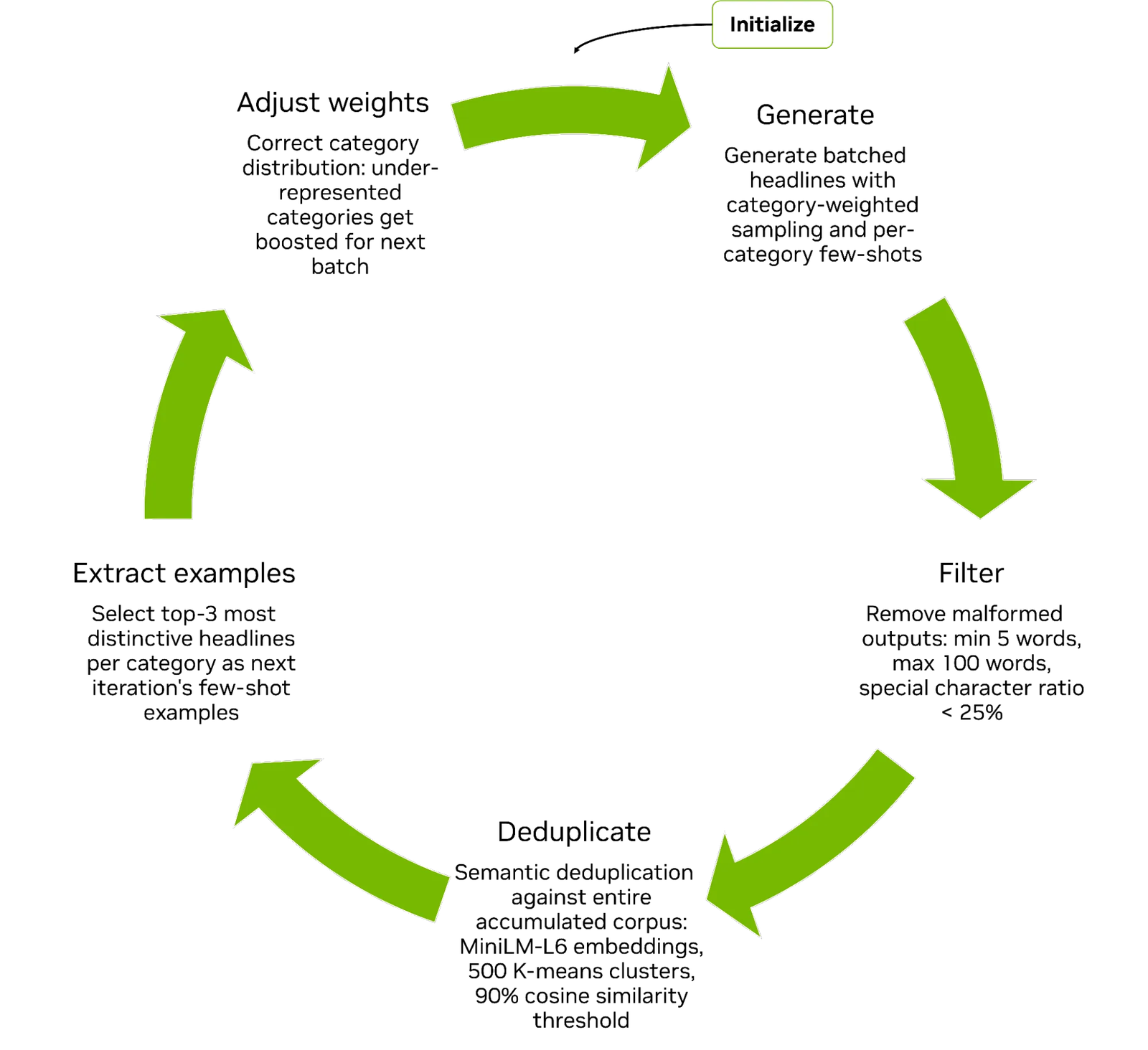
- Backed by NVIDIA's compute scale and demonstrated on genuinely large workloads: a July 2026 NVIDIA technical blog post documents generating 502,536 unique, deduplicated synthetic financial headlines using Data Designer plus NeMo Curator across 82 iterations on a single 8-way B200 node.
- Two purpose-built tools rather than one generic one: Data Designer for structured, schema-driven generation, and Safe Synthesizer specifically for GDPR/HIPAA-oriented differential-privacy synthesis of sensitive datasets.
- Available as an open-source library (the NVIDIA-NeMo/DataDesigner repo on GitHub) in addition to the managed NVIDIA AI Enterprise microservice, so teams can self-host the core generation logic.
- Tight integration with NVIDIA's Nemotron models and NeMo Curator means synthetic generation, deduplication, and downstream fine-tuning can run in one pipeline rather than stitched-together tools.
Cons
- The standalone Gretel product that many practitioners knew is gone, no free tier, no public self-serve sign-up, and its GitHub organization was archived in February 2026.
- Access to the managed microservices runs through an NVIDIA AI Enterprise relationship, which is sales-gated rather than self-serve, a step back for smaller teams used to Gretel's old credit-card checkout.
- Effective use now assumes familiarity with the broader NeMo ecosystem (Curator, Nemotron models, vLLM serving), a steeper learning curve than the old Gretel UI.
- Former Gretel customers had to migrate workloads off the legacy platform onto the new NeMo microservices architecture.
5. K2view
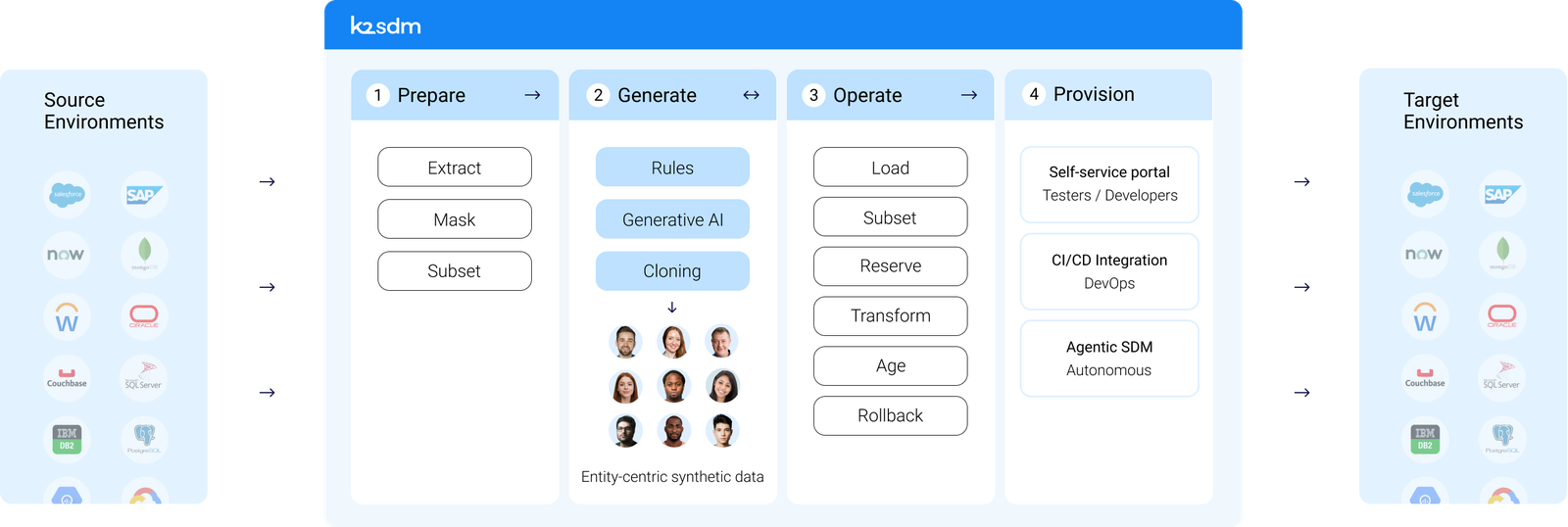
K2view is an enterprise data-integration company whose Data Product Platform includes a synthetic data generation module built on what it calls Micro-Database technology, an entity-based model (customers, accounts, orders) rather than a column-based one, designed to preserve referential integrity across connected systems. The synthetic data tool combines four generation methods, AI-powered, rules-based, data cloning, and intelligent masking, chosen automatically per scenario. K2view says it was named a Visionary in Gartner's Magic Quadrant for Data Integration Tools for a third consecutive year in 2025, and its site names Walmart, Verizon, Vodafone, BBVA, and Hapag-Lloyd as customers of its broader platform.
Best for: large enterprises that want synthetic data generation bundled into a broader data-integration and test-data-management platform rather than a standalone tool.
Pros
- Combines four distinct generation methods (AI, rules-based, cloning, masking) in one product, selected per use case instead of forcing every scenario through a single technique.
- Entity-based architecture is built to preserve referential integrity for whole business objects across multiple connected systems, a common failure point for column-level synthetic data tools.
- Publicly names large, recognizable enterprise customers (Walmart, Verizon, Vodafone, BBVA, Hapag-Lloyd) for its platform, and reports third-consecutive-year Visionary recognition in Gartner's Magic Quadrant for Data Integration Tools.
- Recently raised $15 million, per its own announcement, specifically earmarked for agentic AI and AI-ready data capabilities.
Cons
- Synthetic data generation is one feature inside a much larger data-integration platform, buyers evaluating only synthetic data take on the complexity of the whole platform.
- No public pricing of any kind was found; every path leads to a demo request.
- The Micro-Database architecture is proprietary, which can mean more vendor lock-in than tools built on open, portable formats.
- Built for enterprise IT and test-data teams first, making it a heavier lift to adopt than developer-first, self-serve tools like Tonic Fabricate.
6. YData
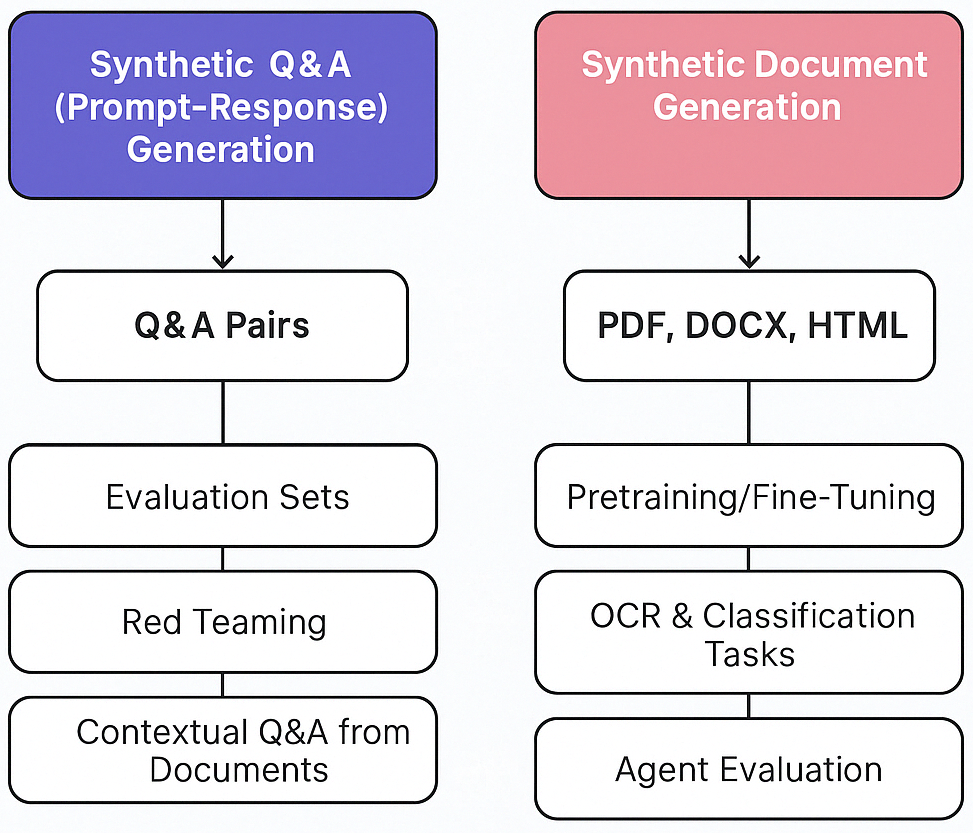
YData, based in Seattle, offers two related products: YData Fabric, a data-centric AI workbench with a Data Catalog, Synthesizers, Pipelines, and on-demand development environments, and the YData SDK, which includes the open-source ydata-profiling library on GitHub. The platform generates synthetic tabular, time-series, and multi-table/relational data, and has more recently added synthetic Q&A and document generation aimed at LLM workflows. YData frames its synthetic data generation around compliance with GDPR, CCPA, HIPAA, and PIPEDA.
Best for: data science teams that want an open-source-first synthesizer with a lightweight paid platform layered on top, rather than a sales-led enterprise deal.
Pros
- Open-source ydata-profiling and synthesizer libraries on GitHub give developers a free, inspectable entry point before any commercial conversation.
- Fabric platform adds a full workbench, data catalog, synthesizers, and pipeline orchestration, on top of the open-source core, rather than shipping the SDK as the only product.
- Supports a wider range of data types than most tabular-focused competitors: tabular, time-series, multi-table/RDBMS, and newer text/Q&A generation for retrieval-augmented generation and LLM fine-tuning workflows.
- Explicit, named compliance framing (GDPR, CCPA, HIPAA, PIPEDA) rather than generic privacy marketing.
Cons
- No public dollar pricing was found for either the Fabric platform or SDK tiers; both route to a dashboard sign-up or sales contact rather than a visible price list.
- Smaller public footprint than Tonic.ai or MOSTLY AI, fewer named enterprise case studies with attributed customer quotes were found during research.
- Core strength is structured and time-series data; computer vision synthesis is outside its focus, unlike Rendered.ai or Synthesis AI.
- Marketing site is built on a third-party CMS (HubSpot) with a comparatively thin public list of named enterprise customers, which made independent verification of large-scale adoption harder than for some competitors here.
7. Synthesis AI
Synthesis AI is a San Francisco company focused specifically on synthetic data for computer vision, using a combination of generative neural networks, procedural generation, and cinematic VFX rendering to produce photorealistic, pixel-perfect labeled images and video of humans. Its two named products, Synthesis Humans and Synthesis Scenarios, generate labeled data, including segmentation maps, depth maps, and 2D/3D landmarks, for use cases like ID verification, driver monitoring, avatar creation, and virtual try-on. The company raised a $17 million Series A in 2022, reported by TechCrunch and PR Newswire.
Best for: teams building face- and body-centric computer vision models, ID verification, AR/VR, driver monitoring, that need synthetic humans at scale.
Pros
- Narrow, deep specialization in human-centric computer vision data, with pixel-perfect labels (segmentation, depth, surface normals, 2D/3D landmarks) purpose-built for that use case.
- Distinct technical approach, combining generative neural networks with cinematic CGI/VFX pipelines, rather than a purely diffusion-model wrapper, aimed at photorealism and label precision together.
- Disclosed, reported funding ($17 million Series A, 2022) with named investors and public coverage in TechCrunch and PR Newswire.
- Dedicated product lines mapped to specific verticals (ID verification, automotive driver monitoring, virtual try-on, avatar creation) rather than one generic image generator.
Cons
- Narrowest scope of the seven platforms compared here, no tabular, text, or general-purpose structured-data synthesis.
- No public pricing information is available anywhere on the company's site; every path leads to a demo request.
- Named customers are described only in general terms, "Fortune 500 companies," "top smartphone manufacturers," without specific disclosed logos, making independent verification of adoption scale difficult.
- Its most recent disclosed funding round is smaller than NVIDIA-backed or larger-scale rivals on this list, which may limit the pace of platform investment against better-capitalized competitors.
- No standalone product image could be sourced for this section; the company's site was unreachable during fact-checking and no press-kit image could be verified and downloaded in time for publication.
How to choose
Start with the data type. If you're generating structured, tabular, or relational data for analytics, testing, or model training, Tonic.ai, MOSTLY AI, YData, or K2view are the relevant category; if you need labeled images or video for computer vision, Rendered.ai and Synthesis AI are built for that instead, and Gretel's NVIDIA-hosted successors sit closer to the foundation-model, text-heavy end of the spectrum. Next, weigh pricing transparency against flexibility: Tonic.ai and Rendered.ai publish real numbers you can budget against before a sales call, while MOSTLY AI, K2view, YData, and Synthesis AI require a conversation to get a quote. Finally, factor in deployment constraints, regulated industries that can't send data to a third-party cloud should prioritize self-hosted or local-SDK options, which rules out purely cloud-only tools regardless of how good the synthetic data quality is.
Frequently Asked Questions
What is synthetic data, and why do AI teams use it?
Synthetic data is artificially generated data that mimics the statistical patterns of real data without containing actual records. AI and data teams use it to train and test models when real data is scarce, imbalanced, sensitive, or restricted by privacy regulation, and to fill in edge cases that are rare or expensive to collect in the real world.
Is synthetic data as good as real data for training AI models?
It depends on the use case. For structured data testing and augmenting imbalanced datasets, high-fidelity synthetic data can closely match real-world statistical properties. For frontier model pretraining, most labs still blend synthetic data with curated real data rather than replacing real data entirely, since synthetic generation can inherit or amplify biases from its source models.
What happened to Gretel, one of the best-known synthetic data startups?
NVIDIA acquired Gretel in March 2025 for a sum reported to exceed its roughly $320 million prior valuation. The standalone Gretel product, including its free tier and public sign-up, has been discontinued; its technology now operates as NVIDIA NeMo Data Designer and Safe Synthesizer, available through NVIDIA AI Enterprise or as an open-source library.
How much does a synthetic data platform typically cost?
Pricing varies widely and few vendors publish full rate cards. Where numbers are public, self-serve tiers start near $0-$30 per month for individual developers (Tonic Fabricate), enterprise computer-vision platforms run $5,000-$15,000 per month (Rendered.ai), and most enterprise tabular and platform deals are negotiated case by case based on data volume and deployment model.
Is synthetic data safe for regulated industries like healthcare and finance?
It can be, but safety depends on the generation method and how rigorously it's evaluated. Platforms built around differential privacy, such as NVIDIA NeMo Safe Synthesizer, and vendors that publish compliance frameworks for GDPR, HIPAA, and CCPA are designed specifically to reduce re-identification risk, but organizations in regulated sectors should still validate a vendor's privacy claims independently before deploying synthetic data in production.
Editor's note -- sources:
- CIO.com, "Synthetic data takes aim at AI training challenges"
- Tonic.ai pricing page and TechCrunch on Tonic.ai's Series B
- MOSTLY AI homepage and Syntho's acquisition announcement
- Rendered.ai pricing page and TechCrunch on Rendered.ai's funding
- SiliconANGLE on NVIDIA's acquisition of Gretel and NVIDIA NeMo documentation
- K2view synthetic data generation page
- YData synthetic data product page
- TechCrunch on Synthesis AI's Series A