
Top 7 Privileged Access Management (PAM) Tools in 2026
The best privileged access management (PAM) tools for 2026, compared: CyberArk, BeyondTrust, Delinea, One Identity, Teleport, KeeperPAM and ARCON - with honest pros, cons and deployment notes.


TL;DR
- Privileged access management (PAM) secures the accounts that can change everything: admin logins, root, service accounts, and now machine and AI-agent identities. The 2026 Gartner Magic Quadrant Leaders are CyberArk, BeyondTrust, and Delinea.
- The category consolidated hard in 2026: Palo Alto Networks closed its CyberArk acquisition (February 11, 2026) and is rebranding the line Idira, while Delinea completed its acquisition of StrongDM (March 5, 2026).
- Pricing is quote-only across every major vendor — none publishes list prices. Budget for a sales cycle, not a credit card.
- Pick CyberArk/BeyondTrust/Delinea for classic enterprise vaulting and session control; Teleport if you want open-source, certificate-based infrastructure access; KeeperPAM for cloud-delivered PAM in the mid-market.
Privileged access management (PAM) is the set of tools that control, vault, and record the accounts with elevated rights — domain admins, root, database superusers, cloud IAM roles, and service accounts. The market leaders are CyberArk (now part of Palo Alto Networks), BeyondTrust, and Delinea, the three Leaders in Gartner's October 2026 Magic Quadrant. Below are seven PAM tools worth evaluating in 2026, ranked by maturity, breadth, and fit, with honest limitations for each. The through-line this year: every vendor is racing to secure non-human and AI-agent identities, not just human admins.
How we picked these
We weighted four things: maturity and track record (Gartner MQ history, how long the vaulting and session-management engines have shipped), capability breadth (credential vaulting, session recording, just-in-time access, zero standing privilege, secrets, and machine-identity coverage), deployment fit (SaaS, self-hosted, or open source), and transparency (published pricing, documented architecture). We did not rank alphabetically, and we make no claim about sponsorship or paid placement. Where a vendor's status changed through acquisition in 2026, we say so.
Quick comparison
| Tool | Best for | Deployment | Pricing model |
|---|---|---|---|
| CyberArk (Idira) | Large regulated enterprises | SaaS + self-hosted | Quote-only |
| BeyondTrust | Vaulting + remote/vendor access | SaaS + self-hosted | Quote-only |
| Delinea | Mid-market to enterprise | SaaS + on-prem | Quote-only |
| One Identity Safeguard | AD-centric enterprises | Appliance / self-managed / managed | Quote-only |
| Teleport | DevOps & cloud-native infra access | Open source + managed cloud | Quote-only (usage-based) |
| KeeperPAM | Cloud-delivered PAM, mid-market | SaaS + self-hosted gateway | Quote-only (per user) |
| ARCON | Regulated / APAC enterprises | On-prem + cloud | Quote-only |
1. CyberArk (now Palo Alto Networks / Idira)
CyberArk is the category's default choice and a Leader in every recent Gartner PAM Magic Quadrant, including October 2026. It pioneered the password-vault model and covers the full span: credential vaulting, endpoint privilege management, secrets, and vendor PAM.
In February 2026, Palo Alto Networks completed its acquisition of CyberArk. In May 2026 Palo Alto introduced Idira, its next-generation identity security platform, into which existing CyberArk SaaS customers migrate across four tiers. Idira's pitch centers on zero standing privilege, just-in-time enforcement, and governance for machine and AI-agent identities. Palo Alto says the identity platform remains available standalone.
Best for: Large, regulated enterprises that want the category incumbent and Palo Alto stack consolidation.
Pros - Gartner PAM Leader for eight consecutive reports, positioned furthest in Completeness of Vision in 2026 (per Palo Alto Networks). - Zero standing privilege and just-in-time access are included in the Modern PAM tier. - Broadest coverage: vaulting, endpoint privilege, secrets, vendor access, and machine/agent identities.
Cons - Brand and roadmap are in flux; the Idira rebrand and four-tier migration add licensing complexity, and ZSP/agentic features are paid add-ons on the Traditional tier. - Quote-only, sales-led pricing with no public list price. - Integration into the Palo Alto platform is still in progress.
2. BeyondTrust
BeyondTrust pairs a credential vault (Password Safe) with Privileged Remote Access, giving it unusually strong vendor and third-party access controls without a VPN. Its 2026 "Pathfinder" platform adds AI agent security, non-human identity governance, and a "Paths to Privilege" attack-path analysis.
It was a Leader in the 2026 Gartner MQ and says it was positioned highest for Ability to Execute in the last two reports. In 2024 it acquired Entitle to strengthen just-in-time and cloud-entitlement access. BeyondTrust is owned by Clearlake Capital and Francisco Partners.
Best for: Organizations that need vaulting, remote/vendor access, and endpoint privilege from one vendor.
Pros - Session recording and monitoring with automatic logging across vaulting and remote access. - Strong vendor/third-party remote access without exposing VPN infrastructure. - Just-in-time, least-privilege access reinforced by the Entitle acquisition.
Cons - Quote-only pricing; nothing published. - Modules are often sold as bundles, which can mean capability sprawl for small teams. - The Pathfinder rebrand and AI/NHI features are new and largely vendor-described.
3. Delinea
Delinea was formed from the Thycotic–Centrify merger and is built around Secret Server (its vault) plus the Delinea Platform. It is a Gartner PAM Leader and is especially strong in the mid-market, where Secret Server's lighter footprint lands well.
In 2026 Delinea completed its acquisition of StrongDM (announced January, completed March), folding StrongDM's just-in-time runtime authorization for infrastructure and databases into its platform and moving toward zero standing privilege. Terms were not disclosed.
Best for: Mid-market-to-enterprise teams that want vaulting-first PAM with a path to zero standing privilege.
Pros - Eight consecutive Gartner Leader placements. - Secret Server is quick to stand up relative to heavier enterprise suites. - The StrongDM acquisition adds modern, ephemeral infrastructure access for developers.
Cons - Quote-only pricing. - The StrongDM integration is new (completed March 2026); product roadmap and branding are still settling. - Combining Secret Server, the Delinea Platform, Iris AI, and StrongDM raises sprawl risk.
4. One Identity Safeguard
One Identity Safeguard splits PAM into two components: Safeguard for Privileged Passwords (the vault) and Safeguard for Privileged Sessions (a session proxy with recording and policy control). Safeguard 9.0, announced November 2026, adds hardware-agnostic deployment and asset-scoped just-in-time group elevation.
The product slipped from Visionary in the 2025 MQ to Challenger in 2026. Separately, One Identity announced in June 2026 that it will spin out from Quest Software as an independent company headquartered in Cork, Ireland; the completion date and post-spin ownership were not stated.
Best for: Active Directory–centric enterprises already invested in One Identity's governance tools.
Pros - Dedicated session proxy (SPS) with recording, separate from the password vault (SPP). - 9.0's hardware-agnostic deployment reduces reliance on physical appliances. - Asset-scoped JIT elevation that grants and removes membership per request.
Cons - Dropped from Visionary to Challenger in the 2026 Gartner MQ. - Mid-corporate-transition: spinning out from Quest with ownership unstated. - The two-component (SPP + SPS) architecture is more to deploy and operate.
5. Teleport
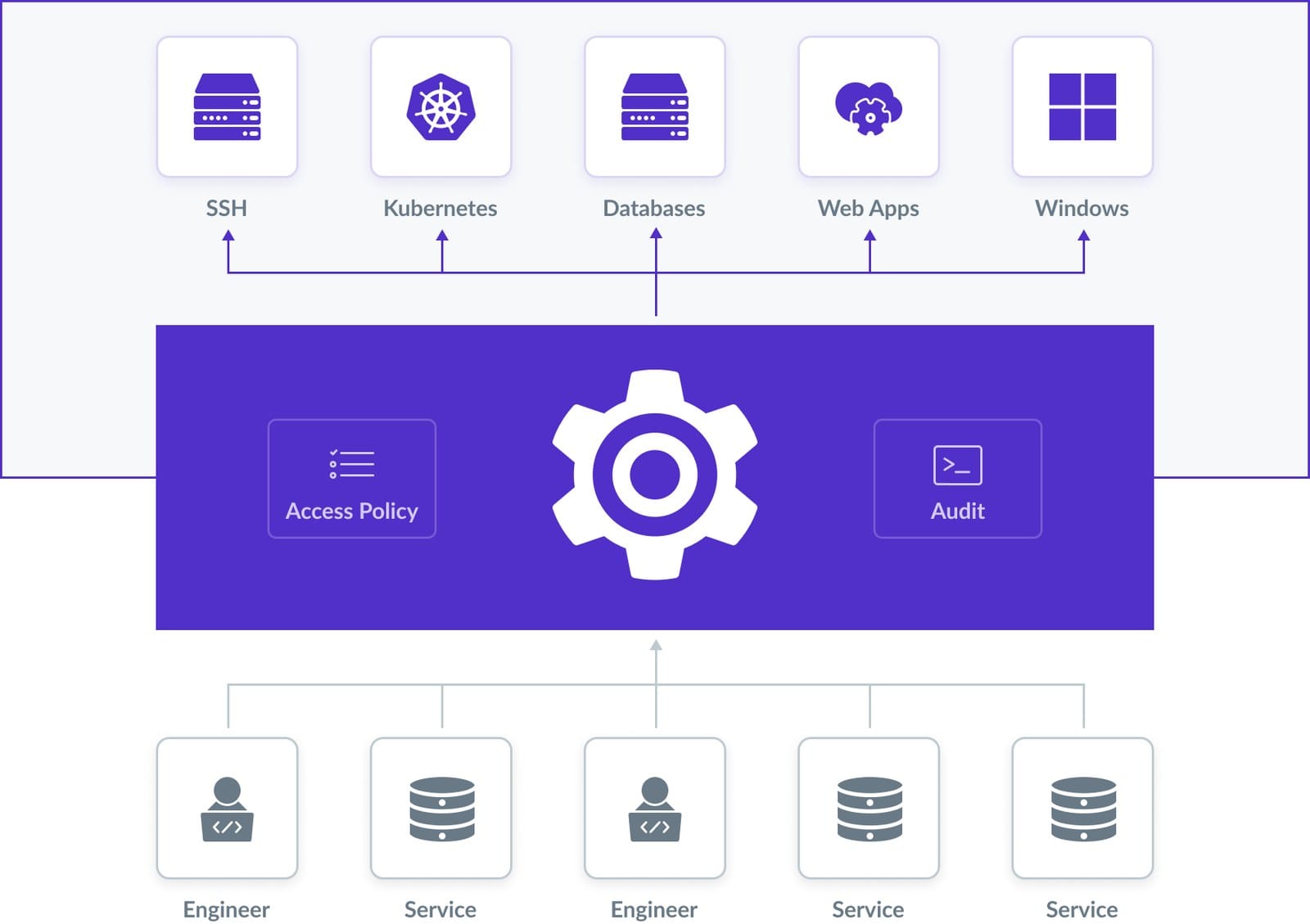
Teleport takes a different approach from the vault-first incumbents: identity-based, certificate-driven access to servers, Kubernetes, databases, and apps using short-lived credentials instead of stored passwords. It is open source (the main repository is AGPL-3.0), which the vault vendors above are not.
Teleport has leaned into AI-agent access with its 2026 Agentic Identity Framework and "Beams," which run agents in Firecracker-isolated runtimes with delegated, secret-less identity and per-action audit. Its last disclosed funding was a $110M Series C in 2022.
Best for: DevOps and platform teams running Kubernetes, cloud, and Linux fleets that want self-hostable access.
Pros - Open-source core (AGPL-3.0), self-hostable, with roughly 20,000+ GitHub stars. - Short-lived certificates across SSH, Kubernetes, databases, and web apps — no long-lived secrets to rotate. - Early, unusual capabilities for isolating and auditing AI-agent access.
Cons - Not a classic vault-first PAM suite; fewer legacy-system password-rotation and compliance features. - Mixed licensing (AGPL-3.0 core, Apache-2.0 API module, commercial Enterprise) warrants legal review. - Enterprise pricing is usage-based and quote-only; no public figures.
6. KeeperPAM
Keeper Security extends its password-manager heritage into full PAM with KeeperPAM, combining password and secrets management, connection management, zero-trust network access, and remote browser isolation in one interface. Browser-based sessions cover SSH, RDP, VNC, HTTPS, and major databases, with just-in-time access, credential rotation, and session recording.
It was recognized as a Niche Player in the 2026 Gartner PAM MQ. Its gateway needs only an outbound connection to Keeper's cloud, avoiding inbound firewall changes or bastion hosts. Keeper publishes FedRAMP High, SOC 2, HIPAA, and ISO 27001 compliance for the platform.
Best for: Mid-market organizations that want cloud-delivered PAM, especially existing Keeper customers.
Pros - Session recording across SSH, RDP, VNC, databases, and browser sessions. - Gateway requires only outbound connectivity — no ingress, firewall changes, or bastion hosts. - Published FedRAMP High and broad compliance certifications.
Cons - Niche Player in the 2026 MQ, a tier below the three Leaders. - Prices are per-user but not published. - Newer to enterprise PAM than the vault specialists.
7. ARCON
ARCON is a privileged-access specialist with a strong footprint in regulated sectors and across India and Asia. Its PAM suite covers an AES-256 password vault with rotation and break-glass workflows, role- and rule-based just-in-time access, a central connection gateway, live session monitoring with text and video logs, and service-account discovery.
ARCON markets a broader "converged identity" platform and recent integrations with Oracle Access Governance and DNV Cyber. We could not confirm a 2026 Gartner MQ placement or any funding/customer figures from primary sources, so we don't publish them.
Best for: Regulated or APAC-based enterprises wanting a PAM suite from a regional specialist.
Pros - Session monitoring with both text and video logs. - AES-256 vault with approval and break-glass workflows. - Role-based JIT access routed through a single gateway.
Cons - Smaller global footprint and fewer independent reviews than the Leaders. - No published pricing or detailed public deployment documentation. - No 2026 Gartner MQ placement we could verify.
How to choose
If you're a large regulated enterprise: shortlist CyberArk (Idira), BeyondTrust, and Delinea — the three Gartner Leaders. Weigh the CyberArk/Palo Alto integration churn against the appeal of consolidating on one security vendor.
If you need strong vendor and third-party remote access: BeyondTrust's Privileged Remote Access is the differentiator.
If you're mid-market and cost-conscious: Delinea's Secret Server or KeeperPAM's cloud delivery deploy faster and lighter than the heaviest suites.
If you're a cloud-native or DevOps team: Teleport's certificate-based, open-source model fits infrastructure access far better than a legacy vault — but it won't replace compliance-driven credential rotation for legacy systems.
If you're Active Directory–centric: One Identity Safeguard aligns with AD and IGA tooling, with the caveat that it's in corporate transition.
A note on pricing: expect a sales cycle. Every vendor here is quote-only, and privileged-account counts, session needs, and machine-identity volumes drive the price. Get at least two quotes scoped to the same account inventory. PAM sits alongside your broader identity and access management and secrets management stack, so factor in how it integrates with what you already run.
Frequently Asked Questions
What is privileged access management?
Privileged access management (PAM) is a security discipline and tool category that controls, secures, and monitors accounts with elevated rights — administrators, root, service accounts, and machine identities. PAM tools vault and rotate credentials, broker and record privileged sessions, and enforce just-in-time, least-privilege access so that standing admin rights are minimized or eliminated.
How does privileged access management work?
PAM works by removing passwords from users' hands and placing them in an encrypted vault. When someone needs elevated access, the tool checks policy, grants time-limited (just-in-time) access, and proxies the session — often recording keystrokes and screen activity. Credentials are rotated automatically after use, and every privileged action is logged for audit and compliance.
How much does privileged access management cost?
None of the major PAM vendors publish list prices; pricing is quote-only and sales-led. Cost is typically driven by the number of privileged accounts or users, the session and recording volume, and increasingly the number of machine and non-human identities. Budget for a procurement cycle and get at least two quotes scoped to the same account inventory.
Why is privileged access management important?
Privileged accounts are the keys to the kingdom: compromise one admin or service account and an attacker can move laterally, disable defenses, and exfiltrate data. PAM limits that blast radius by vaulting credentials, enforcing just-in-time access, and recording sessions. It's also a common requirement for compliance frameworks and cyber-insurance, and it increasingly extends to machine and AI-agent identities.
Which PAM tool is best for a zero-trust strategy?
For zero standing privilege and just-in-time access — the core of a zero-trust approach to privilege — CyberArk (Idira), Delinea (with StrongDM), and Teleport are the strongest fits. Teleport's certificate-based, secret-less model is the most natively zero-trust for infrastructure, while CyberArk and Delinea bring that discipline to classic enterprise accounts.
Editor’s note — sources: Vendor product and pricing pages for CyberArk/Palo Alto Networks, BeyondTrust, Delinea, One Identity, Teleport, Keeper Security and ARCON; Palo Alto Networks press releases on the CyberArk acquisition and Idira; Delinea's StrongDM acquisition announcement; and the 2026 Gartner Magic Quadrant for PAM vendor announcements. Pricing is quote-only across vendors; MQ placements and acquisition dates as of November 2026.