
Top 7 Web Scraping Tools in 2026
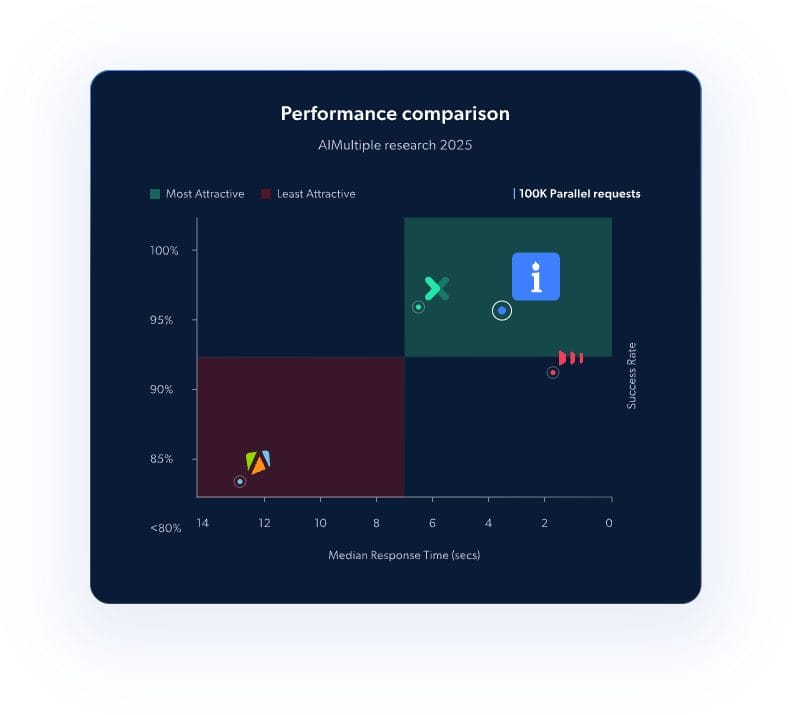
We rank the seven best web scraping tools for 2026 — Bright Data, Firecrawl, Apify, Zyte, Oxylabs, ScraperAPI and ScrapingBee — with real pricing, deployment models, the recent Oxylabs–ScrapingBee acquisition, and honest pros and cons.

TL;DR
- The practical shortlist of web scraping tools for 2026: Bright Data (broadest proxy + API scale), Firecrawl (AI-native, LLM-ready output, ~195k GitHub stars), Apify (platform + 6,000-actor marketplace), and Zyte (the Scrapy creators). Oxylabs, ScraperAPI, and ScrapingBee round out the enterprise and simple-API tiers.
- Consolidation is the 2026 story: Oxylabs acquired ScrapingBee (June 2025) and took its first outside funding — $130M from Warburg Pincus at a $3.6B valuation (July 2026). Firecrawl raised a $14.5M Series A (August 2025).
- Pricing models differ sharply: per-request (Bright Data from ~$1/1k), per-successful-response (Zyte from $0.06/1k), per-page credits (Firecrawl from $16/mo, ScrapingBee from $19/mo, ScraperAPI from $49/mo), or compute units (Apify from $19/mo). All figures observed October 2026.
- Open source exists here: Firecrawl is AGPL-3.0 and self-hostable; Apify maintains Crawlee (Apache-2.0); Zyte maintains Scrapy (BSD). The rest are proprietary SaaS.
Web scraping tools extract data from websites automatically — handling proxies, JavaScript rendering, and anti-bot defenses so you get structured output instead of raw HTML. In 2026 the leaders are Bright Data, Firecrawl, Apify, and Zyte, with Oxylabs, ScraperAPI, and ScrapingBee covering enterprise-proxy and simple-API needs. The best web scraping tool depends on scale, how much you want managed for you, and whether the output feeds a dashboard or a large language model. This guide ranks them on capability, adoption, and fit, with real pricing, the recent ownership changes, and the legal context every team should know.
How we picked these
We weighed capability (proxy breadth, JavaScript rendering, anti-bot handling, structured and LLM-ready output), adoption and maturity, pricing transparency, deployment options including open source, and maintenance status as of October 2026. We noted recent acquisitions and funding because they affect stability and roadmap. Pricing is taken from vendor pages on the date observed; where a figure is not vendor-published we say so. There is no paid placement in this list, and we rank tools on fit for a job, not on marketing.
Quick comparison
| Tool | Best for | Deployment | Pricing model |
|---|---|---|---|
| Bright Data | Enterprise-scale acquisition + datasets | SaaS API + proxy infra | Per request / GB / record; from ~$1/1k requests |
| Firecrawl | AI/RAG and agent builders | Open source (AGPL-3.0) + cloud | Per-page credits; free tier, from $16/mo |
| Apify | Custom scrapers via a marketplace | SaaS platform + OSS Crawlee | Compute units; free, from $19/mo |
| Zyte | Python/Scrapy engineering teams | SaaS API + Scrapy Cloud | Per successful response; from $0.06/1k |
| Oxylabs | Enterprise proxy-heavy operations | SaaS API + proxy infra | Per result + per-GB/IP proxies; API from $30/mo |
| ScraperAPI | Solo devs and high-volume jobs | SaaS API | Per-page credits + threads; from $49/mo |
| ScrapingBee | Small teams, simple JS-rendering jobs | SaaS API | Per-page credits; from $19/mo |
1. Bright Data
Bright Data runs the largest commercial proxy network in the category — residential, datacenter, ISP, and mobile — with scraping APIs layered on top. The product surface is wide: Web Unlocker for anti-bot and CAPTCHA handling, a SERP API, a hosted Browser API with JavaScript rendering, Scraper APIs, and prebuilt Datasets that sell structured feeds so you can skip building scrapers entirely. It also has the clearest legal track record in the space, winning Meta v. Bright Data (January 2024) and seeing X Corp v. Bright Data dismissed (May 2024), both affirming that scraping public data did not breach the platforms' terms. Pricing starts around $1 per 1,000 requests for the Unlocker, SERP, and Crawl APIs, with residential proxies from $2.50/GB (as of October 2026).
Best for: Enterprise-scale data acquisition and buying prebuilt datasets.
Pros
- The widest product and proxy breadth of any vendor here.
- A favorable, precedent-setting legal record on public-data scraping.
- Prebuilt Datasets let you buy structured data without building a scraper.
Cons
- Pricing and the dashboard are complex, and costs climb at scale.
- Know-your-customer and compliance review gate some use cases.
- Its proxy-network sourcing has drawn ethical scrutiny historically, tied to its Hola VPN roots.
2. Firecrawl
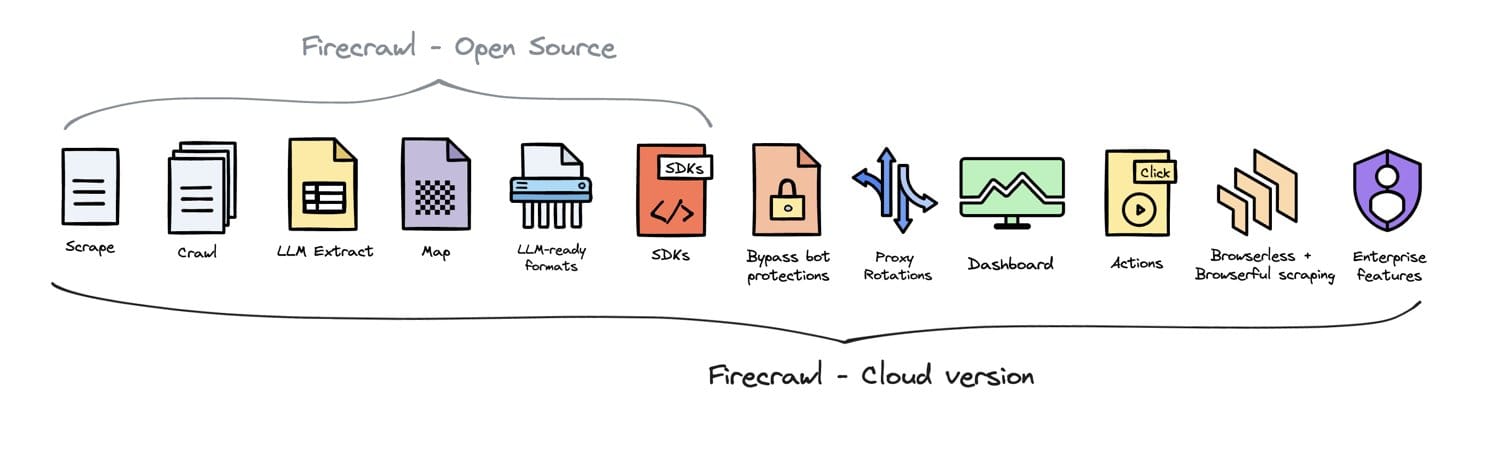
Firecrawl is the AI-native option, built to turn web pages into clean, LLM-ready markdown or structured JSON for RAG and agent pipelines. Its endpoints — Scrape, Crawl, Map, Search, Extract (LLM-powered), and browser Interact — handle JavaScript rendering and anti-bot work, and the output is designed to drop straight into a model context rather than needing a parsing step. It is open source under AGPL-3.0 and self-hostable, with a managed cloud alongside it, and it has become one of the most-starred scraping projects on GitHub (~195k stars). Backed by Y Combinator, it raised a $14.5M Series A in August 2025 led by Nexus Venture Partners. The free tier gives 1,000 credits a month, and paid plans start at $16/mo billed annually (as of October 2026).
Best for: AI, RAG, and agent builders feeding data to large language models.
Pros
- Best-in-class LLM-ready markdown and JSON output for AI pipelines.
- Open source (AGPL-3.0) and self-hostable, with strong community momentum.
- Generous free tier and simple per-page credit pricing.
Cons
- The AGPL-3.0 copyleft license can deter proprietary or commercial self-hosting.
- It is the youngest tool here and the least battle-tested at extreme scale.
- No large residential-proxy network of its own; the focus is crawl and extract, not proxy evasion at scale.
3. Apify
Apify is a cloud platform plus a marketplace of more than 6,000 prebuilt "Actors" — serverless scraping and automation programs you can run, or build and monetize your own. It maintains the open-source Crawlee library (Apache-2.0, ~26k GitHub stars) for the scraping logic itself, so you avoid lock-in on the code even while running it on Apify's infrastructure. JavaScript rendering runs through headless browsers, proxies are an add-on, and the platform has leaned into AI-agent integrations including MCP. It is used by Groupon, Intercom, and others named on its site. Pricing is a free tier with $5 of usage included, then Starter at $19/mo, Scale at $199/mo, and Business at $999/mo, billed on compute units (as of October 2026).
Best for: Developers building or reusing custom scrapers through a marketplace.
Pros
- A large prebuilt-actor marketplace means fast time-to-data.
- Open-source Crawlee (Apache-2.0) keeps your scraping logic portable.
- Flexible pay-as-you-go pricing plus developer monetization.
Cons
- Compute-unit billing is hard to predict and reads as opaque.
- Third-party Store actors vary in quality and maintenance.
- A smaller proxy pool than Bright Data or Oxylabs, with proxies sold as an add-on.
4. Zyte
Zyte — renamed from Scrapinghub in 2020 — is run by the team that created and maintains Scrapy, the open-source Python scraping framework (BSD-licensed, ~64k GitHub stars). Its commercial product is the Zyte API, a unified endpoint with automatic ban handling, headless-browser rendering, AI-powered extraction, a SERP option, and an MCP server, alongside Scrapy Cloud for hosting spiders and Zyte Data for managed delivery. Pricing is unusual and buyer-friendly: you pay only for successful responses, from $0.06 per 1,000 at the higher commit tier, with HTTP requests far cheaper than browser-rendered ones. Commit tiers start at $100/mo (as of October 2026).
Best for: Python and Scrapy engineering teams.
Pros
- Deep crawling pedigree — the Zyte team owns and maintains Scrapy.
- Pay only for successful responses, which aligns cost with results.
- Breadth: API plus managed data plus AI extraction plus an MCP server.
Cons
- Best value assumes Scrapy and Python familiarity — a learning curve for non-coders.
- Per-site difficulty tiers make spend hard to forecast.
- Browser-rendered requests are markedly more expensive than HTTP ones.
5. Oxylabs
Oxylabs is the enterprise-focused proxy and scraping vendor, pairing a large residential, mobile, ISP, and datacenter proxy network with a Web Scraper API suite, a Web Unblocker, an AI parser-builder (OxyCopilot), and prebuilt datasets. It also ships scraper endpoints aimed at AI targets like ChatGPT and Perplexity. 2026 has been a landmark year: Oxylabs took its first outside investment, $130M from Warburg Pincus at a $3.6B valuation (July 2026), after acquiring ScrapingBee in June 2025. Web Scraper API plans run from $30/mo (Starter) to an Enterprise tier from $2,500/mo, with scraping from $0.50 per 1,000 results; proxies are priced separately (as of October 2026).
Best for: Enterprise, proxy-heavy operations that need compliance focus and scale.
Pros
- A large, enterprise-compliance-oriented proxy pool.
- Newly and heavily capitalized, which signals stability.
- A broad API suite, including AI-target scrapers and an AI parser.
Cons
- Oriented to enterprise budgets, with the Enterprise tier from $2,500/mo.
- Proxy pricing is opaque and gated behind sales.
- Scraper and proxy are priced separately, which raises the true cost.
6. ScrapingBee
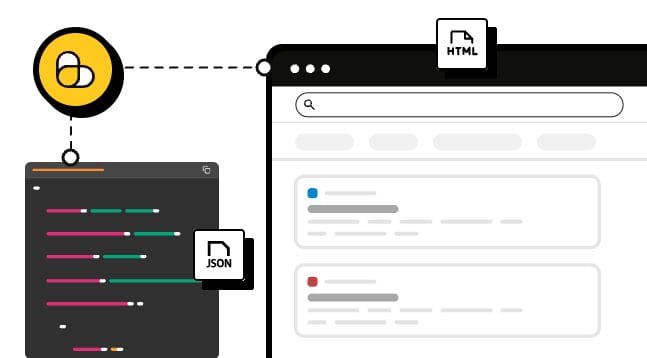
ScrapingBee is the developer-friendly simple-API option: a single endpoint that handles headless-browser JavaScript rendering, rotating proxies, and anti-bot work, plus AI extraction and Google search endpoints. Its appeal is onboarding speed and documentation quality rather than raw scale, which suits solo developers and small teams that want plug-and-play scraping without infrastructure. It was acquired by Oxylabs in June 2025 but operates independently for now, keeping its brand and leadership. Named users include SAP, Zapier, and PostHog. Pricing is credit-based, from $19/mo (Hobby, 75,000 credits) up to enterprise tiers, where JavaScript rendering consumes extra credits per call — the exact multiplier is not published (as of October 2026).
Best for: Small teams with simple JavaScript-rendering scraping jobs.
Pros
- The simplest API plus strong documentation make for fast onboarding.
- JavaScript rendering and proxies are handled transparently.
- Low entry price at $19/mo.
Cons
- The credit cost of JavaScript rendering is not clearly published, a budgeting risk.
- A smaller scale and proxy pool than parent Oxylabs or Bright Data.
- Post-acquisition roadmap and independence are uncertain.
7. ScraperAPI
ScraperAPI is another single-endpoint scraping API, built around proxy rotation, CAPTCHA and anti-bot handling, optional JavaScript rendering, geotargeting, and structured-data endpoints for sites like Amazon and Google. Plans are organized around credits and concurrency threads, and it positions itself on simplicity and high-volume affordability. Pricing runs from $49/mo (Hobby, 100,000 credits, 20 threads) up through higher-volume tiers, with roughly 10% off annual billing and a 7-day trial; one credit is about one standard page, though some domains cost more (as of October 2026). It publishes no customer names or recent funding details, so adoption and ownership signals are thinner than its peers.
Best for: Solo developers and teams wanting plug-and-play managed scraping at volume.
Pros
- A simple single-endpoint API that is easy to integrate.
- Competitive credit pricing at higher volumes.
- Generous concurrency on the upper tiers.
Cons
- JavaScript rendering and premium domains consume extra credits, so costs creep.
- The entry plan at $49/mo is pricier than ScrapingBee's or Firecrawl's starters.
- Less transparent adoption and ownership signals than its peers.
How to choose
Pick by scale, how much you want managed, and where the data goes.
- You're feeding a RAG or agent pipeline and want clean model-ready text: Firecrawl. It exists for exactly this, and you can self-host it.
- You need enterprise scale, the widest proxy coverage, or prebuilt datasets: Bright Data, with Oxylabs the main alternative now that it is well-funded.
- You want to reuse prebuilt scrapers or build custom ones on a platform: Apify, keeping your logic portable through Crawlee.
- Your team writes Python and knows Scrapy: Zyte, where pay-per-success aligns cost with results.
- You want the simplest possible API for a small job: ScrapingBee or ScraperAPI.
A common 2026 pattern: use Firecrawl or Zyte to pull and clean source pages, store the output in a vector database, and serve it through an enterprise RAG platform or an AI agent framework. For recurring extraction that lands in a warehouse, wire the scraper into your ETL and data integration layer rather than scheduling one-off jobs. Whatever you choose, check the legal footing below before you point it at a site.
Frequently Asked Questions
What is web scraping?
Web scraping is the automated extraction of data from websites. A scraper requests pages, then parses the HTML — or renders JavaScript first — to pull out structured data such as prices, listings, or text, and saves it in a usable format like JSON or CSV. Modern tools also handle proxies and anti-bot defenses so the extraction succeeds at scale.
Is web scraping legal?
Scraping publicly accessible data is generally lawful in the US, where courts have repeatedly declined to treat it as a Computer Fraud and Abuse Act violation. Both Meta v. Bright Data (2024) and the dismissed X Corp v. Bright Data case affirmed that scraping public data did not breach platform terms. Legality is far less clear for data behind logins, copyrighted content, or personal data under GDPR and CCPA. This is context, not legal advice.
How does web scraping work?
A scraper sends HTTP requests to target pages, often routed through rotating proxies to avoid rate limits and blocks. It then parses the returned HTML, or runs a headless browser to render JavaScript-heavy pages first, and extracts the specific elements you defined. The structured output is saved or passed downstream. Managed tools automate the proxy, rendering, and anti-bot steps for you.
What is a web scraping API?
A web scraping API is a service you call with a target URL and get back the page's data — rendered, unblocked, and often structured — without running your own proxies or browsers. You send a request, the provider handles JavaScript rendering, proxy rotation, and anti-bot evasion, and returns HTML, JSON, or markdown. Bright Data, Zyte, ScrapingBee, and ScraperAPI all offer this model.
Which web scraping tool is best for AI and LLM projects?
Firecrawl is the most direct fit, because it outputs clean, LLM-ready markdown and structured JSON built for RAG and agent pipelines, and it is open source. Zyte and Bright Data also offer AI-oriented extraction and MCP integrations. For large-scale training-data acquisition, Bright Data's prebuilt datasets or Oxylabs' AI-target scrapers are worth evaluating.
Editor's note — sources: Bright Data (brightdata.com); Firecrawl (firecrawl.dev, GitHub); Apify (apify.com); Zyte (zyte.com); Oxylabs (oxylabs.io); ScrapingBee (scrapingbee.com); ScraperAPI (scraperapi.com). Acquisition and funding facts via reporting from tech.eu and Entrepreneur (Oxylabs–ScrapingBee, Oxylabs–Warburg Pincus). Pricing observed October 2026 and subject to change. Vendor product images for Apify and Zyte were unavailable at publication (neither exposes a product screenshot) and are omitted.