
Best LLM for Translation (2026): Benchmarks & Verdict
The best LLM for translation in 2026 is Google's Gemini for most language pairs, but DeepL and dedicated MT still win on specific pairs and at scale. Here's the benchmark data, real pricing, and which model to pick for your languages.


The best LLM for translation in 2026 is Google Gemini for the widest set of language pairs, with OpenAI's GPT a close second. But "best" depends on your pair: dedicated systems like DeepL still win some European languages, Alibaba's Qwen leads cheap CJK, and a compact translation model topped the hardest automatic benchmark ranking. Here's the data and a verdict by use case.
TL;DR
- Best overall LLM for translation: Google Gemini. Gemini 2.5 Pro led the top human-eval quality cluster in most language pairs at the independent WMT25 shared task; GPT was a close second. The current flagship is Gemini 4 Argon.
- Best for cost: Alibaba Qwen-MT (a dedicated MT model on the Qwen3 base, 92 languages, ~$0.50 / 1M tokens) or Gemini Flash ($0.75 in / $3.75 out per 1M tokens).
- Best dedicated MT: DeepL for European pairs; Google Cloud Translation for volume and low cost ($20 / 1M characters).
- The real finding: quality is language-pair-dependent, not a clean ranking. Frontier LLMs now match or beat Google Translate and DeepL on human eval for most pairs — but a fine-tuned 7B model (Hunyuan-MT) topped WMT25's preliminary automatic ranking, and LLMs still hallucinate and drift on terminology in ways production MT does not.
- One caveat: WMT25's human evaluation scored 2025-generation models. No equivalent independent eval has yet scored the Nov-2026 frontier (GPT-6, Gemini 4, Claude Opus 5.5).
What's the best LLM for translation in 2026?
For most language pairs, Google Gemini is the strongest general-purpose LLM translator, and OpenAI's GPT is right behind it.
That verdict rests on the WMT25 General Machine Translation shared task, the most rigorous independent evaluation in the field. It covered 30 language pairs, ran human evaluation on half of them using Error Span Annotation and MQM, and used deliberately hard, document-level test sets. In the human results, Gemini 2.5 Pro sat in the top quality cluster in most evaluated pairs, with GPT-4.1 close behind and Claude, Command A and DeepSeek in the tier below.
Two honest caveats. First, WMT25's human track tested 2025-era versions. The current frontier — Gemini 4 Argon, the GPT-6 family, Claude Opus 5.5 — has not been through an equivalent independent eval yet, so treat the ranking as directional for the latest models.
Second, the single best-scoring system on WMT25's automatic ranking was not a giant LLM at all. It was Shy-hunyuan-MT, a 7-billion-parameter translation model, which topped the preliminary automatic ranking (AutoRank) in nearly every language pair — though WMT25's official ranking is human-based. Size and general intelligence are not the same thing as translation quality.
How do the top models compare on translation benchmarks?
No single clean leaderboard scores every current model on one metric — so read each benchmark for what it measures, and mind the date.
Here's the defensible picture from the best dated sources, highest-signal first:
| Model | Maker | Type | API price (as of Nov 2026) | Benchmark standing (dated) | Strength | Best for |
|---|---|---|---|---|---|---|
| Gemini (4 Argon / 2.5 Pro) | LLM | $2 in / $10 out per 1M tok (promo) | WMT25 human: top cluster, most pairs (2.5 Pro, 2025) | Broadest language coverage | Default for most pairs | |
| GPT (6 family / 4.1) | OpenAI | LLM | ~$2 in / $10 out per 1M tok (mid tier) | WMT25 human: 2nd tier (4.1, 2025) | Strong CJK, reasoning | Context-heavy, CJK |
| Claude (Opus 5.5 / 4) | Anthropic | LLM | $4 in / $20 out per 1M tok | WMT25 mid-high (Claude 4); WMT24 human #1 (3.5) | Tone, nuance, long docs | Literary / high-stakes copy |
| Qwen-MT | Alibaba | Dedicated MT (LLM-based) | ~$0.50 per 1M tok | WMT24 multilingual: strong (Alibaba claim) | CJK + low-resource, cheap | Cost-sensitive CJK/Asian |
| DeepL | DeepL | Dedicated MT | $32.50/mo per 1M chars | WMT25: mid-pack (independent); 89% win rate (DeepL claim) | European fluency | EU-language business docs |
| Google Translate | Dedicated MT (NMT) | $20 per 1M chars | WMT25: mid-pack (independent) | Speed, scale, 100+ langs | High-volume, low-cost |
Older but fully numeric: on the 2024 COMET-based IntlPull set (0–1 scale, higher is better), GPT-4 Turbo scored 0.847, Claude 3.5 Sonnet 0.841, DeepL API Pro 0.838 and Gemini 1.5 Pro 0.812 — a near-tie, and a reminder that the gaps are small and the generation matters.
Metric meanings: COMET and chrF (higher = better) track semantic adequacy; BLEU (higher = better) is a weaker surface-overlap metric. Human ESA/MQM is the gold standard and what WMT25 leads with.
LLMs vs Google Translate and DeepL: which is better?
For most pairs in 2026, a frontier LLM edges the dedicated engines on quality — but Google Translate and DeepL still win on cost, speed, consistency and some European pairs.
At WMT25, Google Translate, Microsoft Translator and DeepL landed mid-pack, behind the top LLMs and the fine-tuned MT entries. That's a real shift: three years ago the dedicated engines led.
But DeepL contests that framing. In its own June 2026 blind tests, DeepL says professional linguists preferred its output in 89% of test groups across 18 pairs, including a 100% win rate over Google Translate and 83% over GPT-5.5. Treat that as DeepL's vendor claim, not independent data — the test design and pairs favour DeepL's strengths.
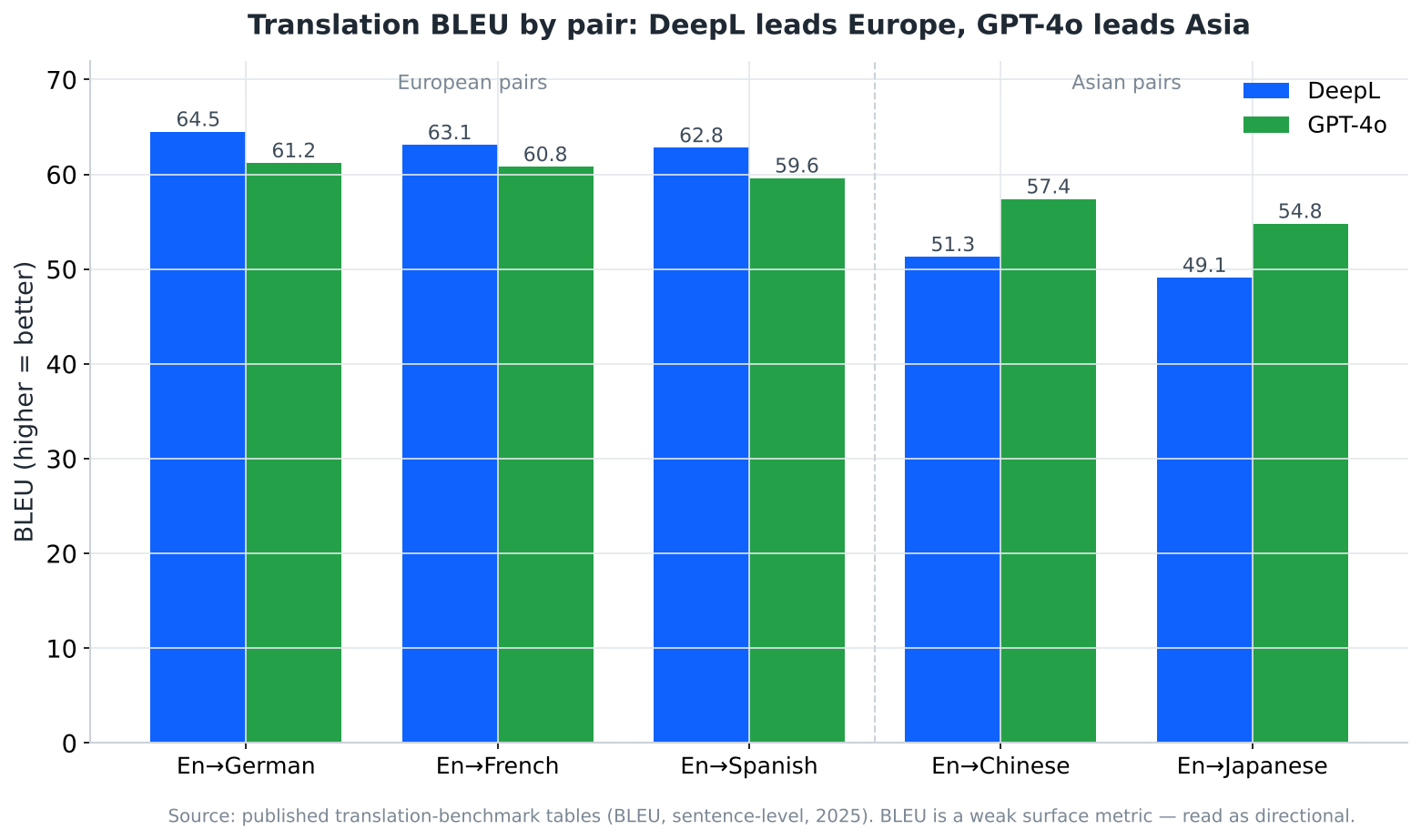
The honest read: the dedicated engines are strongest on high-resource European pairs (En↔De, En↔Fr, En↔Es), where DeepL's fluency is hard to beat. On a 2025 BLEU comparison, DeepL led the European pairs — En→German 64.5 vs 61.2, En→French 63.1 vs 60.8, En→Spanish 62.8 vs 59.6 — while GPT-4o led the Asian pairs: En→Chinese 57.4 vs 51.3 and En→Japanese 54.8 vs 49.1. That crossover is the whole story. (BLEU is a weak surface metric; read it as directional.)
What does translation cost per model?
LLMs bill per token; dedicated MT bills per character — so compare on your real text, not headline rates. For a broader cost picture, see our cheapest AI API breakdown.
Per-token (LLM) pricing, per 1M tokens:
- Gemini 4 Argon: $2 in / $10 out (promo through Nov 30, 2026; $4 / $20 after), per Google's AI Studio pricing. Gemini 3.8 Flash is $0.75 / $3.75.
- GPT-6 family: roughly $2 in / $10 out at the mid (
gpt-6.2-sol) tier, more for the top tier; a small tier (gpt-6-luna) runs $0.05 / $0.25. - Claude Opus 5.5: $4 in / $20 out; Haiku 5.5 is $0.10 / $0.50, per Anthropic's pricing.
- Qwen-MT: ~$0.50 / 1M tokens — the cost leader among capable translators.
Per-character (dedicated MT) pricing:
- Google Cloud Translation: $20 per 1M characters (NMT), or $10 in / $10 out per 1M characters for its newer Translation LLM tier; first 500K chars/month free.
- DeepL API: $32.50/month for 1M characters, then $27.50 per additional 1M. (DeepL retired its old API Free/Pro tiers for new signups in mid-2026.)
Rough rule: ~1,000 characters ≈ 250 input + 250 output tokens. At that ratio, high-volume batch work is usually cheapest on Google Translate NMT or Qwen-MT, and most expensive on a top-tier reasoning LLM.
Which model should you use for your languages?
Pick by pair and workload, not by a single "winner."
- European business docs (De, Fr, Es, It): DeepL first; Gemini if you need one model for everything.
- Chinese, Japanese, Korean: Qwen-MT for cost, GPT or Gemini for context-heavy or literary text.
- Low-resource languages: a frontier LLM (Gemini) or a purpose-built engine; general LLMs still degrade sharply here.
- High volume, low cost, 100+ languages: Google Cloud Translation NMT or Qwen-MT.
- Literary, marketing, tone-sensitive copy: Claude or GPT, which handle register and nuance best.
- Regulated / terminology-locked content: a dedicated MT engine with glossary support, or an LLM wrapped in strict post-editing — not a raw LLM call.
If your workload is a different job — writing, research or code rather than translation — our best LLM for writing and best LLM for data analysis guides rank models for those tasks, and Qwen vs Claude digs into the cost/quality split that also drives the translation picture.
Where do LLM translations still fail?
LLMs fail in production in ways benchmarks rarely capture: hallucination, inconsistency, and format drift.
A general LLM can silently invent, drop or soften content — fine for a chat reply, dangerous for a contract. It may translate the same term three different ways across a document, ignore do-not-translate lists, or mangle tags and placeholders. WMT25's own theme — "time to stop evaluating on easy test sets" — exists because models look great on simple text and crack on hard, document-level input.
Dedicated MT is more predictable: it won't editorialise, and it enforces glossaries and formatting. That reliability, not raw score, is why production localization pipelines still lean on it.
Our take
The honest answer to "what's the best LLM for translation" is that "best" is the wrong frame. Translation quality in 2026 is a function of language pair × workload × tolerance for error, and any article that hands you a single clean ranking is flattening a problem that doesn't flatten. The most defensible claim is narrower and more useful: frontier LLMs have overtaken the dedicated engines on raw human-judged quality for most language pairs — and that still doesn't make them the right tool for every translation job.
Start with what the independent data actually shows, because it's genuinely surprising. On WMT25's preliminary automatic ranking, the top-scoring system wasn't Gemini, GPT or Claude — it was a 7-billion-parameter translation model. A model you could run on a single GPU topped the automatic ranking over trillion-parameter general LLMs. That is the most under-reported fact in this whole debate, and it points at the real lesson: specialisation beats scale for a narrow task. The giant LLMs win on breadth — they'll translate anything, reason about context, follow instructions — but on any single pair you care about, a tuned system can match or beat them for a fraction of the cost and latency.
So where does each model actually fit? Gemini is the right default precisely because its edge is coverage: if you need one model across dozens of pairs, it's the safest single bet, and the Flash tier makes it cheap enough to run at volume. GPT is the pick when the text needs reasoning — context-dependent terminology, ambiguous source, CJK where surface metrics already favour it. Claude earns its higher price only on tone-critical work: marketing, literary, anything where "technically correct but wrong register" is a failure. Qwen-MT is the quiet value champion — a dedicated engine at roughly $0.50 per million tokens that Alibaba claims beats compact GPT and Gemini tiers, and which is the obvious call for cost-sensitive Asian-language volume. DeepL is not obsolete; it's specialised, and on European business prose its fluency and glossary discipline still justify the premium. Google Translate NMT remains unbeaten on the one axis nobody benchmarks: cost-per-character at industrial scale.
What the benchmarks capture well: adequacy and fluency on sampled sentences, via COMET, chrF and human ESA. What they miss, and it's most of what breaks in production: terminology consistency across a 40-page document, do-not-translate handling, tag and placeholder integrity, latency under load, and hallucination rate on adversarial input. An LLM that scores 0.85 COMET and invents a clause once every 500 segments is worse than a dedicated engine scoring 0.82 that never does. For localization teams, that reliability gap is the whole decision, and it's why the mature pattern in 2026 is not "LLM vs MT" but "MT or LLM for a first pass, LLM for post-editing and QA, human in the loop for anything that ships."
The cost/quality judgement: for throwaway or internal translation, use the cheapest capable option — Gemini Flash, Qwen-MT, or Google Translate NMT — and don't overthink it. For customer-facing content, pay for a frontier LLM and budget for review; the API cost is noise next to the cost of a confidently wrong translation. The one thing we'd avoid is wiring a raw, un-reviewed frontier LLM straight into a production localization pipeline and trusting it — the quality ceiling is high, but the floor, when it hallucinates, is lower than any dedicated engine's.
Verdict — best for X / avoid if Y. Best overall LLM: Gemini. Best for cost: Qwen-MT or Gemini Flash. Best for CJK context: GPT. Best for European business docs: DeepL. Best for scale: Google Translate NMT. Avoid any single-model "best" claim, and avoid raw LLM output with no review for anything you'd be embarrassed to get wrong.
Frequently Asked Questions
Which LLM is best for translation?
Google Gemini is the best all-round LLM for translation in 2026, based on the independent WMT25 human evaluation, where Gemini 2.5 Pro led the top quality cluster in most language pairs. GPT is a close second and often better for Chinese, Japanese and Korean. The right pick still depends on your specific language pair.
Is Google Translate an LLM?
Not exactly. Google Translate historically runs on neural machine translation (NMT), a model type built specifically for translation rather than a general large language model. Google now also offers an LLM-based "Translation LLM" tier in Cloud Translation, so the line is blurring — but the classic Google Translate product is a dedicated MT system, not a general-purpose LLM.
Can an LLM translate text accurately?
Yes, for most content. Frontier LLMs now match or beat dedicated translation engines on human-judged quality for many language pairs. But accuracy varies by pair and difficulty, and LLMs can hallucinate, drop content or translate terms inconsistently, so for regulated or published work you still need glossary control and human review.
Are LLMs better than Google Translate or DeepL?
Often, but not always. At the independent WMT25 benchmark, top LLMs outranked Google Translate and DeepL on human evaluation across most pairs. DeepL still leads on European-language fluency and consistency, and dedicated engines win on cost, speed and predictability at scale. It's a trade-off, not a clean win.
What is the best LLM for translation for low-resource languages?
Google Gemini and purpose-built multilingual engines handle low-resource languages best, though all models degrade sharply here. Alibaba's Qwen-MT covers 92 languages, including low-resource dialects, at very low cost. For anything critical in a low-resource language, pair a strong model with human review — error rates remain materially higher than for high-resource pairs.
Editor's note — sources: WMT25 General MT shared-task findings (ACL Anthology) and its preliminary automatic ranking (arXiv 2508.14909); DeepL's own June 2026 quality claims (deepl.com, vendor-reported); API and per-character pricing from Google AI Studio, Google Cloud Translation and Anthropic; the 2024 COMET IntlPull and 2025 BLEU-by-pair figures from published translation-benchmark tables. All linked inline at the claim they support. WMT25 human-evaluation data reflects 2025-generation models; BLEU/COMET figures are directional and dated 2024–2025. Pricing verified against vendor pages as of November 2026.