
Small Language Models: Best SLMs in 2026
Small language models run on a laptop or phone, not a datacentre. Here's what SLMs are, how they beat and trail LLMs, and the best open models in 2026 with verified specs.


Small language models are compact models — roughly 15 billion parameters or fewer — that run on a single consumer GPU, a laptop or a phone instead of a datacentre. As of November 2026 the strongest are Alibaba's Qwen3.5 9B, Google's Gemma 4 (2B–31B), Microsoft's Phi-4-mini and Mistral's Ministral 3 8B. They trade frontier breadth for speed, privacy and cost — and for a growing band of tasks, you no longer pay much for the trade.
TL;DR
- A small language model (SLM) is a language model small enough to run on-device or on one consumer GPU — practically, ≤ ~15B parameters. The ceiling is a deployment line, not a hard science.
- Best all-round open SLM: Qwen3.5 9B (Apache 2.0, multimodal, 262K context). Best for math/reasoning on a budget: Phi-4-mini (3.8B, MIT) — Microsoft reports 94.6 on MATH-500. Best for on-device/edge: Gemma 4 E2B/E4B or Llama 3.2 1B/3B.
- The trade vs an LLM: SLMs are cheaper, faster and private, but have thinner world knowledge, weaker long-horizon reasoning and more hallucination on open-ended tasks.
- Yes, SLMs do agentic AI — the newer ones are tuned for tool-calling and structured output, which is most of what an agent step actually needs.
- Benchmarks here use the Artificial Analysis Intelligence Index, an aggregate; absolute scores shift between index versions, so read them as a ranking within a dated snapshot, not an eternal grade.
What is a small language model?
A small language model is a language model with few enough parameters to run outside a datacentre — on a single GPU, a laptop, or a phone. There is no official cutoff, so we use a practical one: roughly 15 billion parameters or fewer.
Why 15B? A dense ~14B model in 4-bit quantisation fits in about 10GB of memory, which clears a 12–16GB consumer GPU and most modern laptops. Below ~4B you reach phones and edge devices. Above ~15B you are back to multi-GPU or cloud territory — the thing SLMs exist to avoid.
The label is about where the model runs, not a distinct architecture. SLMs are built the same way as large ones — transformers, often with mixture-of-experts — then made small through tighter training data, distillation from a bigger "teacher" model, and quantisation.
SLM vs LLM: what's the real difference?
The difference is deployment first, capability second. An LLM (tens to hundreds of billions of parameters, or trillion-scale MoE) runs in the cloud and is billed per token. An SLM runs where your data already is.
That changes the economics. You pay once for hardware, not per request. Latency drops because there is no network round-trip. And nothing leaves the device, which matters for regulated or sensitive data.
The cost is capability headroom. LLMs still win on broad world knowledge, long multi-step reasoning, and messy open-ended prompts. SLMs are strongest on narrow, well-specified, repeatable tasks — classification, extraction, routing, summarisation, function-calling — where a tuned small model often matches a frontier one at a fraction of the cost.
| Small language model | Large language model | |
|---|---|---|
| Params | ≤ ~15B | ~30B – 1T+ |
| Runs on | Phone, laptop, 1 consumer GPU | Cloud / multi-GPU |
| Cost model | One-time hardware, free inference | Per-token API billing |
| Latency | Low (local, no round-trip) | Network-bound |
| Privacy | Data stays on device | Data sent to provider |
| Best at | Narrow, defined, repeated tasks | Broad knowledge, long reasoning |
What are the best small language models in 2026?
Here are the open small models we would actually reach for as of November 2026, with verified sizes, licences and context windows. All are open-weight and commercially usable.
| Model | Maker | Params | License | Context | Best for |
|---|---|---|---|---|---|
| Qwen3.5 9B | Alibaba | 9B (sparse MoE) | Apache 2.0 | 262K (→~1M) | Best all-round open SLM; multimodal + agents |
| Gemma 4 E4B | ~4B effective | Apache 2.0 | 128K | On-device, multimodal, permissive licence | |
| Phi-4-mini | Microsoft | 3.8B | MIT | 128K | Math/reasoning per watt |
| Llama 3.2 3B | Meta | 3B | Llama 3.2 Community | 128K | Mobile/edge text, huge ecosystem |
| SmolLM3-3B | Hugging Face | 3B | Apache 2.0 | 64K (→128K) | Fully-open, long-context reasoner |
| Ministral 3 8B | Mistral AI | 8B | Apache 2.0 | 256K | Edge, EU sovereignty, function-calling |
A few picks explained.
Qwen3.5 9B is the strongest general-purpose open SLM we can verify. It is a sparse mixture-of-experts model with a 262K native context (extensible toward ~1M), it is natively multimodal, and it ships under a clean Apache 2.0 licence on Hugging Face. Alibaba's newer Qwen3.8 generation now tops the open sub-32B tier (see Qwen vs Llama for the larger open-weight picture), but its smallest sizes sit above the on-device band.
Phi-4-mini is the efficiency story. At 3.8B parameters under an MIT licence, Microsoft reports the reasoning-tuned variant hitting 94.6 on MATH-500, 57.5 on AIME and 52.0 on GPQA Diamond on the Phi-4-mini-reasoning model card — numbers that read like a much larger model. Treat them as vendor-reported.
Gemma 4 gave Google's open line a genuinely permissive Apache 2.0 licence, spanning an E2B (≈2B effective) phone size up to a 31B dense model, per the Gemma 4 launch post. Google claims its 26B MoE "outcompetes models 20x its size" — its claim, not an independent result. For how Google's small models stack up against Alibaba's, see our Gemma vs Qwen comparison.
SmolLM3-3B is the pick when you need full openness — the SmolLM3 model card ships weights, training data and recipe under Apache 2.0, with dual-mode reasoning and a 64K context that extends to 128K.
Ministral 3 8B is the European edge option: 8B, 256K context, Apache 2.0 as of its December 2025 release on Mistral's docs, and tuned for function-calling.
How they score
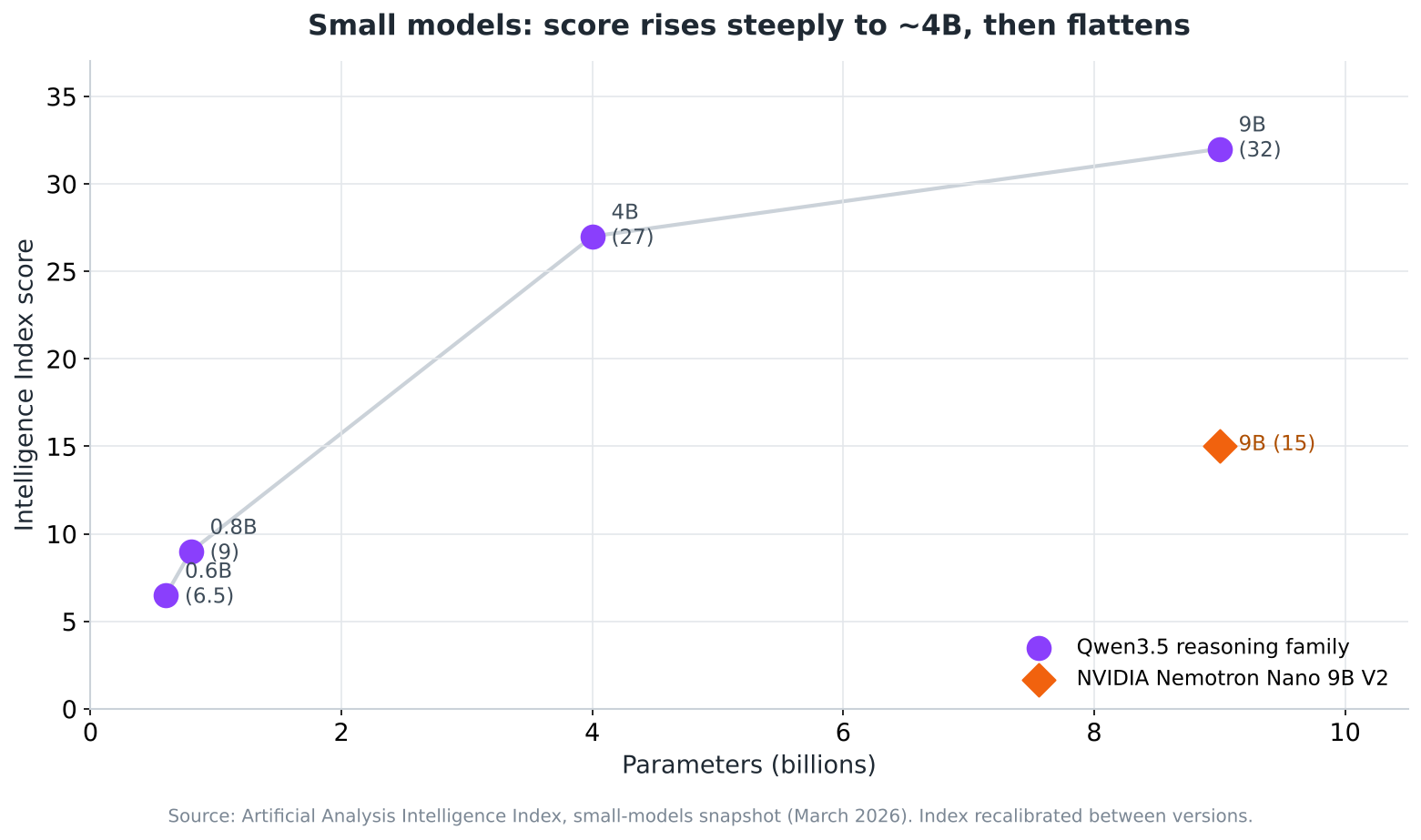
Cross-model benchmarks for small models are messy because aggregate indices get recalibrated, so a score of "32" in one snapshot is not the "32" of another. The cleanest single-version comparison we can cite is Artificial Analysis's Intelligence Index from its Qwen3.5 small-models release analysis (March 2026), which scored a range of sub-10B models on one scale.
On that snapshot, the Qwen3.5 reasoning family climbed 6.5 at 0.6B, 9 at 0.8B, 27 at 4B and 32 at 9B — a steep rise that flattens after about 4B. Same parameter count, very different result: NVIDIA's Nemotron Nano 9B V2 scored 15 at 9B, under half the same-size Qwen. The efficiency sweet spot sits around 4–9B, and architecture matters as much as size.
What can SLMs actually do (and not do)?
Do: classification, entity extraction, summarisation, retrieval-augmented Q&A over your own docs, structured/JSON output, function-calling, code completion, and on-device chat. For these, a tuned 3–9B model is often indistinguishable from a frontier model to the end user.
Don't expect: deep world knowledge from memory, reliable multi-hop reasoning over long novel problems, or graceful handling of genuinely open-ended prompts. SLMs hallucinate more when pushed outside their competence, and a smaller model has less competence to stay inside.
The fix is architecture, not faith. Give an SLM retrieval (so facts come from your data, not its weights) and tools (so it calls a calculator or API instead of guessing), and most of the knowledge gap closes for production tasks.
Do small language models support agentic AI?
Yes — and it is where SLMs are quietly winning. An agent loop is mostly read context → pick a tool → emit structured arguments → check the result. That is a narrow, repeatable task, exactly what small models do well.
The newer small models are explicitly tuned for it. Ministral 3 8B and Qwen3.5 advertise native function-calling; Phi and SmolLM emit clean structured output. For a multi-step agent, cheap and fast per step beats brilliant and slow — you run the step hundreds of times.
The honest limit: SLMs are weaker at long-horizon planning — holding a 20-step goal together without drifting. The 2026 pattern is a hybrid: a frontier LLM plans, and a fleet of SLMs executes the steps.
How do you run an SLM on-device?
You download quantised weights and run them through a local runtime. The common path is llama.cpp or Ollama (a one-command wrapper) with a model in GGUF format, quantised to 4-bit so a 3–8B model fits in 4–6GB of RAM.
For Apple Silicon, MLX uses the unified memory well. For mobile, Meta positioned Llama 3.2 1B/3B for edge and mobile devices, and Gemma 4's E2B targets phones directly. Browsers can run small models via WebLLM (WebGPU).
Rule of thumb: (params in billions) × 0.6 ≈ GB of RAM at 4-bit. A 3B model needs ~2GB; an 8B model ~5GB; a 14B model ~9GB. Start at Q4, raise precision only if quality drops.
Who should use a small model instead of a frontier LLM?
Use an SLM if you are running high-volume, well-defined tasks (classification, extraction, routing), if data can't leave your environment (healthcare, finance, defence), if you need predictable cost at scale, or if you are latency-sensitive and can't afford a network hop.
Stay on a frontier LLM if your workload is open-ended reasoning, broad knowledge recall, or long-horizon planning — or if your volume is low enough that per-token API cost is a rounding error and engineering time matters more.
Most serious 2026 stacks use both: a small model as the default, escalating to a large one only when the task warrants it.
Our take
The useful way to think about small language models in 2026 is that "small" has stopped being a capability tier and become a deployment choice. For a wide and widening band of production work — extraction, classification, routing, summarisation, tool-calling, retrieval-grounded answers — a well-tuned 4–9B model gets you to "good enough that users can't tell," and the remaining gap to a frontier model is paid in latency and dollars you often don't need to spend. The line between SLM and LLM is now drawn mostly by where the model runs and who pays per token, not by what it can do on the tasks most software actually ships.
The benchmarks both support and obscure this. An aggregate like the Artificial Analysis Intelligence Index is the best single comparable we have, and it captures the real shape of the field: scores rise steeply from sub-1B to ~9B, then flatten — diminishing returns kick in early, which is the whole SLM thesis. What those numbers miss is that a 15-point aggregate gap can vanish on your specific task once you add retrieval and tools, because most of a frontier model's edge is knowledge and open-ended reasoning that your RAG pipeline and function schema were going to supply anyway. The index also can't see cost, latency or privacy — the three axes that usually decide a deployment. And it shifts between versions: the same model can read 32 in one snapshot and 15 in a later, harder one, so treat any score as a ranking inside a dated snapshot, never a permanent grade. We've dated every figure here for exactly that reason.
For builders, the implication is concrete. Default to a small model and make the frontier model the exception you escalate to, not the baseline you start from. That inverts the usual instinct and it is almost always cheaper and faster, because the escalation rate for well-scoped tasks is low. For people building agents, the case is stronger still: an agent runs its inner loop hundreds of times, and each loop is a narrow, structured step — pick a tool, emit arguments, read a result — which is precisely where SLMs are competitive and where per-step cost and latency dominate the bill. The emerging pattern — a large model that plans, a swarm of small models that execute — isn't a compromise; it's the right factoring of the problem. Long-horizon planning is the one place small models still genuinely struggle, so keep that job with the big model and hand everything else down.
Where do the top picks actually fit? Qwen3.5 9B is our default open SLM: strongest verified general capability, multimodal, Apache 2.0, long context. Phi-4-mini is the one to reach for when reasoning-per-watt matters and the task is mathy or logical — an MIT licence and a 3.8B footprint make it almost free to run. Gemma 4's small sizes and Llama 3.2 1B/3B are the on-device defaults, with Gemma's Apache 2.0 licence the more commercially relaxed of the two. Ministral 3 8B is the edge-plus-sovereignty pick for European deployments. SmolLM3 is for teams who need fully open weights, data and recipe — reproducibility over raw score.
The verdict. Best for most builders: Qwen3.5 9B. Best on-device: Gemma 4 E2B/E4B or Llama 3.2 3B. Best for reasoning on a budget: Phi-4-mini. Avoid an SLM if your core workload is open-ended reasoning or broad factual recall with no retrieval layer to lean on — there, the frontier gap is real and you'll feel it. For everything else, start small. You can always escalate; you rarely need to.
Frequently Asked Questions
What is a small language model?
A small language model is a language model compact enough to run outside a datacentre — on a phone, laptop or single consumer GPU. In practice that means roughly 15 billion parameters or fewer. They are built like large models but trained and compressed to trade broad capability for speed, privacy and low cost.
What's the difference between an SLM and an LLM?
The core difference is deployment. An LLM runs in the cloud and bills per token; an SLM runs locally with free inference after you buy the hardware. LLMs win on broad knowledge and long reasoning; SLMs win on latency, privacy and cost for narrow, well-defined, high-volume tasks like extraction and classification.
Do small language models support agentic AI?
Yes. Modern SLMs such as Qwen3.5 and Ministral 3 are tuned for tool-calling and structured output, which is most of what an agent step needs. They are cheap and fast enough to run a loop hundreds of times. Their weak spot is long-horizon planning, so many stacks pair a large planner with small executors.
What are the limitations of small language models?
Fewer parameters mean thinner world knowledge, weaker multi-step reasoning on novel problems, and more hallucination when pushed outside their trained competence. They handle open-ended prompts poorly. Most of these gaps shrink in production when you add retrieval (facts from your data) and tools (actions instead of guesses).
How do you run a small language model on-device?
Download quantised weights and run them in a local runtime like Ollama or llama.cpp (GGUF format), MLX on Apple Silicon, or WebLLM in a browser. Quantise to 4-bit so a 3–8B model fits in a few gigabytes of RAM — roughly params × 0.6 = GB needed. Raise precision only if quality drops.
Editor's note — sources: model specs from the Qwen3.5 9B, Phi-4-mini-reasoning, SmolLM3-3B and Ministral 3 8B model cards and docs, the Gemma 4 launch post, and Meta's Llama 3.2 edge announcement — all linked inline at the claim they support. Benchmark scores are from Artificial Analysis's March 2026 small-models analysis; its Intelligence Index is recalibrated between versions, so treat scores as a ranking within that dated snapshot, not a permanent grade. Vendor-reported figures (Microsoft's Phi benchmarks, Google's Gemma claim) are attributed as such. Verified as of November 2026.