
DeepSeek Alternatives in 2026: Benchmarked & Priced
On DeepSeek and hitting a wall, a China-hosting concern, or a license snag? We benchmark and price the serious DeepSeek alternatives — Qwen, Kimi, GLM-5.3, Claude and GPT — and name the pick for each reason, including why self-hosting DeepSeek's own MIT weights is often the real answer.


The best DeepSeek alternative depends on why you're leaving DeepSeek — and the serious DeepSeek alternatives split three ways. For a near-frontier open-weight model you can self-host, Qwen3 (Apache-2.0) or Kimi K3.1 Pro are the cleanest swaps. For data residency, run DeepSeek's own MIT weights on US infrastructure, or pick a cheap US-hosted model like Claude Haiku 5.5. Trade up to Claude or GPT only if you've hit a real capability ceiling.
TL;DR
- Best open-weight alternative: Kimi K3.1 Pro scores highest of the open-weight pack on the Artificial Analysis Intelligence Index (47, v5.0.2, Nov 2026); Qwen4 Max (43) is close with a cleaner permissive open line (Qwen3, Apache-2.0).
- Best if you want more capability: Claude Sonnet 5.5 (index 55) or GPT-6.2 Astra (62) — you pay 5–30× DeepSeek's price for it (see our DeepSeek vs Claude comparison).
- Best cheap US-hosted option: GPT-6 Luna at $0.05/$0.25 per 1M tokens, or Claude Haiku 5.5 at $0.10/$0.50 if you want higher quality.
- The self-host angle: DeepSeek's weights are MIT. The "alternative" might not be a different model at all — run DeepSeek V4 on Together, Fireworks, or your own GPUs and the China-hosting concern disappears.
- What DeepSeek still wins: raw price and license purity. V4.1 Flash runs $0.15/$0.60 off-peak under MIT. Nothing here is cheaper per unit of intelligence.
The comparison table (prices and scores as of November 2026)
| Model | Maker | Context | Price in/out per 1M | AA Intelligence Index (v5.0.2) | License | Best for |
|---|---|---|---|---|---|---|
| DeepSeek V4.1 Flash | DeepSeek | 1M | $0.30 / $1.20 peak ($0.15 / $0.60 off-peak) | 32 | MIT | Anchor: cheapest open-weight, text + vision |
| DeepSeek V4 Pro | DeepSeek | 1M | $1.32 / $3.96 peak ($0.66 / $1.98 off-peak) | 23 | MIT | Anchor: long-context text, open weights |
| Qwen4 Max | Alibaba | 1M | ~$1.50 / $4.50 | 43 | Proprietary API* | Highest-scoring near-cheap model; cleanest open line |
| GLM-5.3 | Z.ai | 1M | $1.40 / $4.40 | 32 | Custom GLM license | Agentic/coding; check the license |
| Kimi K3.1 Pro | Moonshot | 1M | ~$2 / $10 | 47 | Modified MIT (MaaS revenue clause) | Highest open-weight intelligence |
| Claude Haiku 5.5 | Anthropic | Up to 1M | $0.10 / $0.50 | 37 | Proprietary | Cheap US-hosted, fast |
| Claude Sonnet 5.5 | Anthropic | Up to 1M | $2 / $10 | 55 | Proprietary | Coding/agentic workhorse |
| Claude Opus 5.5 | Anthropic | Up to 1M | $4 / $20 | 59 | Proprietary | Top-end reasoning |
| GPT-6 Luna | OpenAI | Not disclosed | $0.05 / $0.25 | 28 | Proprietary | Cheapest US-hosted |
| GPT-6.1 Terra | OpenAI | Not disclosed | $0.50 / $2.50 | 51 | Proprietary | Mid US-hosted, strong |
| GPT-6.2 Astra | OpenAI | Not disclosed | $8 / $40 | 62 | Proprietary | Frontier |
| Gemini 4 Neon | 1M | $3 / $15 | 62 | Proprietary | Frontier | |
| Gemini 3.5 Flash-Lite | Not disclosed | $0.30 / $2.50 | 12 | Proprietary | Cheap US-hosted |
Qwen4 Max is a proprietary hosted API. Alibaba's open-weight Qwen3 line (Qwen3, Qwen3-VL, Qwen3-Coder) is Apache-2.0* and free to self-host. Qwen4 Max and Kimi K3.1 Pro prices are approximate (RMB-converted / list-price). DeepSeek, Claude, OpenAI and Gemini prices are confirmed on vendor pricing pages.
Why look for a DeepSeek alternative?
Three reasons send people off DeepSeek, and they point at different models. One, you've hit a capability ceiling — V4.1 Flash lands at 32 on the Artificial Analysis Intelligence Index and V4 Pro at 23, below every frontier model. Two, data residency: DeepSeek's hosted API runs on China-based inference, which many teams can't clear with legal or compliance — we cover that in depth in is DeepSeek safe. Three, you want different trade-offs — a cleaner license, vision, or a specific agentic strength.
The important split: "alternative to DeepSeek the hosted API" and "alternative to DeepSeek the open-weight model" are different questions. Because the weights are MIT, you can keep the model and change everything else around it.
What's the best open-weight alternative to DeepSeek?
Kimi K3.1 Pro is the strongest on paper — 47 on the Intelligence Index, the top open-weight score here, with a 1M context window and open weights you can host. The catch is the license: it's a modified MIT with a large-scale commercial (MaaS) revenue clause, so a managed-API reseller past the revenue gate needs to read the terms. At roughly $2/$10 hosted on Moonshot's platform, it's still a fraction of frontier pricing.
Qwen4 Max (43) is the pragmatic pick. The hosted API is proprietary at about $1.50/$4.50 on Alibaba's Model Studio, but Alibaba's open Qwen3 line is Apache-2.0 — the cleanest permissive license in this group, with no revenue gates or security-review conditions. If license purity matters for a commercial product, Qwen is the answer.
GLM-5.3 (32) is competitive on agentic and coding work at $1.40/$4.40, but its open weights ship under a custom GLM license with conditions, not plain MIT. GLM-5.3-Flash is MIT; the flagship is not. Verify before you build on it — we put the two side by side in GLM vs DeepSeek.
Is Qwen a better choice than DeepSeek?
For most teams leaving DeepSeek on capability or license grounds, yes. Qwen4 Max outscores both DeepSeek tiers on the Intelligence Index (43 vs 32 and 23), and the open Qwen3 weights carry a clean Apache-2.0 license versus DeepSeek's MIT — both permissive, but Qwen's open line has broader model coverage (VL, Coder).
DeepSeek wins on raw price. V4.1 Flash at $0.15/$0.60 off-peak is cheaper than Qwen4 Max, and if you self-host either, the API price is moot. So "is Qwen better than DeepSeek" comes down to this: Qwen if you want more intelligence or a tidier open line; DeepSeek if cost-per-token is the only axis that matters. Our full DeepSeek vs Qwen head-to-head digs into the benchmarks.
What's the cheapest US-hosted alternative?
GPT-6 Luna at $0.05/$0.25 per 1M tokens, per OpenAI's pricing, is the cheapest US-hosted model here — cheaper than DeepSeek's off-peak Flash rate — though its 28 Intelligence Index score sits below V4.1 Flash. For a quality bump, Claude Haiku 5.5 at $0.10/$0.50, per Anthropic's pricing, scores 37 and is faster than most of the open-weight pack.
Gemini 3.5 Flash-Lite ($0.30/$2.50) is another US-hosted budget option, but at 12 on the index it's the weakest model in this comparison — fine for classification and routing, not for reasoning.
Can you self-host instead of switching?
Often, yes — and this is the answer the SEO blogs miss. DeepSeek's V4 weights are MIT, so the China-hosting concern is a property of DeepSeek's API, not the model. Run those weights on Together, Fireworks, Baseten, or your own GPUs on US or EU infrastructure and you keep DeepSeek's intelligence and price profile while owning the data path.
That reframes the whole search. If your reason for leaving is data residency rather than capability, the "DeepSeek alternative for self-hosting" is frequently DeepSeek itself, relocated — or Qwen3 (Apache-2.0) if you want a license with zero conditions attached.
What does DeepSeek still do best?
Price and openness. At $0.15/$0.60 off-peak under MIT, per DeepSeek's pricing docs, DeepSeek V4.1 Flash is the cheapest route to ~index-30 intelligence that you can also self-host without license conditions. No model in this comparison beats it on cost-per-unit-of-capability, and only Qwen's Apache-2.0 line matches its license cleanliness. If neither capability nor residency is your problem, you may not need an alternative at all.
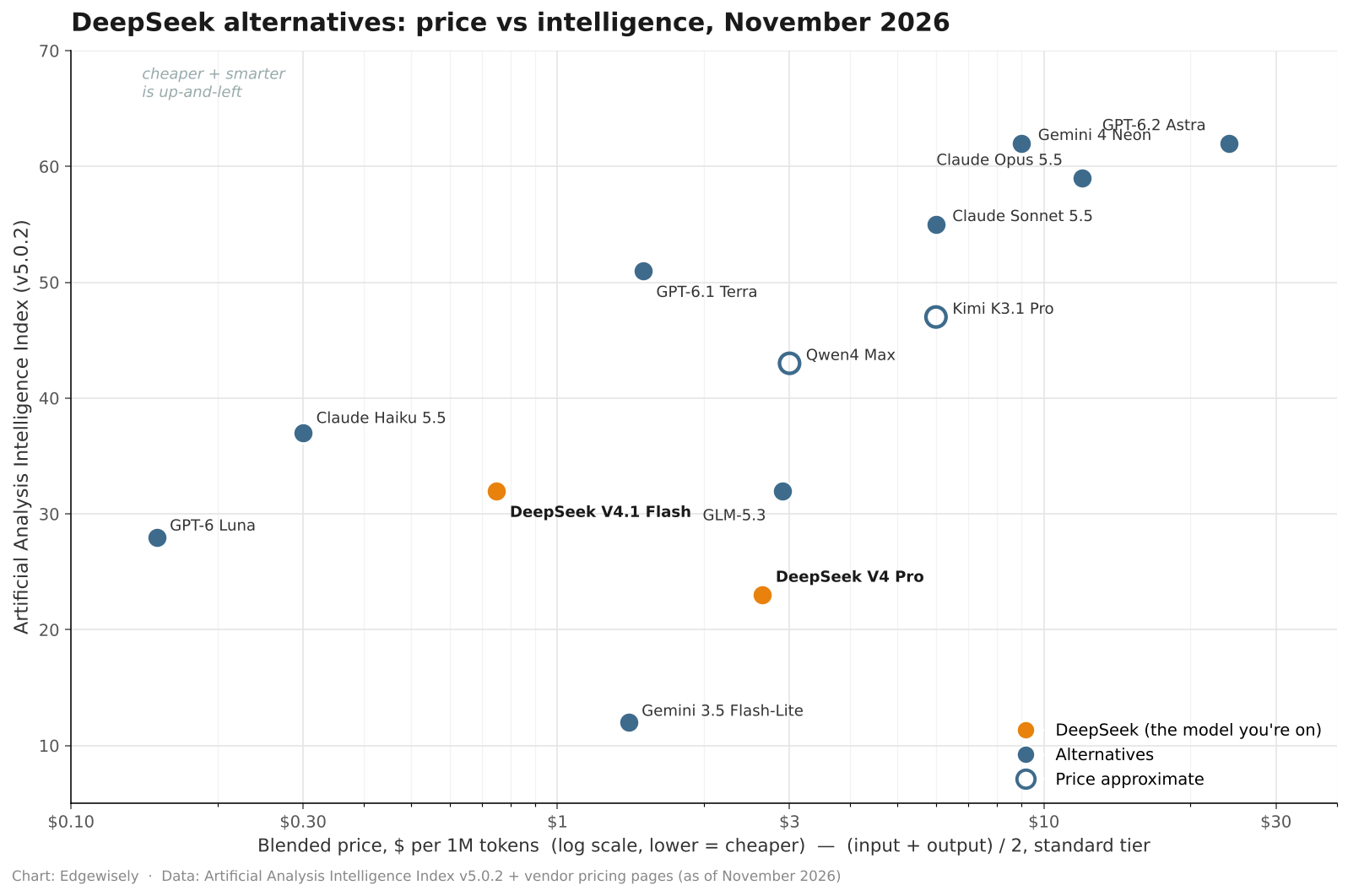
Price versus intelligence, mapped
Our take
Here's the thesis most "DeepSeek alternatives" articles get wrong: they treat this as a capability-shopping problem, and it usually isn't. The reader on DeepSeek already has near-frontier intelligence at the lowest price in the market. If capability were the pain, they'd have left for Claude or GPT months ago. What actually drives this search is governance — a security review that flags China-hosted inference, a customer contract with a data-residency clause, a procurement team that won't sign off. That's an opinion, but it's grounded in what DeepSeek is: cheap enough and good enough that the only common reason to leave is where the tokens are processed, not how smart they are.
If that's right, the honest recommendation for most teams is not a frontier upgrade. It's one of two moves. Either relocate DeepSeek's own MIT weights onto US or EU infrastructure through Together or Fireworks, keeping the exact model and price you already validated — or switch to Qwen3 on Apache-2.0, which gives you a permissive license with no revenue gates and a hosting path you control. Both answers cost a fraction of trading up to Opus, and both solve the problem the reader actually has. Spending 10–40× on a frontier model to fix a hosting-location issue is a category error.
Now, what the Intelligence Index captures and what it misses. The index is a useful single number — it correctly ranks Opus 5.5 (59) and Astra (62) above the open-weight field, and it correctly shows Kimi K3.1 Pro (47) leading the open pack. But index parity is not coding parity, and it's not agentic parity. Two models a point apart on the aggregate can diverge sharply on SWE-bench-style tasks or long-horizon tool use, and the index blends reasoning, knowledge, and math in a way that can flatter a model that's strong at exams and weak in an agent loop. If your workload is coding or multi-step agents, treat the index as a filter, then run your own evals on the two or three survivors. We'd never pick a model for a coding product on the Intelligence Index alone, and neither should you.
The license column deserves as much weight as the score column, and the market is actively splitting here. DeepSeek (MIT) and Qwen3 (Apache-2.0) are genuinely permissive — build commercially, no conditions. GLM-5.3 ships a custom license with security-review and revenue conditions; its Flash variant is MIT but the flagship is not. Kimi K3.1 Pro carries a modified-MIT revenue clause aimed at large-scale managed-API resellers. For an internal tool none of this matters. For a commercial product where you redistribute or resell inference, the difference between Apache-2.0 and a bespoke "open" license is a legal review, not a footnote. Our blunt view: if you're shipping a product on open weights, start from Qwen3 or DeepSeek and only move to a conditionally-licensed model if its capability edge is measured and material.
On cost-versus-quality, the frontier is clear. DeepSeek V4.1 Flash, GPT-6 Luna, GPT-6.1 Terra, and Qwen4 Max define the efficient curve; Kimi K3.1 Pro and GLM-5.3 are priced above where their scores justify once you can self-host a cheaper open model. Claude Sonnet 5.5 and GPT-6.2 Sol are the honest "I need more and I'll pay for it" picks.
The verdict. Pick Qwen3 (Apache-2.0) on US/EU infrastructure if you're leaving for data residency or license purity — it's the cleanest swap. Pick Kimi K3.1 Pro if you want the most capable open-weight model and the revenue clause doesn't apply to you. Pick Claude Haiku 5.5 or GPT-6 Luna if you want cheap US-hosted inference with zero self-host overhead. Trade up to Claude Sonnet 5.5 or GPT-6.2 Astra only if you've measured a real capability gap. Avoid reflexively jumping to a frontier model to solve a hosting problem, and avoid any conditionally-licensed open model for a commercial product until you've read the terms.
Frequently Asked Questions
What is the best alternative to DeepSeek?
It depends on your reason. For the most capable open-weight swap, Kimi K3.1 Pro leads the open field on the Artificial Analysis Intelligence Index (47, Nov 2026). For license purity and self-hosting, Qwen3 (Apache-2.0) is cleanest. For cheap US-hosted inference, Claude Haiku 5.5 or GPT-6 Luna.
Is there a cheaper alternative to DeepSeek?
Barely. DeepSeek V4.1 Flash runs $0.15/$0.60 off-peak, among the lowest in the market. GPT-6 Luna is cheaper per token at $0.05/$0.25 but scores lower on intelligence (28 vs 32). For most workloads, nothing meaningfully undercuts DeepSeek on cost-per-unit-of-capability while matching its openness.
What is the best open-source alternative to DeepSeek?
Qwen3, under the permissive Apache-2.0 license, is the best truly open alternative — no revenue gates or usage conditions, with broad model coverage (VL, Coder). Kimi K3.1 Pro scores higher (47) but uses a modified-MIT license with a commercial revenue clause. GLM-5.3 ships a custom license; verify terms before commercial use.
Is Qwen better than DeepSeek?
On the Intelligence Index, Qwen4 Max (43) outscores DeepSeek V4.1 Flash (32) and V4 Pro (23). Qwen's open line also carries a cleaner Apache-2.0 license. DeepSeek wins on raw price. Choose Qwen for more capability or license tidiness; choose DeepSeek when cost-per-token is the only thing that matters.
Can I self-host a DeepSeek alternative?
Yes. DeepSeek's own V4 weights are MIT, so you can run them on US or EU infrastructure (Together, Fireworks, your own GPUs) and remove the China-hosting concern without changing models. For a conditions-free license, Qwen3 (Apache-2.0) self-hosts freely. Check GLM-5.3 and Kimi K3.1 Pro license terms first.
Editor's note — sources: Benchmark scores are from the Artificial Analysis Intelligence Index (v5.0.2, November 2026); per-token prices are from each vendor's own pricing page (DeepSeek, Alibaba, Z.ai, Moonshot, Anthropic, OpenAI, Google) as of November 2026. Prices marked approximate are RMB-converted or list-price; figures we could not confirm are marked not disclosed. Vendor claims are attributed as such.