
Gemini Alternatives (2026): Benchmarked & Priced
On Google Gemini and weighing a switch? We benchmark and price the serious alternatives — Claude, GPT-6.2, DeepSeek, Grok and Qwen — on the Artificial Analysis Intelligence Index, with a clear pick for each reason you might leave: cost, coding, open-weight, or quality.


The best Gemini alternative for most people is Anthropic's Claude Fable 5.2, which currently tops the Artificial Analysis Intelligence Index, while OpenAI's GPT-6.2 line is the closest drop-in swap and DeepSeek V4.1 Flash is the cheapest way out. The right Gemini alternative depends on which constraint pushed you off Gemini in the first place.
If you are on Google Gemini and want to know which other frontier model to move to, this is a benchmarked, priced comparison with a verdict by use case. Every score and price below was checked against a primary source as of November 2026.
TL;DR
- Best overall alternative: Claude Fable 5.2 (Intelligence Index 65) edges out Gemini 4 Neon on raw capability; GPT-6.2 Sol is the easiest swap if you want ChatGPT-grade quality at Gemini-tier pricing.
- Cheapest alternative: DeepSeek V4.1 Flash at $0.30 / $1.20 per 1M tokens (peak), roughly a tenth of what you pay for a frontier closed model.
- Best open-weight alternative: DeepSeek V4.1 Flash (MIT, 1M context) — the only serious open option you can self-host and still get image input.
- Best for coding: Claude Opus 5.5 or GPT-6.2 Sol; both beat Gemini's mid tier on reasoning for a similar or lower output price.
- What Gemini still wins: price-for-intelligence at the top (Gemini 4 Neon scores 62 for $3/$15), native multimodal breadth, and the 1M context that ships by default.
Why look for a Gemini alternative?
Most people searching for a Gemini alternative are not chasing more intelligence. They are escaping a specific constraint: a rate limit, a data-residency rule, a price that moved, a refusal pattern, or a dependency on a single vendor.
That matters because the "best" alternative changes completely depending on the reason. Leaving over cost points you at DeepSeek. Leaving over lock-in points you at an open-weight model. Leaving over quality on hard reasoning points you at Claude or GPT.
Google also keeps the Gemini 4 tier names (Neon, Carbon, Hydrogen, Argon) and their prices moving. Gemini 4 Carbon and Argon run at a promotional $2/$10 through November 30, then rise to $4/$20, per Google's Gemini 4 Neon rollout coverage. A price you budgeted around can double on a schedule, which is reason enough to know your exits.
What's the best overall alternative to Gemini?
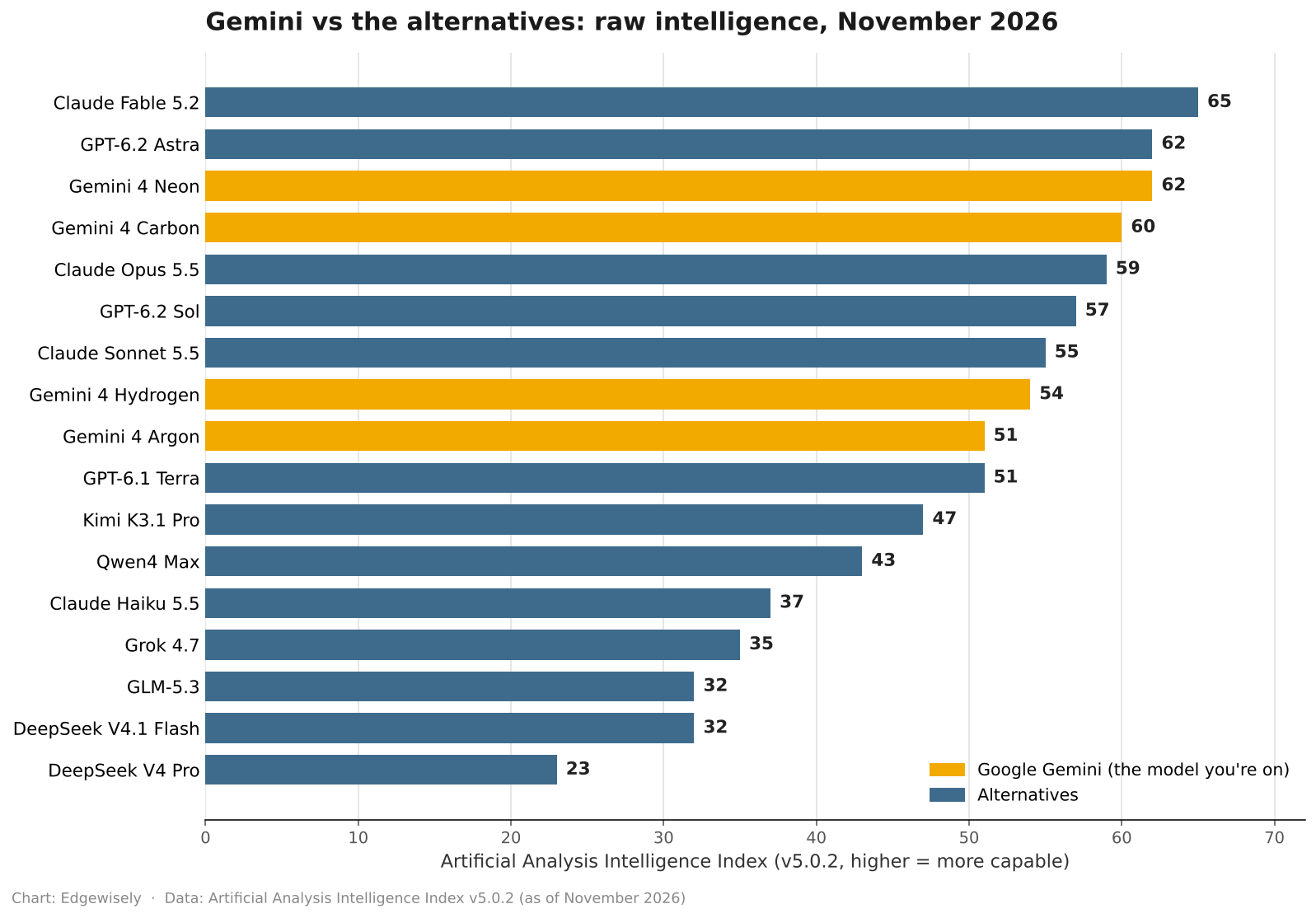
Claude Fable 5.2 is the top-scoring model available right now at 65 on the Artificial Analysis Intelligence Index v5.0.2, one point above Gemini 4 Neon and GPT-6.2 Astra at 62.
But Fable is priced like a frontier model: $8 / $40 per 1M tokens, per Anthropic's pricing page. That is the same headline rate as Gemini's top reasoning tier and OpenAI's Astra.
For a true like-for-like swap, GPT-6.2 Sol is the more practical pick. It scores 57, sits between Gemini 4 Hydrogen and Neon, and costs $2 / $10 — identical to Claude Sonnet 5.5 and to Gemini's old Flash pricing. You get a second frontier vendor without paying more.
Here's how the alternatives compare
Every cell below was verified against the vendor or Artificial Analysis as of November 2026. Prices are standard-tier, per 1M tokens. Gemini is included as the anchor row.
| Model | Maker | Context | Price (in / out) | AA Index v5.0.2 | Open/closed + license | Best for |
|---|---|---|---|---|---|---|
| Gemini 4 Neon | 1M | $3 / $15 | 62 | Closed, API | The Gemini you're on | |
| Claude Fable 5.2 | Anthropic | up to 1M | $8 / $40 | 65 | Closed, API | Top raw capability |
| Claude Opus 5.5 | Anthropic | up to 1M | $4 / $20 | 59 | Closed, API | Coding, agents |
| Claude Sonnet 5.5 | Anthropic | up to 1M | $2 / $10 | 55 | Closed, API | Balanced workhorse |
| GPT-6.2 Astra | OpenAI | not disclosed | $8 / $40 | 62 | Closed, API | Frontier ChatGPT swap |
| GPT-6.2 Sol | OpenAI | not disclosed | $2 / $10 | 57 | Closed, API | Cleanest Gemini swap |
| GPT-6.1 Terra | OpenAI | not disclosed | $0.50 / $2.50 | 51 | Closed, API | Cheap closed workhorse |
| Grok 4.7 | xAI | 500K | $2 / $6 | 35 | Closed, API | Cheap long output |
| DeepSeek V4.1 Flash | DeepSeek | 1M | $0.30 / $1.20 | 32 | Open, MIT | Cheapest / open-weight |
| DeepSeek V4 Pro | DeepSeek | 1M | $1.32 / $3.96 | 23 | Open, MIT | Large open-weight, text |
| Qwen4 Max | Alibaba | not disclosed | not disclosed | 43 | Closed API (Qwen3 open, Apache-2.0) | Open-friendly ecosystem |
Gemini 4 Carbon (AA 60) and Hydrogen (AA 54, $1.50/$7.50) round out Google's own lineup. DeepSeek prices shown are peak; off-peak is half.
What's the cheapest alternative to Gemini?
DeepSeek V4.1 Flash at $0.30 / $1.20 per 1M tokens (peak), falling to $0.15 / $0.60 off-peak, per DeepSeek's pricing docs. That is roughly one-tenth of Gemini 4 Neon's output price and it ships with a 1M context window and image input.
Among closed models, GPT-6.1 Terra at $0.50 / $2.50 is the value pick, scoring 51 — above Gemini 4 Argon. For long, cheap generation, Grok 4.7 runs $2 / $6 with a 500K window, though it scores only 35.
The trade is real: DeepSeek V4.1 Flash scores 32, well below Gemini's 54–62 tiers. You are buying "good enough for most volume work" at a fraction of the cost, not frontier reasoning. For the full budget ranking across vendors, see our cheapest AI API breakdown.
What's the best open-source Gemini alternative?
DeepSeek V4.1 Flash is the best open-weight option: MIT-licensed, 1M context, text and image input, and cheap even through the hosted API. You can run the weights yourself with no usage cap and no refusal policy you did not write.
Its larger sibling DeepSeek V4 Pro (1.6T parameters, MIT) is also open but text-only and scores lower at 23, so Flash is the one most teams should reach for.
We put the same open option up against Google's model directly in our DeepSeek vs Gemini comparison. If you want an open model inside a broader ecosystem, Alibaba's Qwen line is the other candidate: Qwen4 Max (API, Intelligence Index 43) sits alongside open-weight Qwen3 under Apache-2.0. Z.ai's GLM-5.3 (32) and Moonshot's Kimi K3.1 Pro (47) are worth watching, with Kimi the strongest open-leaning score of the group.
No open model matches Gemini's top tiers on the Index. The reason to pick one is control, not capability.
Which is better for coding?
For a Gemini alternative aimed at code, Claude Opus 5.5 is the default. It scores 59, Anthropic's models consistently lead agentic and software benchmarks, and at $4 / $20 it undercuts Gemini 4 Neon on input while beating it on reasoning depth. We rank the field in our best AI model for coding tests.
GPT-6.2 Sol ($2/$10, score 57) is the better price-performance choice if you are writing a lot of tokens. GPT-6.1 Terra ($0.50/$2.50) is a credible budget coder for routine edits.
Gemini is not weak at code — Gemini 4 Argon is explicitly positioned for it — but if coding quality is why you are leaving, Claude is the move.
What does Gemini still do best?
Gemini's real advantage is price-for-intelligence at the top. Gemini 4 Neon scores 62, matching GPT-6.2 Astra, for $3 / $15 — well under Astra's and Fable's $8/$40. On a pure cost-per-point basis, that is hard to beat among frontier closed models.
Gemini also ships a 1M context window by default across its main tiers and remains the strongest native multimodal family for mixed text, image, audio, and video in one call. If your reason for leaving is anything other than cost, policy, or lock-in, you may not have a better option.
Where the models rank on intelligence
Our take
Most people typing "Gemini alternatives" into a search bar do not actually need a smarter model. They need to escape one specific Gemini constraint, and the correct move depends entirely on which one. That is the whole decision, and the benchmark leaderboard barely touches it.
Start with the honest read of the Intelligence Index. Gemini is not behind. Gemini 4 Neon scores 62 and costs $3/$15; the only model clearly above it is Claude Fable 5.2 at 65, and Fable costs nearly three times as much on input and output. If your complaint about Gemini is that it is not smart enough, you are mostly wrong, and switching will cost you money for a point or two of benchmark. The exception is a genuinely hard, narrow workload — deep agentic coding, long multi-step reasoning — where Claude's lead shows up in practice more than the single Index number suggests.
The Index is a composite of reasoning and knowledge evals. It does not measure latency, refusal behavior, data residency, rate limits, tool-calling reliability, or how a model degrades at 800K tokens of context. Those are the things that actually drive people off a platform, and none of them appear in a bar chart. Treat the score as a capability ceiling, not a product verdict.
So match the exit to the reason. If you are leaving over cost, DeepSeek V4.1 Flash is the answer and it is not close: MIT-licensed, 1M context, image input, and roughly a tenth of Gemini's output price. The catch is a score of 32, so it belongs on high-volume, lower-stakes work — classification, extraction, drafting, bulk transforms — not your hardest reasoning. If you are leaving over lock-in or policy, the same open-weight model is the answer for a different reason: you can host it, inspect it, and set your own guardrails. If you are leaving over raw quality on a hard problem, pay for Claude Opus 5.5 or Fable 5.2 and stop optimizing for price.
For people building agents, the calculus shifts again. Agentic workloads spend tokens in bursts and live or die on tool-calling reliability and consistent structured output, not on a single benchmark point. Here Claude's models earn their premium: Opus 5.5 at $4/$20 is a defensible default for an agent loop, and Sonnet 5.5 at $2/$10 matches Gemini's mid-tier price while coming from a vendor whose models are tuned hard for tool use. The move most teams should make is not "replace Gemini" but "route": cheap open-weight for the fan-out, a frontier closed model for the steps that must not fail. A one-model stack is the actual constraint, more than the model you happened to start on.
On cost versus quality, the defensible line is a barbell. Run DeepSeek V4.1 Flash or GPT-6.1 Terra for the 80% of calls that do not need frontier reasoning, and reserve Claude Opus 5.5 or GPT-6.2 for the 20% that do. Paying frontier rates for every token is the most common and most expensive mistake, and it is the one thing Gemini's attractive $3/$15 top tier quietly encourages.
Our verdict. Best overall: Claude Fable 5.2 if budget is no object, GPT-6.2 Sol if it is. Best value swap: GPT-6.2 Sol at $2/$10. Cheapest and best open-weight: DeepSeek V4.1 Flash. Best for coding and agents: Claude Opus 5.5. Avoid switching at all if your only complaint is intelligence — Gemini 4 Neon's price-for-score is genuinely hard to beat, and you will likely pay more to gain little.
Frequently Asked Questions
What is the best alternative to Google Gemini?
Claude Fable 5.2 is the highest-scoring alternative on the Artificial Analysis Intelligence Index (65 as of November 2026), just above Gemini 4 Neon. For a cheaper like-for-like swap, GPT-6.2 Sol at $2/$10 per 1M tokens is the most practical choice. The best pick depends on whether you are optimizing for quality or cost.
Is there a free alternative to Gemini?
There is no fully free frontier model, but DeepSeek V4.1 Flash is open-weight under the MIT license, so you can self-host it at no per-token cost on your own hardware. Open-weight Qwen3 (Apache-2.0) is another option. Most closed vendors, including Gemini, offer a limited free tier rather than unlimited free use.
What is the best Gemini alternative for coding?
Claude Opus 5.5 is the strongest coding alternative, scoring 59 at $4/$20 per 1M tokens, with Anthropic's models consistently leading agentic and software tasks. GPT-6.2 Sol ($2/$10) is the better price-performance option for high token volume. Both beat Gemini's mid tier on reasoning depth for coding work.
Is Claude or ChatGPT a better alternative to Gemini?
Both are frontier-grade. Claude Fable 5.2 (65) narrowly leads GPT-6.2 Astra (62) on the Index and is generally preferred for coding and agents. GPT-6.2 Sol is the cleaner price-matched swap for Gemini at $2/$10. Pick Claude for hard reasoning and tool use, ChatGPT for the broader product and ecosystem — and if Claude is your lead candidate, see our Claude alternatives guide for the full comparison.
Can I replace Gemini with an open-source model?
Yes, for many workloads. DeepSeek V4.1 Flash is MIT-licensed, has a 1M context window, and accepts image input, making it a genuine open replacement for high-volume tasks. It scores 32 versus Gemini's 54–62 tiers, so reserve it for work that does not need frontier reasoning and keep a closed model for the hardest steps.
Editor's note — sources: All benchmark scores are from the Artificial Analysis Intelligence Index (v5.0.2, November 2026); per-token prices are from each vendor's own pricing page (Anthropic, OpenAI, Google, xAI, DeepSeek) as of November 2026. Vendor benchmark claims are attributed as such; figures we could not confirm are marked not disclosed.