
Kimi vs Claude: Cheaper, Not as Capable
Kimi vs Claude compared: Kimi K3.1 Pro is cheaper, but scores 46 vs Claude Opus 5.5's 59 on Artificial Analysis. Pricing, benchmarks and a clear verdict.


Kimi vs Claude comes down to one trade: price against raw capability. Moonshot's Kimi K3.1 Pro costs about half of Claude Opus 5.5 per token and edges it on agentic terminal tasks. But Claude wins overall intelligence by a wide margin — 59 to 46 on Artificial Analysis — even though Kimi K3.1 Pro's weights are now open. Pick on the job, not the logo.
TL;DR
- Claude is smarter; Kimi is cheaper. Claude Opus 5.5 scores 59 on the Artificial Analysis Intelligence Index v5.0.1; Kimi K3.1 Pro scores 46 (as of November 2026).
- Is Kimi cheaper than Claude? Yes. Kimi K3.1 Pro is $2 in / $10 out per 1M tokens versus Opus 5.5's $4 / $20 — roughly half. Against Claude Sonnet 5.5 ($2 / $10) the prices tie.
- Kimi wins one thing that matters for agents: Terminal-Bench 4.0, where K3.1 Pro hits 67% vs Opus 5.5's 60%.
- "Open source Claude alternative" is now real. Moonshot released Kimi K3.1 Pro's open weights in early November 2026, so the best Kimi is self-hostable. Claude offers no open weights at any tier.
- What changed recently: Kimi K3.1 Pro launched October 23, 2026, and Moonshot published its open weights in early November — making the index-46 flagship the strongest openly available Kimi.
Kimi vs Claude: which is better?
Claude is better at general reasoning; Kimi is better at cost. On the Artificial Analysis Intelligence Index v5.0.1 — a blend of nine evaluations — Claude Opus 5.5 sits at 59 and Kimi K3.1 Pro at 46, per Artificial Analysis's head-to-head page. That is a real gap, not noise.
Claude Sonnet 5.5, Anthropic's mid-tier model, scores 55 — still nine points above Kimi's flagship, at the same token price.
So "is Kimi better than Claude?" has a blunt answer: not on measured intelligence. Kimi's case is price and one category — agentic tool use — where it genuinely leads.
Index versions matter here. Artificial Analysis moved to v5.0.1 in late October 2026, and scores are not comparable across versions. Older blog posts quoting Kimi at "54" or "third globally" used a pre-v5 index. Ignore them.
The spec and price table
Verified on primary sources, as of November 2026.
| Model | Maker | Open / closed (license) | Context | Price $/1M (in · out) | Best for |
|---|---|---|---|---|---|
| Kimi K3.1 Pro | Moonshot AI | Open weights (Kimi K3.1-Pro License) | 1M | $2 · $10 | Cheapest capable agentic model, now self-hostable |
| Kimi K3 | Moonshot AI | Open weights (Kimi K3 License) | 1M | $3 · $15 | Self-hosting; data stays in your VPC |
| Claude Opus 5.5 | Anthropic | Closed (proprietary) | 1M | $4 · $20 | Hardest reasoning, long agent runs |
| Claude Sonnet 5.5 | Anthropic | Closed (proprietary) | 1M | $2 · $10 | Best price/intelligence for most work |
| Claude Haiku 5.5 | Anthropic | Closed (proprietary) | 1M | $0.10 · $0.50 | High-volume, cheap classification/extraction |
Prices: Anthropic from claude.com/pricing; Kimi from Artificial Analysis's Kimi model cards (Kimi lists a ~90% cache-hit discount). Context windows: Kimi's 1M is 1,048,576 tokens per Kimi's platform docs; Claude is up to 1M, varying by model.
The benchmark table
| Benchmark (Nov 2026) | Kimi K3.1 Pro | Claude Sonnet 5.5 | Claude Opus 5.5 |
|---|---|---|---|
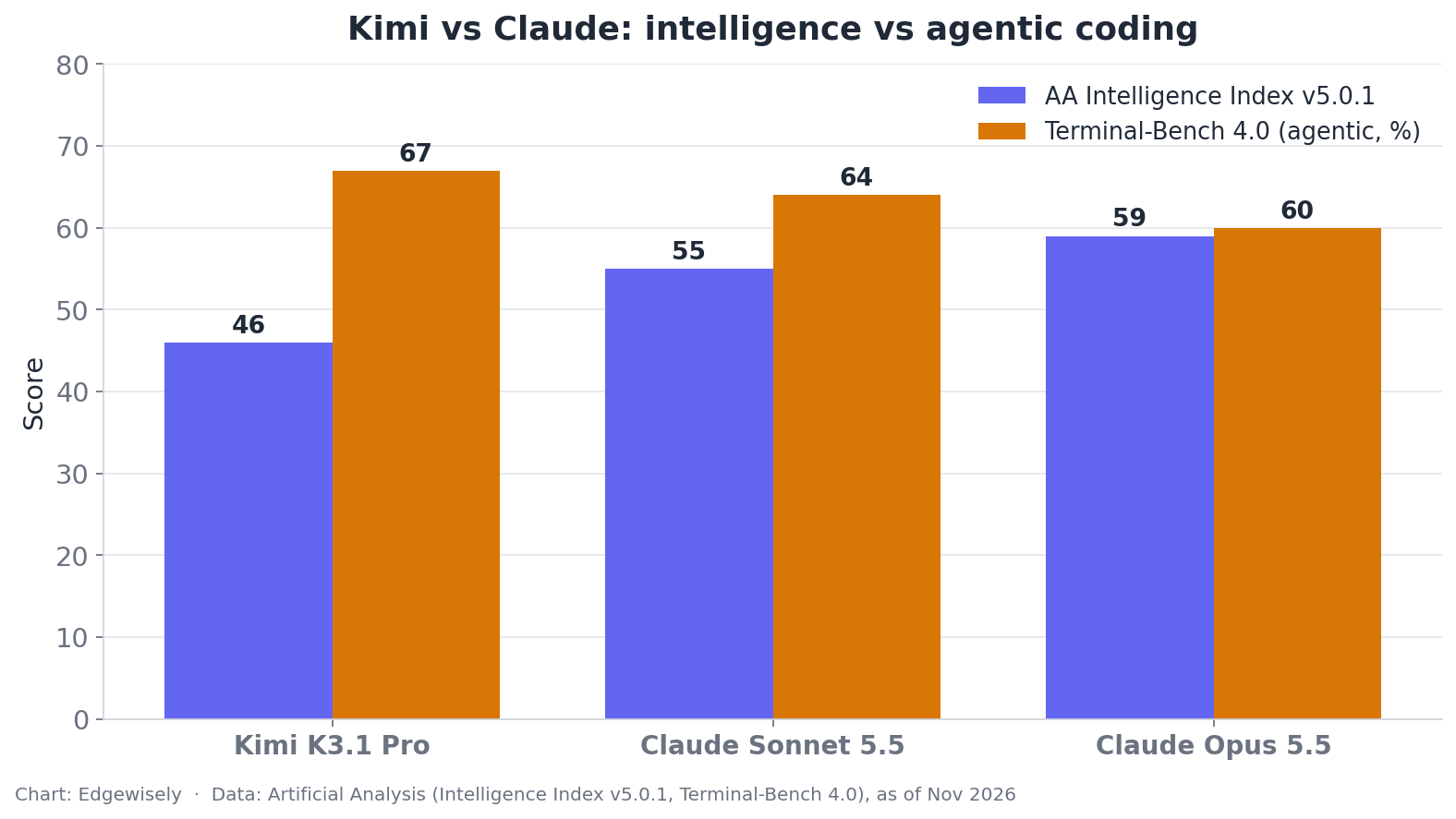
| AA Intelligence Index v5.0.1 | 46 | 55 | 59 |
| Terminal-Bench 4.0 (agentic) | 67% | 64%* | 60% |
Index and Opus/Kimi Terminal-Bench from the Artificial Analysis comparison page. Sonnet's Terminal-Bench figure is from Artificial Analysis's Kimi K3.1 Pro launch analysis, which also reports K3.1 Pro at Humanity's Last Exam 52%*.
Is Kimi cheaper than Claude?
Yes — but how much depends on which Claude you compare it to. Against the top tier, Kimi K3.1 Pro's $2 / $10 undercuts Claude Opus 5.5's $4 / $20 by half on both input and output.
Against Claude Sonnet 5.5, the headline rates are identical ($2 / $10). At that point Kimi's price edge disappears and Sonnet's higher intelligence score (55 vs 46) makes it the better buy for most workloads.
Both sides discount cached input heavily. Kimi advertises roughly a 90% cache discount; Anthropic lists 95% on Opus 5.5. If your workload is cache-heavy — long shared system prompts, repeated context — the real gap narrows further and favors whoever you've already tuned for.
The cheapest option overall is neither flagship: Claude Haiku 5.5 at $0.10 / $0.50 is an order of magnitude below Kimi for high-volume, low-reasoning jobs. For the lowest token prices across every major vendor, see our cheapest AI API comparison.
Is Kimi open source — and can you self-host it?
Yes — and as of early November 2026 the good one is open too. Moonshot released Kimi K3.1 Pro's open weights, per Moonshot's weight-release announcement, published under the "Kimi K3.1-Pro License" with commercial use allowed. So the Kimi you'd actually want — the one scoring 46 and leading Terminal-Bench at 67% — is now self-hostable. (Artificial Analysis was mid-update when we checked, with its comparison page already reflecting the open-weight license.)
The catch is scale, not availability. Kimi K3.1 Pro is a 2.8T-parameter Mixture-of-Experts model (104B active). "Self-host" here means a multi-GPU data-center deployment, not a workstation — real ops and real capex.
The older Kimi K3 (July 2026) remains open under the "Kimi K3 License," per Artificial Analysis's Kimi K3 comparison, but it's weaker — 13% on Terminal-Bench 4.0 against K3.1 Pro's 67%. Now that K3.1 Pro is open, K3 is mostly a fallback for lighter hardware.
This is where the "open source Claude alternative" framing finally holds. Claude has no open weights at any tier. If data residency or air-gapping is a hard requirement, Claude is out — and your choice is a self-hosted Kimi (now including the frontier-adjacent K3.1 Pro) or another open model. Our DeepSeek vs Claude breakdown walks the same open-versus-closed decision with a different open contender.
Kimi vs Claude for coding and agents
Split decision. On the one agentic benchmark where both are scored, Kimi K3.1 Pro leads: 67% on Terminal-Bench 4.0 vs Opus 5.5's 60%, per the Artificial Analysis comparison. Moonshot's launch data called it the top score of any model on that test.
That is meaningful. Terminal-Bench measures whether a model can drive a shell, chain commands, and recover from errors — the core loop of a coding agent.
But Terminal-Bench is one axis. On the broad intelligence index that folds in reasoning, math, science and knowledge, Claude is 13 points ahead. For multi-step refactors, architecture reasoning, or anything where a wrong turn compounds, Opus 5.5's margin shows up as fewer dead ends.
Our read: Kimi is a credible coding-agent engine when you're cost-sensitive and your tasks are tool-heavy and well-scoped. Claude is the safer pick when the task is open-ended or the cost of a bad answer is high. If you're weighing open models against each other rather than against Claude, our Kimi vs DeepSeek comparison covers that matchup.
Our take
Here's the thesis: Kimi K3.1 Pro is the best-value frontier-adjacent model on the market right now, and it still shouldn't be your default if Claude Sonnet 5.5 is on the table. The cost story is real but narrower than the Reddit threads suggest, and the open-source story — now that K3.1 Pro's weights are public — is finally substantive rather than aspirational.
Start with what the benchmarks capture well and what they don't. The Artificial Analysis Intelligence Index is a solid, independent, multi-eval composite — far better than any single vendor's self-report — and a 46 vs 59 gap is large enough to trust directionally. Kimi is genuinely a tier below Claude's flagship on general capability. What the index does not capture is your workload. Terminal-Bench says Kimi is excellent at shell-driving agents, and that single result can matter more to a coding team than the composite. Benchmarks are a prior, not a verdict. Run both on your own eval set before you commit a production path.
Three things the leaderboards hide. First, latency and throughput. Independent measurements put Kimi's big models at modest output speeds and long time-to-first-token — the open K3 clocked around 44 tokens/sec with a multi-second first-token delay. For interactive agents, slow is its own failure mode, and Claude's serving infrastructure is generally the more predictable. Second, reliability at the edges. Composite scores smooth over the tail cases — the malformed tool call, the 180K-token context, the ambiguous instruction — where frontier models separate from challengers. Third, where the model runs. Kimi K3.1 Pro's API is operated by a China-based company. For many US and EU teams that's a procurement, compliance and data-residency conversation before it's a benchmark conversation. The new wrinkle: because K3.1 Pro's weights are now open, you can run the full-strength Kimi in your own VPC and sidestep the hosted-API objection entirely — if you can stand up a 2.8T-parameter MoE.
Now the price judgement, because it's the whole reason people ask "kimi vs claude." The headline — half of Opus — is true but compares Kimi to Anthropic's most expensive model. The honest comparison is Kimi K3.1 Pro vs Claude Sonnet 5.5: same $2 / $10 price, and Sonnet scores 55 to 46. At identical cost, you'd take the nine extra intelligence points unless Kimi's Terminal-Bench lead maps directly to your use case. Kimi's price advantage is real only against Opus, and you reach for Opus precisely when you want maximum capability — the one place you'd least want to trade it away to save money.
For builders shipping agents, the decision tree is short. Tool-heavy, well-scoped, cost-sensitive, and comfortable with a China-hosted API? Kimi K3.1 Pro earns a serious pilot, and its Terminal-Bench lead backs that up. Need the hardest reasoning, long autonomous runs, or enterprise procurement that won't clear a Chinese vendor? Claude Opus 5.5, full stop. Want the best default for mixed work at a sane price? Claude Sonnet 5.5 quietly wins more of these than either flagship.
The verdict. Best for cost-sensitive agentic coding with no data-residency constraint: Kimi K3.1 Pro. Best for hardest reasoning and long agent runs: Claude Opus 5.5. Best all-round value: Claude Sonnet 5.5. Avoid Kimi if your tasks are open-ended reasoning rather than scoped tool use (it's 13 index points behind Opus), or if a China-hosted API fails compliance and you can't stand up a 2.8T-parameter MoE to self-host its open weights. Avoid Claude if your hard requirement is running the weights yourself — Anthropic doesn't offer that at any tier.
Frequently Asked Questions
Is Kimi better than Claude?
Not on general intelligence. Claude Opus 5.5 scores 59 on the Artificial Analysis Intelligence Index v5.0.1 versus Kimi K3.1 Pro's 46 (November 2026). Kimi leads on one agentic benchmark, Terminal-Bench 4.0 (67% vs 60%), and costs less. For broad reasoning, Claude is clearly ahead.
Is Kimi cheaper than Claude?
Yes, against Claude's top model. Kimi K3.1 Pro is $2 input / $10 output per 1M tokens, about half of Claude Opus 5.5's $4 / $20. But it ties Claude Sonnet 5.5 ($2 / $10), which scores higher — so Kimi's price edge only holds against Opus, not against Claude's mid-tier.
Is Kimi open source?
Yes. Moonshot released Kimi K3.1 Pro's open weights in early November 2026 under the Kimi K3.1-Pro License, with commercial use allowed — so the flagship (index 46, Terminal-Bench 67%) is self-hostable. The older Kimi K3 is also open. Caveat: K3.1 Pro is a 2.8T-parameter MoE, so running it takes serious hardware. Claude is fully closed.
Can Kimi replace Claude for coding?
For some teams, yes. Kimi K3.1 Pro leads Terminal-Bench 4.0 (67%), the agentic shell benchmark, and costs less — a strong fit for scoped, tool-heavy coding agents. For open-ended refactors or complex reasoning, Claude's 13-point intelligence lead means fewer wrong turns. Test both on your own tasks first.
Is it safe to use Kimi (a Chinese AI model)?
It depends on how you run it. Kimi K3.1 Pro's hosted API is operated by Moonshot AI, a China-based company, which raises data-residency and compliance questions for many US and EU teams. But because K3.1 Pro's weights are now open, you can self-host the full model in your own VPC and remove the data-residency objection entirely. For non-sensitive workloads, the API is a standard vendor-risk decision.
Editor's note — sources: Artificial Analysis: Kimi K3.1 Pro vs Claude Opus 5.5 (Intelligence Index v5.0.1 scores, prices, Terminal-Bench, open-weight license); Moonshot's Kimi K3.1 Pro weight-release announcement (open-weights release, early Nov 2026); Artificial Analysis: Kimi K3.1 Pro launch analysis (Terminal-Bench, HLE, 2.8T parameters); Artificial Analysis: Kimi K3 comparison (Kimi K3 open-weight license, Terminal-Bench 13%); Anthropic / claude.com pricing (Claude token prices); Kimi platform docs (1,048,576-token context window). All benchmarks and prices as of November 2026 on Artificial Analysis Intelligence Index v5.0.1; index versions are not comparable across releases.